
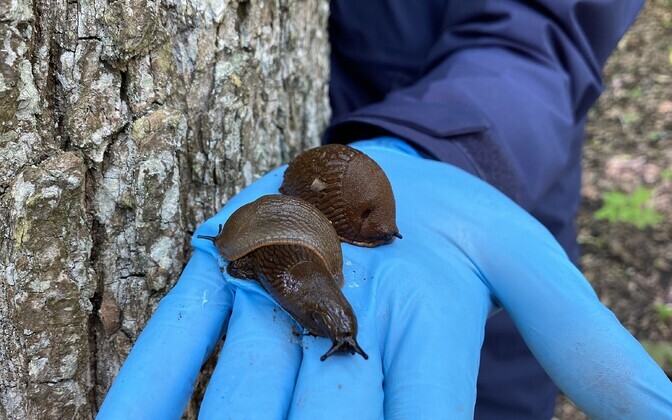
A thick blanket of snow may thrill winter sports enthusiasts, but it also gives invasive Spanish slugs a surprisingly warm hideout to survive the Estonian winter.
Snow acts as an insulator, keeping temperatures mild at the ground level, where recently hatched young Spanish slugs typically overwinter, explained Eha Kruus, a plant protection specialist at the Estonian University of Life Sciences (EMÜ). As temperatures drop, the juvenile slugs burrow into compost piles, plant debris or soil.
Under snow, soil temperatures typically stay just one or two degrees below freezing, she said, dropping to about -3 degrees Celsius only in extreme cold.
“If someone wants to reduce the Spanish slug population on their property, now would be the right time to grab a snow shovel,” Kruus said. Clearing compost and garden waste would remove many of their winter shelters.
While sudden deep freezes can kill some slugs, the Spanish slug is a hardy species and rarely totally wiped out. “Deep winter is a dormant phase for them, giving them a good store of energy for spring,” she added.
Research in Norway shows just how adaptable they are — climate models there suggest Spanish slugs could even spread north of the Arctic Circle. “There’s no reason to hope that nature alone will limit them,” Kruus emphasized.
What does hurt them is unstable winter weather, as repeated thaw-freeze cycles can be lethal. Although slugs like moisture in summer, they seek dry places to overwinter, and water or moisture seeping in can be fatal.
Meltwater is especially dangerous if it refreezes, as ice crystals can puncture slugs’ bodies and dry out their surroundings — just like in your freezer. “When ice forms, foods start to dry out,” Kruus said, likening it to freezer burn.
On top of dry conditions, a layer of ice can leave soil-dwelling organisms short of oxygen. Kruus said Spanish slugs cope better than most, however — thanks to their anaerobic metabolism, which allows them to survive long periods without oxygen.
Though hardy, Spanish slugs aren’t invincible. During droughts, they stay hidden and emerge mostly at night, when dew forms.
Disease outbreaks, called epizootics in animals, do occur among slugs, but Kruus cautioned against hoping that nature will take its course wiping out Spanish slugs.
“If this scourge is already in your backyard, people have to fight it themselves,” she said.
How to tell slugs apart
Estonia currently still bans microbiological plant protection products against slugs over concerns they could harm native species.
The specialist said the restriction goes too far, noting that local species have broader ranges beyond Estonia and can bounce back once a competitor is gone.
“I don’t think this kind of bureaucratic obstacle is justified,” Kruus said. “It takes away one of the few options we do have for bringing these invasive slugs under control.”
Either way, Spanish slug eradication efforts should start in spring, when the slugs are still young. Juvenile Spanish slugs are paler than adults and have stripes along their sides, however, making them easy to confuse with native species.
The slugs’ behavior offers a clearer clue. Estonia’s native slugs never curl into a defensive ball, and they rarely appear in large groups.
“Because they spread so aggressively, whenever we see these slugs in large numbers, we can assume we’re dealing with the invasive species,” Kruus confirmed.
—