
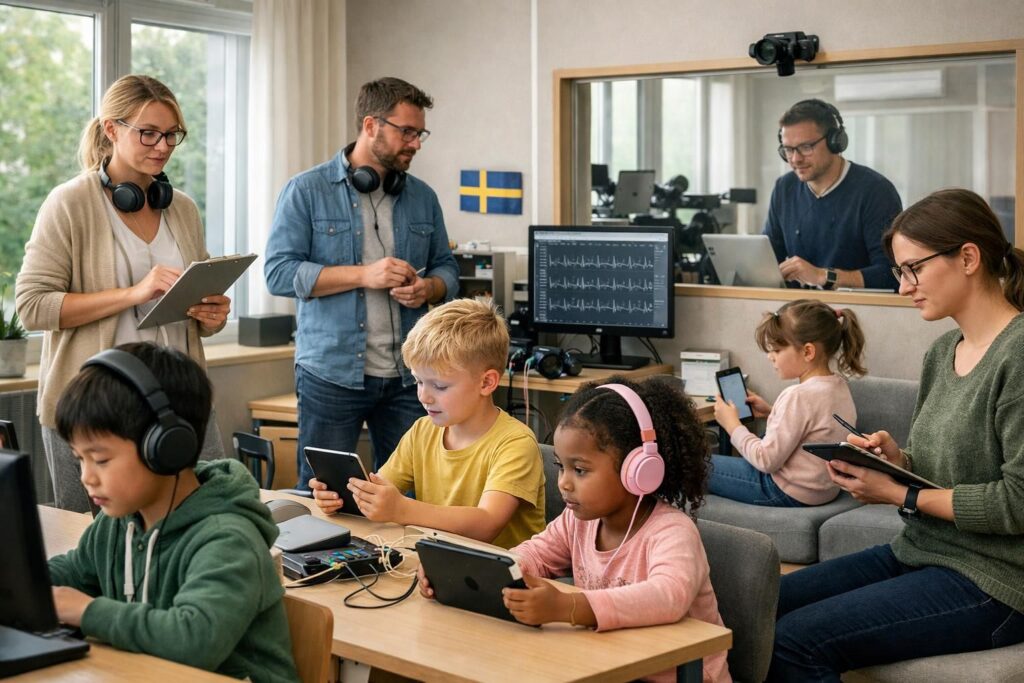
- Sweden is turning public-health research into practical advice on screen time for children, with a strong focus on sleep, mental wellbeing, and daily movement.
- Recent studies point to consistent effects on sleep when phones are present in bedrooms, especially when used at night.
- Not all technology use is equal: passive, endless scrolling tends to correlate with worse outcomes than social play or moderated gaming.
- Guidance increasingly connects child development to routines—bedtime, physical activity, and family norms—rather than simply counting minutes.
- Education systems are rethinking device policies, while debates continue about data practices, persuasive design, and digital rights for minors.
Sweden’s latest push to understand the health impact of screens is not a moral panic about modern life; it’s a public-health attempt to name what families have quietly noticed for years. The ordinary evening scene—one parent answering messages, a child watching short videos, a teenager scrolling in bed—has become so common that it’s difficult to tell what is “normal” and what is quietly draining sleep, mood, and attention. Swedish researchers and agencies have tried to separate the obvious from the uncertain: what patterns appear again and again across age groups, and what depends on context. One recurring signal is hard to ignore: when digital devices move into the bedroom, sleep quality often falls, and with it the next day’s resilience.
The debate is also shaped by recent history. The pandemic years expanded remote schooling and normalized longer hours on screens, even for very young children, while parents used streaming content as a practical tool to get through working days. Now, with school routines restored, Sweden is asking a different question: how do we keep the benefits of connected education and communication while reducing the measurable downsides? That approach—grounded in research, updated guidelines, and realistic family strategies—sets the tone for how Sweden studies the effects of screen time on children.
Sweden studies the effects of screen time on children: what the evidence keeps finding
Across Swedish research summaries and public-health discussions, one theme stands out for its consistency: sleep. Lina Eklund, an associate professor in informatics and media who contributed to a government-commissioned knowledge compilation on digital media and youth health, has emphasized an especially robust association: having a phone in the bedroom, and using it during the night, aligns with poorer sleep across age groups. Sleep is not a minor detail in child development; it is a foundation for emotional regulation, growth, learning consolidation, and immune function. When sleep is repeatedly shortened or fragmented, the “cost” shows up elsewhere—attention problems, irritability, and difficulty coping with everyday stress.
What makes this area tricky, Eklund and other scholars note, is cause and effect. Do screens cause depressed mood, or do young people in a low mood retreat into feeds and games because it feels like relief? Is social withdrawal driven by scrolling, or does scrolling fill the space created by loneliness? Sweden’s studies often avoid simplistic claims and instead highlight correlations, risk patterns, and vulnerable groups who may experience a steeper downside.
Those vulnerabilities matter for policy. Children affected by socio-economic stress, neuropsychiatric conditions, physical disabilities, or social marginalization—such as LGBTI youth—can face stronger negative links between heavy screen engagement and wellbeing. The paradox is that these groups are often the hardest to reach with generic guidelines. A household juggling multiple jobs may rely on screens for quiet and safety. A child with attention challenges may use games for structure and predictable reward. Sweden’s public-health stance is therefore moving toward risk-aware recommendations rather than one-size-fits-all moral messaging.
Body image, mental health, and the “infinite feed” problem
Swedish research has also supported the idea that social platforms can shape how young people see their bodies. Exposure to idealized images, filters, and “before-and-after” narratives is associated with poorer body image and links to disordered eating in some adolescents. The key mechanism isn’t simply “seeing photos”; it’s the combination of social comparison, algorithmic amplification, and the pressure to perform a curated identity.
Importantly, young people themselves often distinguish between healthy and unhealthy uses. Messaging friends, sharing jokes, and coordinating plans is not what they describe as the most damaging. The negative experience tends to cluster around hours of passive scrolling on short-video platforms, where the interface is designed to keep attention engaged. Eklund has argued that this style of persuasive design conflicts with children’s rights principles because it nudges prolonged use in ways minors are less equipped to resist.
Gaming is another nuanced area. Despite sensational headlines, Swedish reviews have found limited evidence that gaming is uniformly harmful. Many adolescents play with siblings or friends, which can be socially supportive. Risks appear more clearly when play is isolated, sleep-displacing, or paired with heavy social media use—an overall pattern that correlates with depressive symptoms. The insight is not “games are bad,” but “context decides the outcome.” That framing leads naturally into guidelines, household rules, and how to design environments that protect sleep.
Insight: Sweden’s studies repeatedly suggest that the most reliable lever for improving wellbeing is not banning devices outright, but protecting sleep and reducing endless, algorithm-driven consumption.
Sweden’s screen time guidance by age: from “none under 2” to balanced use in adolescence
Sweden’s public-health recommendations have attracted attention for their clarity, especially around early childhood. The headline message is straightforward: children under two should have no exposure to digital screens, including television. The reasoning is rooted in child development: the first years are shaped by language learning, face-to-face interaction, motor exploration, and sleep regularity. Screens can crowd out these experiences even when content seems “educational.”
The guidance becomes more permissive with age. For preschoolers roughly aged two to five, Sweden’s suggested ceiling is about one hour per day. For ages six to twelve, it increases to around two hours, and for teenagers to three hours. Those numbers are not meant as a stopwatch-driven discipline tool; Sweden positions them as an anchor for families to evaluate routines. A school day with digital assignments is different from a weekend of video clips. A teen using a laptop to compose music is different from a teen trapped in a late-night doom-scroll.
To make the guidance usable, Swedish educators and clinicians increasingly talk in “behavioral blocks” rather than pure minutes: when does screen time happen, what does it replace, and how does the child look afterward? A child who watches a short program and then happily plays outside presents a different picture from a child who becomes dysregulated after autoplay chains of short videos.
Age group
Sweden’s suggested daily limit
Primary developmental priority
Practical household focus
Under 2
None
Attachment, language exposure, sensory-motor exploration
Create screen-free routines; prioritize caregiver interaction
2–5
Up to ~1 hour
Play, self-regulation, early literacy
Co-view when possible; avoid autoplay loops
6–12
Up to ~2 hours
Learning habits, peer relations, physical activity
Tech-free bedroom; “device parking” after dinner
Teenagers
Up to ~3 hours
Identity, autonomy, sleep, mental health resilience
Negotiate rules; protect sleep; talk about algorithms and comparison
How Swedish families translate guidelines into daily life
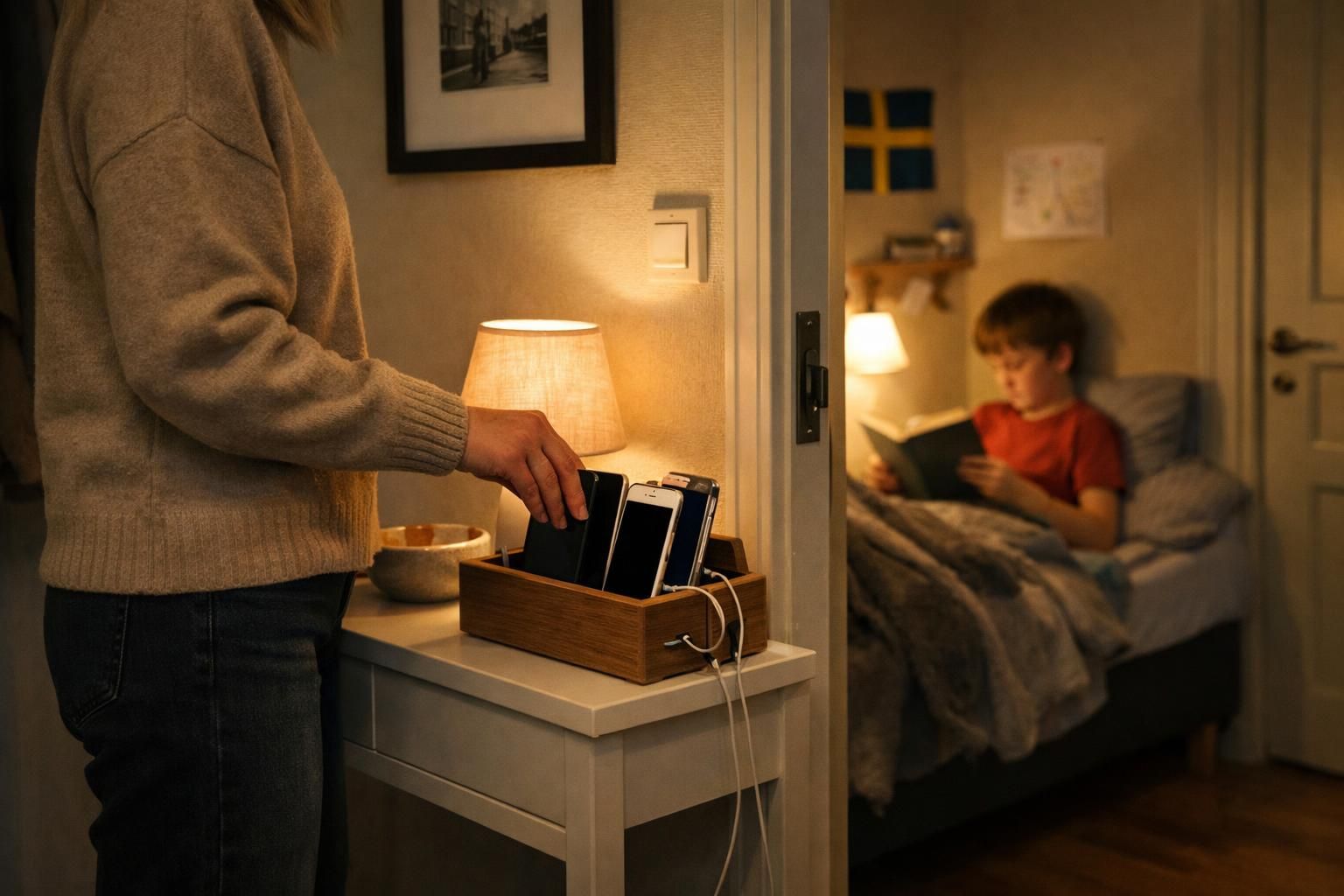
Consider a fictional family in Uppsala: the Nilssons. Their 10-year-old, Alma, loves YouTube craft videos, while 15-year-old Leo chats constantly with friends. When the family tried “no screens on weekdays,” it failed within days because school communication, group projects, and peer life all run through devices. Their second attempt worked better: a phone-free bedroom policy and a shared charging station in the hallway. Alma still gets her videos, but earlier in the evening, and Leo keeps his phone—just not in bed.
They also changed what happens when screens are off. The father revived a weekend “walk-and-fika” routine; the mother stocked comics and library books. This matters because limits without replacements feel like punishment. Sweden’s message aligns with that reality: the goal is to strengthen sleep, movement, and social contact rather than create constant conflict.
For readers interested in how other societies build non-screen habits, it’s worth looking at Portugal’s reading campaigns, which show how communities can make offline culture visible and appealing rather than merely “healthy.”
Insight: Sweden’s age-based numbers are most effective when paired with household routines that make “off-screen” time genuinely rewarding.
That leads directly into school policies and the education debate: if screens are restricted at home but required at school, what does balance actually look like?
Screen time, education, and the post-pandemic classroom: what Sweden can and can’t control
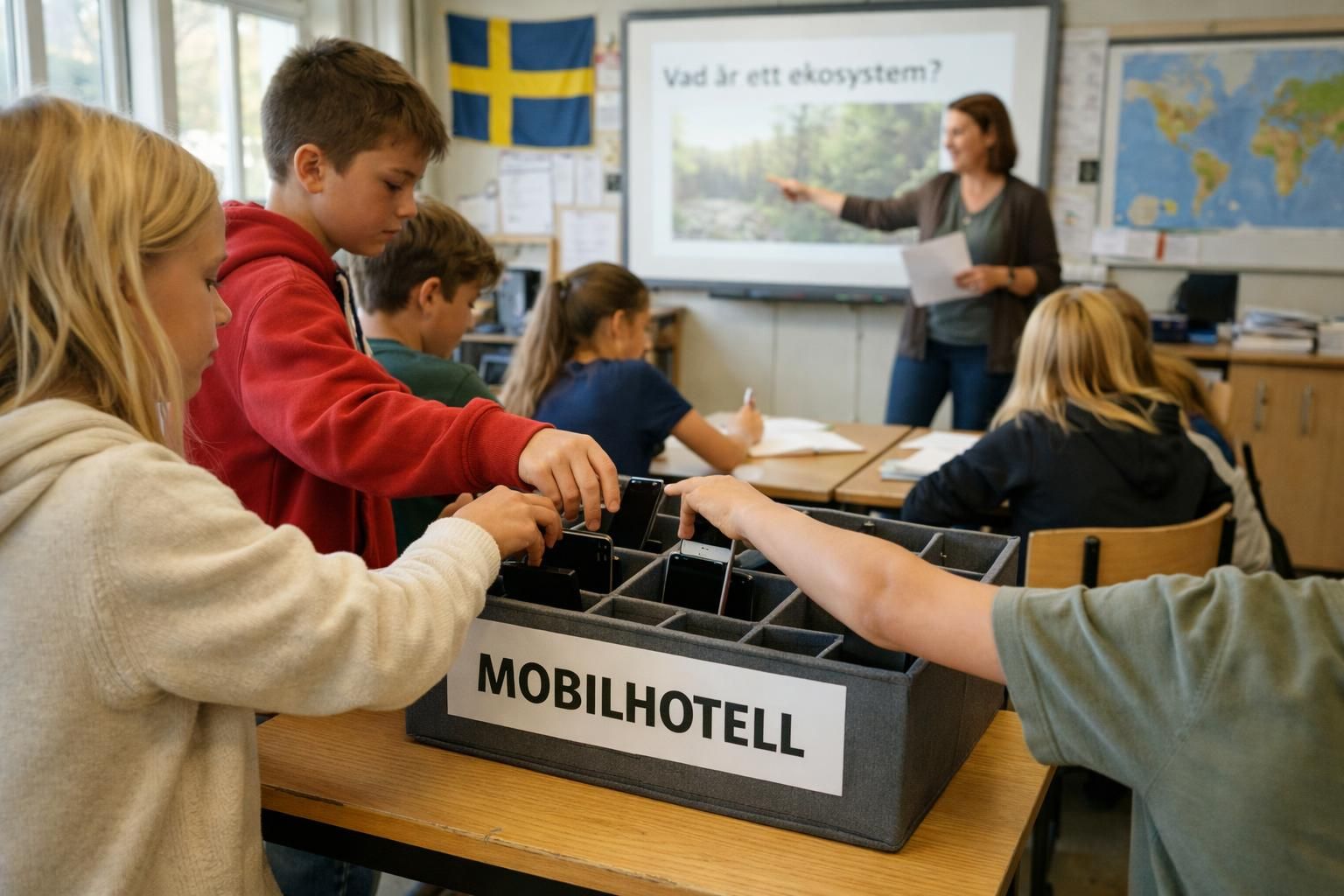
In many countries, the school has become the battleground for screen time policy. Phone bans, locking pouches, and classroom collection bins can reduce distraction, but Sweden’s research-oriented approach suggests that policy success depends on what replaces the phone. If students are prevented from checking devices but are left bored, stressed, or socially anxious, the habit may simply move to evenings and nights, where the sleep damage is worse.
Education also complicates “daily limits.” A 12-year-old may use a tablet for assignments, language practice, and collaboration tools, then go home to watch videos. The question becomes: how does a school system use technology in a way that supports learning without normalizing constant stimulation? A UNESCO report from the mid-2020s argued that digital tools can expand collaboration and learning environments, yet come with costs in socialization and real-life learning, and raise concerns about data exploitation, misinformation, and hate speech. Sweden’s conversation echoes those themes but adds a pragmatic focus: does tech use deepen learning, or does it fragment attention?
Remote learning after the crisis years: lessons that still apply
The pandemic forced distance learning into the mainstream, and many families still live with its aftereffects: school platforms that push notifications late into the evening, homework posted in multiple apps, and a sense that a student must be “always online” to keep up. Even as Sweden reviews screen time effects, it also has to navigate the reality that education systems have invested heavily in digital infrastructure.
What helps is separating purposeful educational technology from open-ended entertainment feeds. Schools can reduce evening device dependence by setting assignment deadlines earlier, limiting late-night announcements, and teaching students how to manage notifications. For a wider view of where distance learning could head next, consider reporting on the future of remote learning in the U.S., which highlights hybrid models that try to keep flexibility without turning home life into a permanent classroom.
Safety concerns and the “I need to reach my child” argument
Parents sometimes oppose phone restrictions because they want emergency contact. This concern is particularly strong in places shaped by fears of school violence. Solutions exist that preserve safety without full access: schools can provide clear emergency communication channels and allow phones during travel to and from school while restricting use during lessons. Discussions about school security infrastructure—like those explored in coverage of Dallas school security measures—show how quickly safety debates can reshape everyday policies, including device access.
In the Swedish context, the goal is to avoid false choices: students can be reachable without being perpetually distracted, and learning can benefit from digital tools without surrendering the classroom to notification culture.
Insight: School rules matter, but Sweden’s education debate increasingly focuses on redesigning attention environments—not just confiscating phones.
Health impact beyond sleep: physical activity, mental resilience, and inequalities in technology use
Sleep is the clearest signal, but it isn’t the only one. Swedish population-based research tracking physical activity and screen habits across childhood and adolescence has pointed to a common pattern: as children get older, physical activity tends to drop while recreational screen engagement can rise, creating a double hit—less movement and more sedentary time. Public-health agencies interpret this as a call for targeted interventions, especially for older age groups where habits become harder to shift.
One practical way to explain this is substitution: an hour on a feed often replaces an hour that might have been spent outdoors, walking to a friend’s house, or simply moving around. That matters because movement is not only about weight or fitness. It supports sleep quality, improves mood through stress regulation, and gives children a non-digital sense of competence—climbing, cycling, dancing, practicing a sport. When physical activity declines, children can become more reliant on online spaces for reward and belonging.
Swapping time, not just cutting it: a workable behavioral strategy
A Swedish research approach that resonates with families is the “swap” framing: replace one hour of certain screen activities with one hour of movement. In a follow-up line of research discussed by Swedish institutions, swapping time from social media to physical activity was associated with improved mental health, with particularly strong effects reported among girls. This is not surprising: exercise can buffer stress, reduce rumination, and build self-efficacy—exactly the capacities that social comparison platforms can erode.
For the Nilsson family, this became concrete. Leo wanted to keep chatting with friends, so they agreed on a trade: he could keep his evening messaging window if he walked the dog or did a gym session first. The rule wasn’t moralizing; it was transactional and predictable. Over time, the “swap” built a healthier rhythm, and Leo began noticing that late-night scrolling made him feel worse the next day.
Why vulnerable groups can experience stronger negative effects
Sweden’s studies repeatedly highlight that socio-demographic and health factors shape outcomes. A child in a cramped apartment may have fewer safe outdoor spaces. A teenager facing discrimination may seek refuge online, where community can be supportive but also expose them to harassment or harmful content. A child with ADHD may be especially sensitive to rapid-reward design, making disengagement harder. These realities mean that “just turn it off” advice can be tone-deaf.
Community-level solutions help. Cities can invest in accessible play spaces, youth clubs, and supervised activities. An example of civic attention to outdoor alternatives appears in a report on a playgrounds push in Charlotte, illustrating how built environments can compete with screens by making physical play easy and attractive.
Digital policy also intersects with wellbeing. Stronger rules on data collection and targeted advertising can reduce manipulative pressure on minors. For a wider policy lens, Canada’s digital safety efforts for children and Australia’s digital privacy bill debate show how governments are trying to make platforms less predatory for young users.
Insight: Sweden’s screen time conversation is increasingly about fairness—changing environments so that healthy choices are realistic for every child, not only the privileged.
That fairness question leads naturally to the technology industry itself: if the interface is designed to prolong engagement, can families and schools realistically shoulder all responsibility?
Design, regulation, and children’s rights: why Sweden’s research points at platforms, not only parents
When Sweden studies the effects of screen time on children, the discussion often lands on an uncomfortable conclusion: many harms are not accidental side effects but predictable outcomes of engagement-driven design. Autoplay, infinite scroll, streaks, algorithmic recommendation loops, and “just one more” prompts are optimized to extend use. For minors—whose self-control is still developing—this is not a level playing field.
Lina Eklund and other commentators have pointed out that young people describe the most negative experiences not as “talking with friends,” but as getting stuck in long sessions of short-form videos. That distinction matters for policy because it suggests that the primary lever is not banning all digital devices, but reducing compulsive design features and making stopping points more natural.
What a children’s-rights lens changes in practice
A children’s-rights approach reframes the issue from “bad habits” to “adult-designed systems.” If a platform’s business model depends on capturing attention, then asking a child to resist is like asking them to out-negotiate an entire product team. Sweden’s public-health agencies have therefore called for platform changes so children do not fall into hours-long consumption spirals or get funneled toward harmful material.
In several countries, policymakers have intensified scrutiny. In the United States, state lawsuits have argued that major platforms knowingly created addictive features that harm young people. While Sweden’s legal context differs, the broader direction is similar: shifting some responsibility upstream to the companies that control recommendation systems and ad targeting.
Concrete household rules that align with what research actually shows
Even while regulation evolves, families need tools that work this week. Swedish researchers often recommend strategies that protect the most sensitive areas of child development: sleep, self-regulation, and peer connection. The following list collects approaches consistent with the evidence Sweden has been weighing:
- Keep phones out of bedrooms and charge devices in a shared area to reduce late-night use and sleep disruption.
- Set a screen curfew that starts 60–90 minutes before bedtime, replacing it with low-arousal activities (reading, drawing, calm music).
- Favor active and social use (creating, collaborating, playing with friends) over passive scrolling loops.
- Use “swap rules”: exchange a block of social media time for physical activity to support mental resilience.
- Negotiate rules that include adults too; children notice hypocrisy, and role modeling influences household norms.
Notice how these rules focus less on counting minutes and more on timing, context, and the type of interaction. That aligns with Sweden’s overall research stance: the health impact of screen time depends strongly on what happens around it—sleep schedules, activity, vulnerability, and platform design.
Insight: Sweden’s most powerful message is that protecting children online is not only a parenting task; it is also a design and governance challenge.
{“@context”:”https://schema.org”,”@type”:”FAQPage”,”mainEntity”:[{“@type”:”Question”,”name”:”Do Swedenu2019s screen time recommendations include television as well as phones and tablets?”,”acceptedAnswer”:{“@type”:”Answer”,”text”:”Yes. Swedenu2019s guidance treats TV as a digital screen exposure too, especially for the underu20112 recommendation of no screen exposure. For older children, the key is still the total daily dose and whether it displaces sleep, movement, and offline interaction.”}},{“@type”:”Question”,”name”:”Is all screen time equally harmful for child development?”,”acceptedAnswer”:{“@type”:”Answer”,”text”:”No. Swedish studies and youth self-reports suggest the effects vary by activity. Social connection (chatting with friends), creative work, or cooperative gaming can be different from hours of passive, algorithmic short-video scrolling, which is more often linked with poorer sleep and mood.”}},{“@type”:”Question”,”name”:”What is the single most evidence-backed change a family can make?”,”acceptedAnswer”:{“@type”:”Answer”,”text”:”Keeping mobile phones out of bedrooms is one of the most consistent, practical steps linked with better sleep. Protecting sleep tends to improve attention, mood, and overall health impact across age groups.”}},{“@type”:”Question”,”name”:”How should schools balance education technology with attention and wellbeing?”,”acceptedAnswer”:{“@type”:”Answer”,”text”:”A workable balance separates purposeful digital learning from open-ended entertainment patterns. Schools can reduce distraction by limiting in-class phone access, setting predictable communication hours, and teaching notification management, while still using technology for collaboration and accessible learning tools.”}}]}
Do Sweden’s screen time recommendations include television as well as phones and tablets?
Yes. Sweden’s guidance treats TV as a digital screen exposure too, especially for the under‑2 recommendation of no screen exposure. For older children, the key is still the total daily dose and whether it displaces sleep, movement, and offline interaction.
Is all screen time equally harmful for child development?
No. Swedish studies and youth self-reports suggest the effects vary by activity. Social connection (chatting with friends), creative work, or cooperative gaming can be different from hours of passive, algorithmic short-video scrolling, which is more often linked with poorer sleep and mood.
What is the single most evidence-backed change a family can make?
Keeping mobile phones out of bedrooms is one of the most consistent, practical steps linked with better sleep. Protecting sleep tends to improve attention, mood, and overall health impact across age groups.
How should schools balance education technology with attention and wellbeing?
A workable balance separates purposeful digital learning from open-ended entertainment patterns. Schools can reduce distraction by limiting in-class phone access, setting predictable communication hours, and teaching notification management, while still using technology for collaboration and accessible learning tools.