
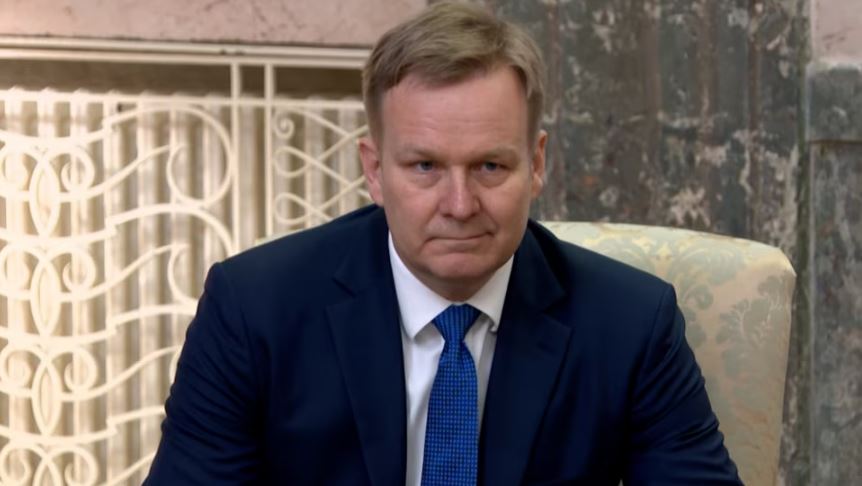
Peter Sorensen—the European Union’s Special Envoy for the dialogue between Kosovo and Serbia—will visit Pristina and Belgrade on Wednesday and Thursday, the European External Action Service (EEAS) has confirmed.
According to announcements from Brussels, the European envoy is expected to hold meetings with the leaders of both countries, while in Kosovo a meeting with representatives of opposition parties is also planned.
Sorensen will begin his visit on January 14 in Pristina, and one day later, on January 15, he will stay in Belgrade.
This will be his first visit since his mandate was extended for another two years as envoy for the dialogue on the normalization of relations between the two neighboring countries.
During his first mandate, he held only two meetings at chief negotiator level, which did not yield results. The lack of progress in the dialogue during this period was attributed mainly to internal political developments in Kosovo and Serbia, rather than to a lack of engagement by the European mediator.
His visit comes at a time when Kosovo is expected to form a new government following the snap elections of December 28, which were decisively won by the Vetëvendosje Movement, the party of the acting Prime Minister, Albin Kurti.
Brussels expects that after the formation of the new government in Pristina, the dialogue process will be revived and possibly even a meeting at the highest political level will be held.
The EU High Representative for Foreign Affairs and Security Policy, Kaja Kallas—who has not yet mediated a round of dialogue at the highest political level—will seek to achieve progress in the Western Balkans.
This has been justified by the difficult political circumstances in both countries, including the political deadlock in Kosovo that characterized 2025 and the situation in Serbia as a result of student protests ongoing since the autumn of 2024.
However, following the election result in Kosovo and the clear victory of the Vetëvendosje Movement, the European Union believes that the conditions are now ripe to aim for organizing a round of dialogue at the leaders’ level, as soon as the country establishes its new institutions.
The European Union has repeatedly appealed—also through official documents—to both Kosovo and Serbia to adopt a constructive approach to the dialogue process.
In its conclusions of December 2025, the EU Council of Ministers welcomed Kallas’s readiness to convene a high-level dialogue meeting as soon as favorable conditions are created.
Kosovo and Serbia reached an agreement on the path toward normalization, known as the Ohrid Agreement, in 2023, but it has not been implemented.
Although the agreement has not been signed, the European Union insists that it is binding for both parties.
This 11-article agreement, among other things, provides for a level of self-management for the Serbian community in Kosovo, mutual recognition of state symbols, requires Serbia not to block Kosovo’s membership in international organizations, and calls on Pristina and Belgrade to implement all previous agreements reached during the 15-year dialogue process.