
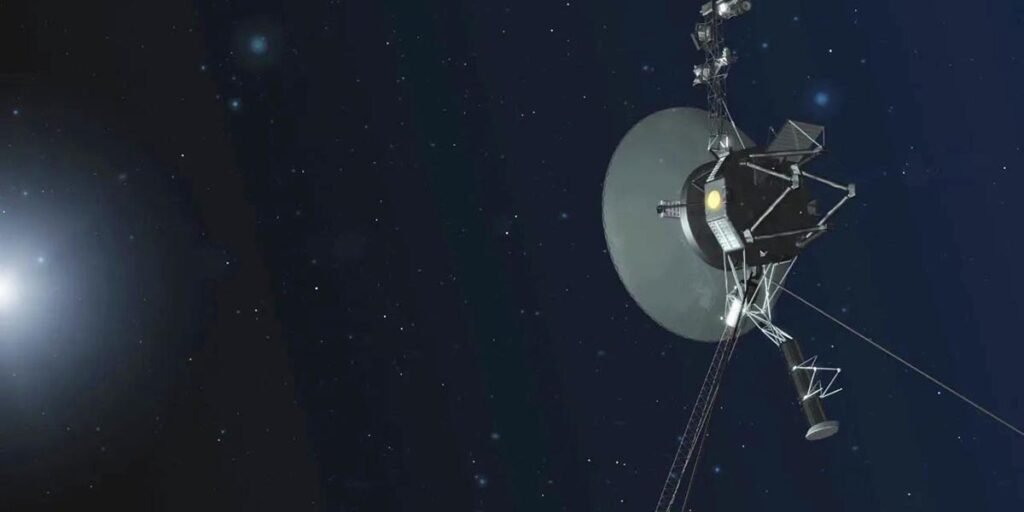
It was the first space probe to reach the heliopause, in August 2012
On September 5, 1977, a NASA space probe was launched that has achieved a record that will be very difficult to surpass.
The history of the five NASA spacecrafts that travel beyond the Solar System
Spain: huge abandoned satellite dishes that participated in a NASA program
On its journey through the Solar System, the Voyager 1 probe flew past the planets Jupiter and Saturn as well as several of their moons, discovering Jupiter’s rings and three new moons of Saturn: Prometheus, Pandora, and Atlas. Afterward, it continued its journey into outer space. On February 17, 1998, it became the farthest-reaching human-made object, a record previously held by the Pioneer 10 probe since 1983.

On August 25, 2012, Voyager 1 achieved a new milestone, becoming the first human-made object to reach the helipause, the interstellar boundary where the solar wind ceases. Thus, this spacecraft was the first to leave the Solar System. Voyager 1 is a relic of an already obsolete technology. According to NASA, this spacecraft has about 3 million times less memory than modern mobile phones and transmits data about 38,000 times slower than a 5G internet connection.

Despite having very outdated technology to communicate with this space probe, NASA has managed to maintain contact with Voyager 1, but not for much longer. As its nuclear fuel runs out, its signal will become increasingly weak, and communication with it will be lost in the coming years, making this spacecraft the most isolated human-made object.

It should be noted that Spain has played a key role in this mission. Voyager 1 communicates with us thanks to NASA’s Deep Space Network (DSN). For decades now, this network has had three mission tracking complexes: Goldstone (California, USA), Canberra (Australia), and Robledo de Chavela (Madrid, Spain). The Spanish complex, officially known as the Madrid Deep Space Communications Complex (MDSCC), has six antennas for this tracking, the largest of which has a diameter of 70 meters.

At the end of December, the YouTube channel AdagioCero, which began its journey on November 21, 2025, and which publishes content of excellent quality, published a magnificent video about the long journey of Voyager 1, explaining its history, its current situation, and what will become of it in the future (the video is in English; you can activate automatic Spanish subtitles in the bottom bar of the player):
—
Main image: NASA.