
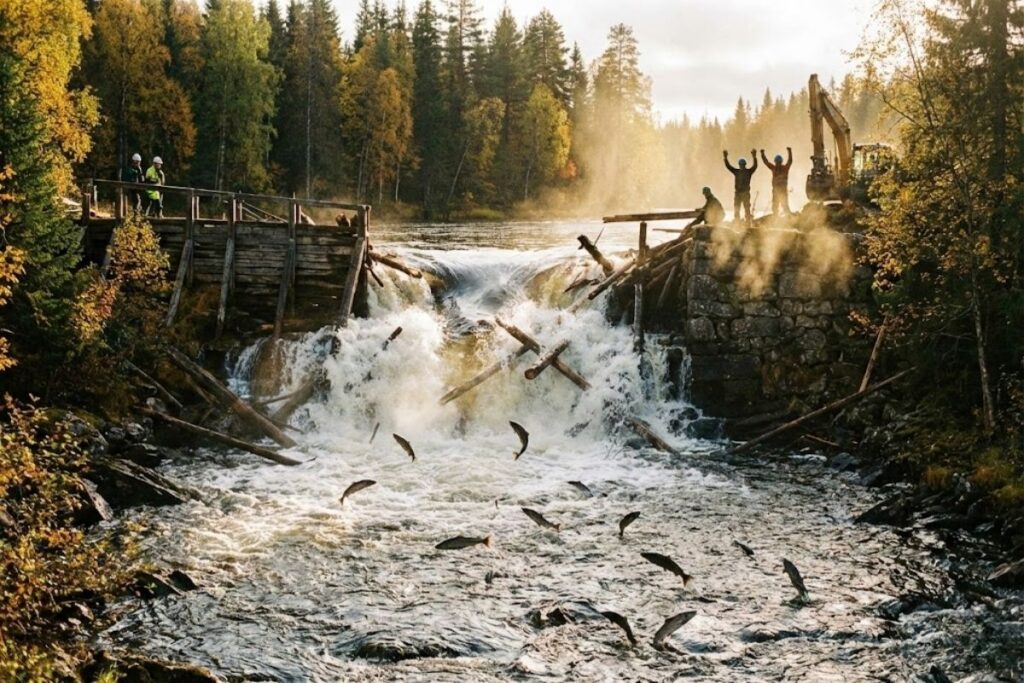
In Sweden, within the Nordic taiga and the Vindelälven-Juhttátahkka Biosphere Reserve, in the county of Västerbotten, a field operation is removing dams Small and obsolete solutions will restore to rivers a basic attribute of nature: the continuity of flow, riverbed, and life.
The work is being conducted by the Rewilding Sweden team with financial support from the Open Rivers program and focuses on results. something rare to see with such clarity: When concrete is removed from the path, natural processes reappear.Connectivity is restored, and aquatic species are once again using stretches of water that had been blocked for decades.
What was removed and where exactly did it happen?
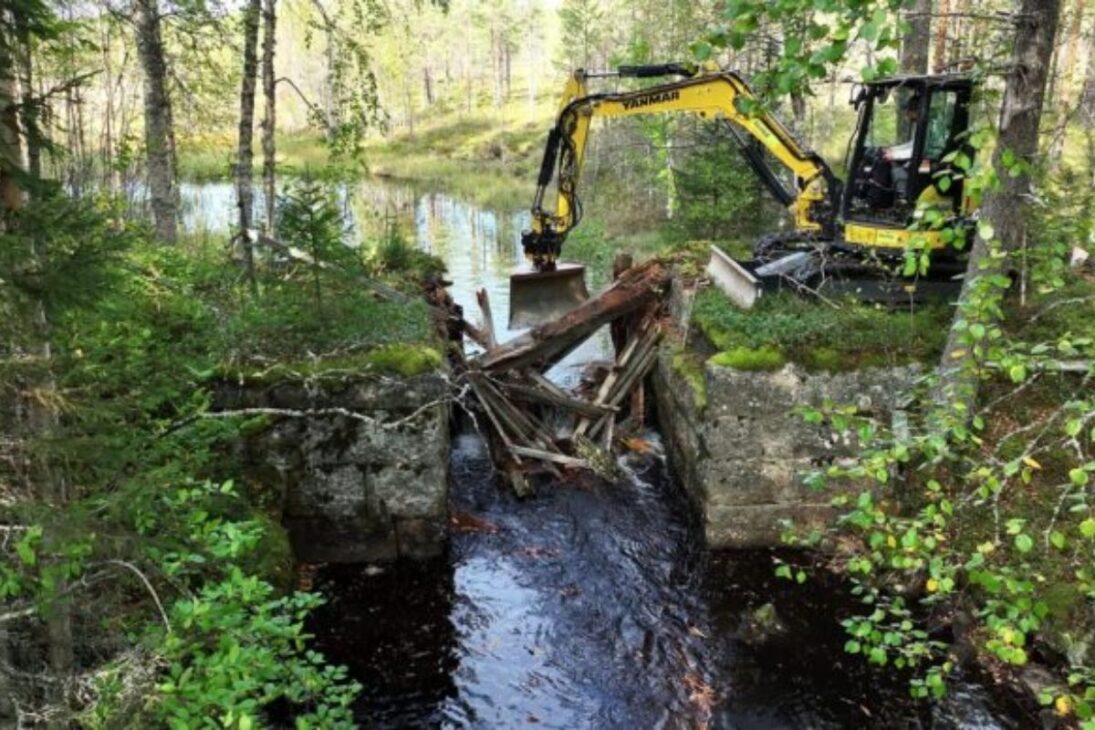 Removing the four dams will improve connectivity and natural processes, benefiting a wide range of wildlife species.
The removal took place within the Vindelälven-Juhttátahkka Biosphere Reserve, an area northwest of the city of Umeå, in Västerbotten county, northern Sweden.
There, four structures were identified as river barriers to be removed in order to reopen waterways and wildlife pathways.
the four dams removed have names and history: Strömbäcksdammen, Långträskdammen, Långhjuksnordammen and Alträskdammen.
Despite their small size, they were positioned in such a way as to interrupt sections that feed into a larger network.
When the barrier is in the wrong place, it doesn’t just block “one point” of the river, it blocks entire kilometers of ecological function.
The number that measures the turnaround: 84 kilometers reconnected.
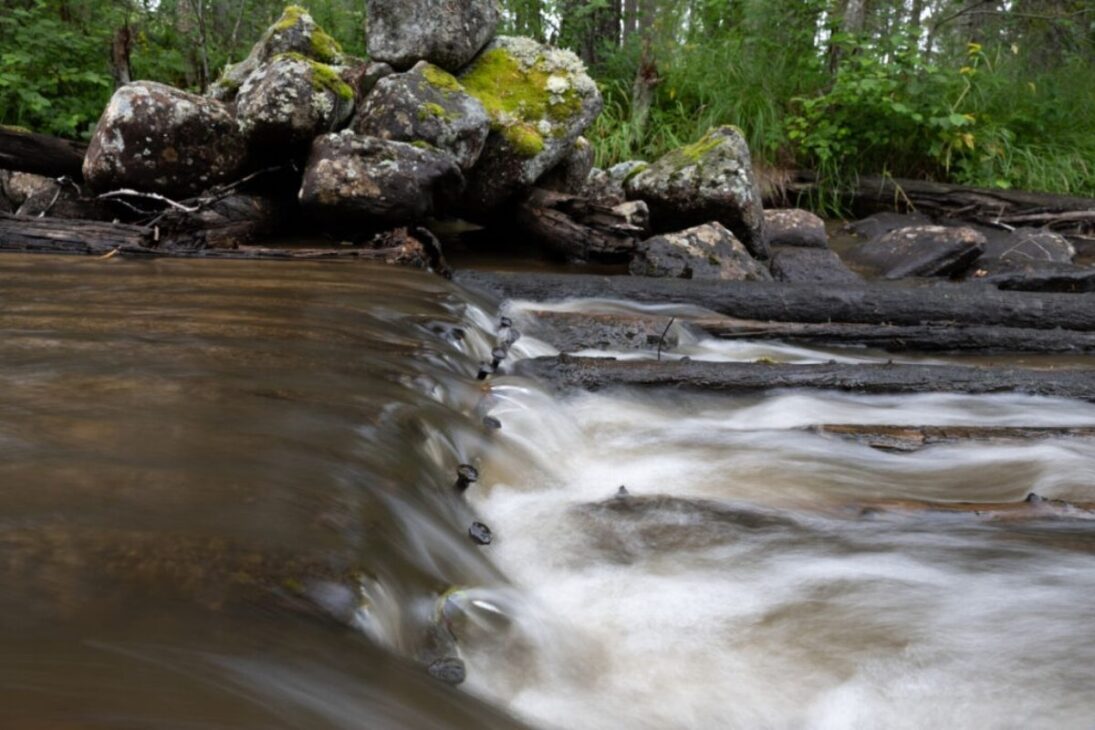
The most objective consequence of removing the four dams It is the improvement of connectivity in 84 kilometers of waterways.
These streams flow into the Vindel River, described as a tributary with 450 kilometers long, which in turn flows into the Ume River.
In practice, this means that the intervention is not limited to the location where the concrete was removed. The reconnection spreads downstream and upstream.Because the river system functions as a corridor.
By reopening the waterways, the river will once again transport what it has always transported, and the landscape will once again receive what it has always received.
Why small dams cause great damage to the ecosystem.
Artificial barriers are identified as one of the main threats to aquatic and riparian biodiversity on a global scale.
Even when they don’t seem “gigantic,” dams They degrade river ecosystems in several ways simultaneously.
They cause habitat loss and fragmentation, alter the distribution of sediments and nutrients, and can concentrate pollutants in dammed areas.
The result is usually less diversity, less resilience, and less capacity for the river to support the wildlife populations that depend on it.
In the Nordic taiga, this is even more significant because the rivers are ecological corridors across a vast landscape.
A roadblock doesn’t just stop movement.It fragments a path that connects environments, seasons, and reproductive cycles.
What changes when free flow truly returns?
The removal of dams The project in the Vindel basin aims to restore the river’s natural processes and, thereby, improve the overall health of the river system.
This “return to nature” is not an abstract idea. It happens in very concrete components of how a river functions:
Water begins to circulate again with fewer interruptions and patterns closer to the original. Sediments start to move and redistribute themselves.
Nutrients are no longer trapped in specific locations. Seeds and organic matter are once again transported by the current, nourishing riverbanks and stretches of the river.
Furthermore, in some cases, The wooden flooring installed in the riverbed was also removed.This detail is crucial, because it wasn’t just the dam that was causing problems.
The wooden lining at the bottom of the river acted as a physical barrier and blocked riverbed processes, preventing the natural circulation of water, sediment, and organic matter.
Fish migration and the quick test: Salmo trout in two days.
One of the most striking signs of the ecological response appeared with unusual speed: there was Salmo trutta returns 2 days after restoration..
This type of rapid turnaround is an indication that the physical barrier was a major bottleneck for movement.
When the obstacle disappears, nature tends to test the path almost immediately, especially in species that depend on movement along the river.
The logic is simple: Free-flowing rivers benefit migratory fish.Because they need access to different areas throughout the year for feeding, shelter, and reproduction.
The removal of dams and associated structures create a path for these fish to circulate again without the “wall” interrupting the corridor.
The crucial technical challenge: preventing the water level from dropping.
To tear down dams Older rivers have a difficulty that doesn’t appear in before-and-after photos: maintaining the water level upstream.
When many of these dams were built, stones were moved downstream to increase the height difference above and below.
If the dam were removed without replacing these stones, the water level above could artificially drop, creating a new imbalance, this time caused by the restoration itself.
Therefore, the team needed to build natural and gentle thresholds where the dams were. These thresholds do three things at the same time.
First, they prevent an abnormal drop in upstream water levels. Second, They improve the natural aesthetics of the waterway.so that the restored area does not look like a technical scar. Third, they prevent the flow from becoming so strong as to hinder the movement of fish and other wildlife.
As part of this process, Large rocks were put back in place. to stabilize the stretch and ensure that the river regains its function, not just “a waterway”.
The overarching strategy: aquatic landscape and green-blue corridors.
The removal of dams It is not treated as an isolated event. It is part of a long-term strategy to restore the Vindel River watershed, maximizing the results of previous large-scale river restoration work and connecting the intervention to other ongoing efforts.
The approach adopted is described as “aquatic landscape,” focusing on enhancing blue-green corridors for nature and wildlife.
This means strengthening the connection between rivers and surrounding landscapes, restoring free flow and allowing dynamic processes to operate again.
When the river regains its freedom, the entire landscape achieves ecological coherence.Because riverbanks, wetlands, and forested areas begin to interact again with the pulse of the water.
In the Vindel basin, Rewilding Sweden also works on other fronts of long-term ecological restoration. In addition to removing damsThe team focuses on restoring drained wetlands and degraded forests.
Forest restoration has an additional role: increasing biodiversity and support reindeer migration through a landscape dominated by commercial forestry.
This point helps to understand why dam removal is more than just “a river project.” It fits into a territorial plan where water, forest, and wildlife need to function as a system again.
Where did this problem come from: the legacy of the Swedish forestry industry.
Three out of four dams The trees that have been removed, or are in the process of being removed, are described as a legacy of Sweden’s long history of industrial-scale forestry, which has heavily impacted the landscape.
Beginning in the 1850s, before the era of roads and railroads, waterways were channeled and cleared to form a vast network of river transport. Rapids were removed and bends straightened to allow logs to float hundreds of kilometers downstream for processing.
In many places, wooden planks were laid in the riverbeds to facilitate passage. Simultaneously, an extensive network of drainage ditches connected to the rivers was excavated to create drier soils and encourage tree growth.
And then came the dams En masse: thousands of small structures were built to artificially raise water levels in the spring.
When the logs were ready for transport, the dams were opened and the wood was carried downstream by the resulting current.
What was designed to accelerate timber production also left an ecological trail: hundreds of obsolete dams They still exist in the Vindel basin and other regions of Sweden, and those that remain continue to have a negative impact.
Why “removing concrete” has become a simple and effective measure.
Among the possible actions to improve the health and functionality of rivers and connected areas, removing dams It is described as a simple and effective measure because it eliminates the most direct obstacle to connectivity.
It doesn’t require “reinventing” the river, it requires removing from its path whatever prevents it from managing itself. When the barrier disappears, the river begins to reorganize sediments, nutrients, and flow.and wildlife regains complete pathways, not fragments.
Next step already scheduled: investigate five more dams.
The plan continues to expand. A second grant from the Open Rivers program will fund research next year on five more dams in the Vindel River watershed, for possible removal by the project team.
This step is important because it expands the reach of the reconnected corridor and, at the same time, reinforces the method: map, assess, and remove, always taking care not to create artificial drops in water level and to maintain functional passages for wildlife.
Efforts to remove dams The actions in the Vindel basin are described as aligned with European waterway management policies, which seek to restore biodiversity and ecological connectivity.
This work also contributes to an objective of the European Biodiversity Strategy: to restore free flow in at least 25.000 kilometers of European rivers by 2030.
In addition to Open Rivers, financial support is cited from Rewilding Europe, which is involved in the European movement for the free flow of rivers and is a founding partner of Dam Removal Europe.
The central logic behind this is the same as the Swedish project: with climate change bringing new challenges, the need arises for a new relationship with water, accepting it back into landscapes and restoring habitat. Natural where possible, with dynamic processes. and natural phenomena such as free-flowing and flooded areas.
Which of these actions do you think would yield faster results in rivers blocked by dams: demolishing the structure first or rebuilding the riverbed with natural thresholds before fully releasing the flow?