
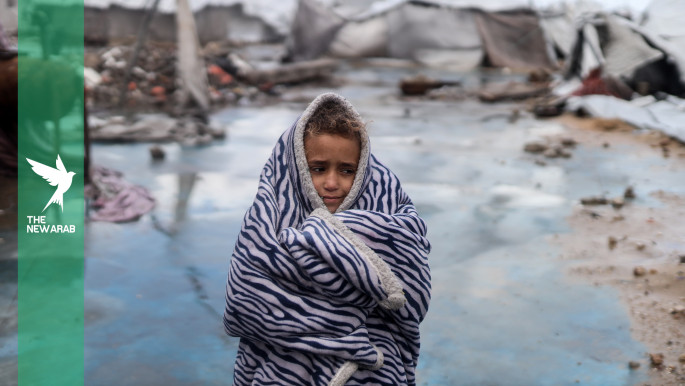
Following Israel’s NGO registration deadline, scores of international relief organisations working alongside the UN and Palestinian civil society can no longer operate in Gaza, cutting off vital life-saving assistance to Palestinians.
The Israeli government announced on 30 December that it would revoke the licences of 37 international humanitarian NGOs operating in Gaza and the West Bank, including East Jerusalem, and ordered them to cease operations within 60 days.
The ban targets major organisations such as Doctors Without Borders (MSF), the Norwegian Refugee Council, ActionAid, the International Rescue Committee, and Oxfam.
A tightening grip on humanitarian space
The announcement followed Israel’s introduction in March last year of additional NGO registration requirements demanding detailed disclosure of staff, finances, operations, and the identities of all foreign and Palestinian employees.
The decision not to renew aid groups’ licences will force their offices in Israel and occupied East Jerusalem to close and prevent them from sending international personnel or humanitarian aid into Gaza. Organisations that failed to comply with the December 2025 deadline were told to cease all activities by 1 March.
Israeli authorities have framed the newly introduced NGO rules as security and anti-terror safeguards intended to prevent militant groups from diverting aid and infiltrating humanitarian organisations.
However, critics, including the UN, aid agencies and rights groups, say that the conditions exceed routine oversight, undermine humanitarian neutrality and independence, and risk drastically reducing aid to civilians in need.
The most controversial rule requires NGOs to prove they do not engage in activities seen as “delegitimising” Israel, a vague term that could include criticism, advocacy, or routine reporting. This puts any organisation in Gaza or the West Bank at risk of being deemed illegal simply for documenting what they observe.
Talking to The New Arab, Shawan Jabarin, general director of the Palestinian human rights organisation Al-Haq, argued that Israel does not tolerate the slightest criticism. He said the registration conditions enforced on INGOs are part of its “strategy” to intimidate them, demand adherence to the official line, and create a climate of fear and self-censorship.
“Israel aims to control NGOs both administratively and by shaping the narratives and language they use,” the Palestinian human rights defender said, highlighting Tel Aviv’s opposition to their monitoring of rights abuses.
Israel’s move to de-register INGOs has drawn global outcry amid fears that restricting humanitarian access will heighten civilian suffering and further cut Gaza off from international institutions.
In May 2025, a coalition of 55 international organisations warned that Israel’s new NGO registration rules appear aimed at controlling independent humanitarian, development, and peacebuilding work, suppressing advocacy activities, and consolidating Israeli control over the occupied Palestinian territory.
Israel’s war on Gaza, labelled a genocide by the UN and international human rights organisations, killed over 70,000 Palestinians, including 20,000 children. [Getty]
Isolation by design
Oxfam, which has worked in Israel and Palestine since the 1950s, is among the aid organisations affected by the licence revocations following changes Israel introduced to the registration process in March.
“It’s extremely brutal to block so many organisations from delivering aid,” Oxfam MENA humanitarian coordinator Ruth James told The New Arab, commenting on Israel’s refusal to renew its registration, which she described as “yet another measure” to restrict the humanitarian response in Palestine.
She pointed out that, regardless of the recent ban, Israeli authorities have consistently blocked Oxfam’s relief supplies from entering the blockaded strip since last March without explanation.
Like many NGOs, Oxfam declined to submit a list of Palestinian staff, fearing it would breach duty of care and international data protection obligations, and put its personnel at risk, particularly given that more than 500 aid workers have been killed in Gaza during the war.
James expressed deep concern that without INGOs on the ground to support relief efforts in Gaza, their Palestinian colleagues would face greater danger from Israeli authorities, and the suffering of Gazans would worsen.
“It’s another step in Israel’s genocidal policy, and the future looks extremely bleak,” the regional humanitarian advisor denounced, urging all member states to apply maximum pressure on Israeli authorities to immediately repeal the registration constraints.
The new stringent regulations imposed on foreign NGOs are part of a “broader, long-term crackdown on humanitarian and civic space,” the civil society network asserted.
It is not the first time Israel has targeted international aid organisations. During the war, it accused the UN aid agency for Palestinian refugees (UNRWA) of being infiltrated by Hamas and claimed that its facilities and aid were being misused – allegations the agency has denied – imposing restrictions on its operations.
Chris Doyle, director of the Council for Arab-British Understanding (CAABU), told TNA that the draconian registration policy comes amid a “shrinking space for civil society”, affecting international NGOs, Palestinian organisations, as well as Israeli human rights groups.
“It demonstrates contempt for those agencies that provide humanitarian aid to Palestinians, but also hostility toward anyone or any organisation seeking to hold Israel accountable under international law,” he contended.
Humanitarian needs in Gaza remain extreme, with one in four families surviving on a single meal a day, and 1.3 million people urgently needing shelter. [Getty]
Doyle explained that Israel’s latest escalation is the “advancement” of a process of tightening restrictions on Gaza, first by limiting the entry of internationals – including journalists, human rights monitors, and humanitarian workers – and second by severely restricting aid to the coastal strip.
“It’s extremely serious,” the regional expert said, adding that it would leave no international witnesses inside Gaza and allow a “genocide to continue”, while compromising the ability to obtain casualty counts and other data.
Prominent humanitarian groups have condemned Israel’s decision to bar them from aiding Palestinians in Gaza, pointing to years of smear campaigns, increased surveillance, and actions that limit access, endanger staff, and erode humanitarian principles.
“This is about the manipulation and the instrumentalisation of humanitarian assistance,” MSF secretary-general Christopher Lockyear said in an interview with CNN’s Christiane Amanpour.
Earlier this month, 53 INGOs urged the Israeli government to lift its recent measures, stressing that humanitarian access is a “legal obligation”, and calling on donor governments to act to secure their rollback.
“This is not a technical or administrative matter, but a deliberate policy choice with foreseeable consequences,” the joint statement said, adding that the step amounts to “obstructing humanitarian assistance at scale”.
The NGO bloc also stated that the policy would establish a dangerous precedent by extending Israeli control over humanitarian operations in the Palestinian territory, undermining both the role of the Palestinian Authority (PA) and the internationally recognised legal framework.
International aid groups provide over half of the food assistance in Gaza, support most field hospitals and primary healthcare centres, deliver nearly three-quarters of shelter and non-food aid, offer water, sanitation, and protection services, treat severely malnourished children, and handle a third of emergency education efforts.
Their de-registration threatens to discredit humanitarian organisations, halt their operations, and further jeopardise aid delivery amid an already severe humanitarian crisis, despite the ceasefire.
Permanent control of Gaza
Humanitarian needs in Gaza remain extreme. One in four families survives on a single meal a day, winter storms have displaced tens of thousands, and 1.3 million people urgently need shelter. Over half of health facilities are only partially functional, with critical shortages of medical supplies. Since Israel launched its war in October 2023, more than 71,400 Palestinians have been killed, including hundreds from severe malnutrition and thousands from preventable diseases.
Placing restrictions on foreign organisations, which are indispensable to humanitarian and development operations, would block essential services and life-saving aid to Palestinians at a critical time, directly endangering civilian lives.
“By stopping them, Israel seeks to carry on its genocide in Gaza,” Jabarin said, noting how constraining the work of NGOs would not only deny access to humanitarian relief but also deepen the besieged enclave’s isolation from international support.
Al-Haq’s general director noted that barring international NGOs from Gaza fits Israel’s aim of long-term occupation and limiting external scrutiny. He cited Israeli Defence Minister Israel Katz’s pledge never to leave Gaza as further indication of plans for a permanent presence.
The rights advocate insisted that the status quo will change only if third-party states, including the home countries of the 37 affected organisations, take concrete steps to make Israel pay a political, diplomatic, and economic price. Otherwise, “Israel will expand it to more groups and institutionalise it permanently”, he added.
On Monday, senior Israeli officials openly called for a permanent military presence in the Gaza Strip, challenging a US-backed plan that prohibits Israeli occupation or annexation of the territory.
US President Donald Trump unveiled his proposal to end the war in Gaza in late September, calling for a ceasefire, the release of Israeli captives, the disarmament of Hamas, Israeli withdrawal, a technocratic administration, and deployment of an international stabilisation force to monitor the truce and support governance transition.
Israel insists that any foreign or stabilisation forces must meet its security requirements and be approved by Israeli authorities, indicating reluctance to allow outside military involvement.
Doyle observed that rather than implementing the 10 October ceasefire plan by loosening its grip on Gaza and withdrawing, Israel has instead intensified its military control, effectively splitting the enclave along a so‑called “Yellow Line” and maintaining authority over more than half of the territory.
“The current status quo suits Israel, which wants sole control with US backing,” he said.
Alessandra Bajec is a freelance journalist currently based in Tunis
Follow her on Twitter: @AlessandraBajec
Edited by Charlie Hoyle