
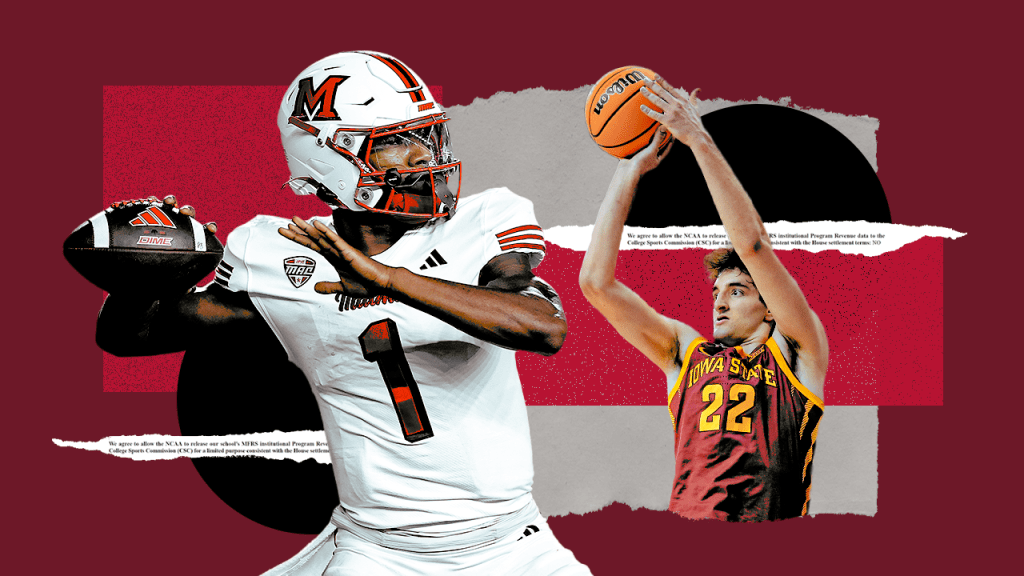
Some FBS schools are instructing the NCAA not to share their annual athletic financial information with the College Sports Commission (CSC), the embattled enforcement entity established in the wake of the House v. NCAA settlement to regulate money paid to players.
By Jan. 15 each year, Division I athletic departments are required to provide their revenue and expense data from the previous fiscal cycle to the NCAA’s membership financial reporting system (MFRS), yielding documents that are typically about 80 pages long. For the latest batch covering the fiscal year 2025, schools are now required to state whether they will allow the NCAA to share revenue data from the report with the CSC.
The seemingly benign question, however, has already revealed itself as a flashpoint and the latest sign of the commission having its authority challenged.
This week, Sportico began requesting copies of the latest MFRS reports from every FBS school subject to public disclosure and, as of Thursday morning, three of the five that responded—Iowa State, Bowling Green and Miami (Ohio)— stipulated that they do not want their data shared with the CSC.
“We agree to allow the NCAA to release our school’s MFRS institutional Program Revenue data to the College Sports Commission (CSC) for a limited purpose consistent with the House settlement terms,” reads the prompt at the top of the report. Schools are then asked to indicate a “yes” or a “no.” Both Oregon and Nebraska consented to sharing their MFRS data with the CSC.
It’s unclear exactly why some schools are choosing to take this route—spokespeople for Miami, Bowling Green and Iowa State athletics did not immediately respond to email inquiries—or why it confers any sort of privacy. All three of those institutions are public, which means the documents can be obtained via open records requests. The decision for private schools, such as Notre Dame or Vanderbilt, may therefore carry a different calculus.
A spokesperson for the CSC did not immediately comment on what schools’ refusals to share MFRS reports might mean for its work. While the move may not ultimately post a practical obstacle for the commission, it, at the very least, reinforces the perception that the CSC lacks buy-in from universities that helped set it up and help finance it, and whose actions it is supposed to referee.
The commission is currently lobbying for schools to sign a new participation agreement, which bars schools and their affiliates from suing the CSC over rules or penalties. The 11-page agreement, which was reportedly haggled over for months by Power Four conferences, met a frosty reception when it was initially distributed in November. Soon thereafter, Texas attorney general Ken Paxton publicly advised schools in his state not to sign the document while a bipartisan group of state AGs sent a letter to the CSC condemning the agreement as “cartoonishly villainous.”
On Wednesday, outside Washington, D.C., where the annual NCAA convention is underway, CSC CEO Bryan Seeley expressed public confidence that a revised version of the agreement could be executed, following a letter of support sent earlier in the week from university presidents at Arizona, Georgia, Virginia Tech and Washington.
The CSC was established last summer by the NCAA’s five largest conferences to help regulate pay-for-play compliance, which has grown dramatically more nuanced in recent years. The commission—via its NIL Go platform, created through a partnership with Deloitte—reviews and approves NIL deals on the basis of their fairness and compliance with NCAA rules and the House settlement. In an announcement earlier this week, the commission reported that it had cleared 17,321 deals worth a total of $127.21 million through the end of 2025. Over that same span, the CSC said it had rejected 524 deals with a paper value of $14.94 million, because of either limited deliverables or compensation that exceeded fair market value.
The House settlement, which took effect July 1, 2025, established a new system by which schools could share revenue with their athletes. Under the settlement’s injunctive relief, schools are allowed to distribute a pool of revenue with athletes that is equal to 22% of the average Power Five conference school’s athletic media, ticket and sponsorship revenue—with an initial cap of about $20.5 million for this season. That cap gets recalculated every three years, which may be one reason why the CSC would want schools’ MFRS data. However, that would not explain the need for institutions such as Miami, which is not a power conference member, to also share its financial data.
An NCAA spokesperson did not respond to a request for comment.
Money for athletes beyond the revenue-sharing cap must be done via NIL deals that filter through the CSC. The group’s presence has drawn controversy through its first seven months in operation, initially for its logjam of pending deals and later for the opacity of its deliberation process. The CSC has the potentially impossible tasks of policing an economy whose rules are being stretched by many of the very institutions that stood it up. Last week the commission sent a note to schools warning them about its “serious concerns” about unregulated NIL deals, either those that are not being reported or those structure outside the rules.