
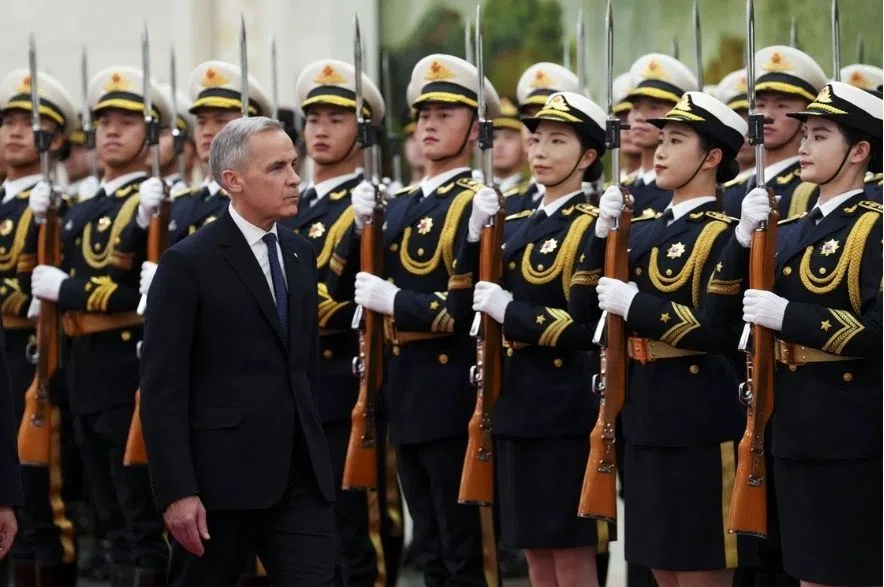
While Ottawa has appeared to be trying to keep expectations low for what might come out of the Prime Minister’s meeting with the Chinese president on Friday, one observer said some progress has already been made.
Vina Nadjibulla is Vice-President of Research & Strategy for the Asia-Pacific Foundation of Canada, a think-tank that provides analysis and policy advice on Canada-Asia relations.
On Thursday, Canada and China announced a number of memorandums of understanding around things like energy and food safety. While it’s not a deal on canola tariffs, which many in Saskatchewan had been watching for, Nadjibulla said it’s a sign of early progress.
“What this trip has really been about is opening up opportunities and setting the political conditions for deeper economic relations in some sectors, resolving issues like tariffs on canola,” explained Nadjibulla.
“At the same time, (they’re) still acknowledging that there are difficult issues and that there will be some issues on which there will be no engagement, like around AI or around defence-related technologies.”
While the MOUs are progress in and of themselves, she said the Canadian and Chinese leaders have already signalled they want to see progress on difficulties between the two countries. That’s why, Nadjibulla explained, there have been preliminary steps like the MOUs and meetings with lower-level officials.
However, she said a complete removal of tariffs would be very difficult given all of the international complexities at play.
China has said it will drop its canola tariffs if Canada drops its electric vehicle tariffs, but Nadjibulla said the whole reason for the canola tariffs is to apply pressure.
“While Canada wants to do everything possible to relieve the pain that farmers and businesses are feeling, we also have to do it in a smart way – first, not to invite further coercion and not to essentially create this as a pattern, and second, to manage other interests within the country,” she explained.
She said Canada has to balance interests between Saskatchewan, with canola and the auto sector in Ontario, as well as pay attention to the U.S. concerns about Chinese electric vehicles.
According to Nadjibulla, timing will be important – considering what happens with the CUSMA renegotiations and what happens with the auto sector there, and what happens with the U.S. and its negotiations for a deal with China.
This isn’t the first time China has reached for Canadian canola tariffs as a pressure tactic, it also came into play between 2019 and 2022. Nadjibulla said the big lesson from that was that Canada needs to reduce trade over-reliance on one country, like China.
“We’re living in a time of weaponized supply chains, we’re living in a time when great powers are using their economic power for political leverage and for their own objectives,” she said.
“So the best way to pursue a strategy that protects Canadian interests is to move up the value chain – so diversify the kinds of things that we sell – and have many more customers.”
It seems unlikely a final sweeping solution will be presented on Friday, but Nadjibulla said there could be some sort of progress or a middle ground found. She pointed to the European Union, which had a sliding scale of lower tariffs, depending on the subsidy the Chinese company gets, and recently announced a minimum price for Chinese EVs in the EU.
“There are other ways to protect the auto sector without having to go to 100 per cent tariffs, and all of that has to be negotiated – what is the correct formula, some percentage of tariffs, plus a minimum pricing, maybe plus some other commitments around investments,” she explained.
Whatever formula is settled on, she said that’s what is currently being negotiated.
After the meetings are over and Carney leaves, Nadjibulla said people will have to pay attention to what happens with the MOUs and working groups and how quickly something tangible comes out of them.
“This trip is not the end of the difficulties, it’s the beginning of a process which will hopefully lead to some additional opportunities in some sectors, like energy, and will lead to a resolution on these difficult issues like tariffs,” she said.
Nadjibulla said, at the end of the day, the Canadian government has to focus on workers and industries in Canada.