
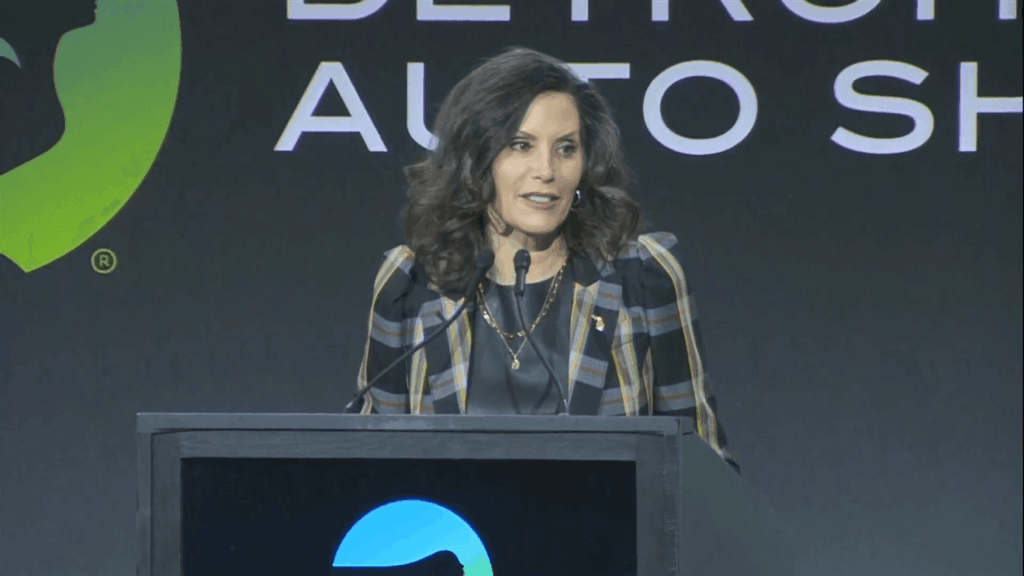
LANSING, Mich. — Michigan’s economy has been in the spotlight all week following President Donald Trump’s visit Tuesday, and now, we’re hearing Gov. Gretchen Whitmer’s assessment.
“Costs are up and uncertainty is everywhere,” Whitmer said in her opening remarks.
Just days after the president hailed what he called the “Trump economic boom,” the Democratic governor painted a different picture, criticizing his tariff policies as damaging and alienating to international partners.
“American manufacturing has contracted for nine straight months, leading to job losses and production cuts,” Whitmer said. “Every industry that relies on a skilled, hands-on workforce is facing shortages, which will only get worse without a serious shift in national policy. We need a change.”
Despite that dire view, Whitmer did point to some successes, such as investments by big automakers.
“2025 tested us, but we still are we who we are,” Whitmer said. “#1 for auto manufacturing, R&D, and workforce, #1 for battery and EV investment, #4 for regional workforce development, top 10 for clean energy jobs and top 10 for doing business for the third year in a row.”
Dr. Chris Douglas, a professor of economics at University of Michigan Flint, agrees that tariffs are hurting the economy, and while he sees some bright spots, he also feels it’s a mixed bag.
“A lot of it has to do with difficulties in the auto industry, not just due to tariffs, but due to post pandemic challenges in general,” Douglas said. “Because if you look at the price of a new vehicle post pandemic, it shot way up by about 25%. And it hasn’t come back down yet.”
Whitmer says innovation should be Michigan’s future, especially research and development in the auto industry.
That’s why she announced an economic transition strategy, to better position Michigan to adapt to a changing economy.
Douglas, though, feels government can only do so much.
“It’s impossible for one governor or a state legislature to wave a magic wand and diversify the economy,” Douglas said. “The Michigan economy is dependent on who wants to come in and do business in Michigan, and largely that’s the auto industry and suppliers, simply because of the history of the auto-industry in Michigan.”
Douglas said it’s hard to see the Michigan economy moving away from the auto industry anytime soon.
Otherwise, Whitmer will need the legislature to achieve some of her goals, and she urged lawmakers to help.
House Speaker Rep. Matt Hall (R-Richland Township) says he likes what he heard from Whitmer on deregulation, and that he’s open to working with her.
Still, he supports tariffs, and also wants less incentives for corporations.
“A lot of those are drying up and were failures that came at the cost of other important public services like roads, education, and public safety,” Hall said. “You know, the small businesses were where most people are employed these days. So if we can grow the small businesses, some of those will spiral off and become big businesses. I think that’s a better way to do it.”
Whitmer took some action ahead of her speech, signing an executive order to explore natural hydrogen as a new source of green energy.
The governor says Michigan could be a leader in that sector because of potential reserves underground.