

Listen to this article
Estimated 5 minutes
The audio version of this article is generated by AI-based technology. Mispronunciations can occur. We are working with our partners to continually review and improve the results.
Top diplomats from Denmark and Greenland are earning praise for their approach in dealing with U.S. President Donald Trump’s repeated threats to take over the Arctic island.
While Trump ramped up his rhetoric this week, calling anything less than U.S. control of Greenland “unacceptable,” the foreign ministers of Denmark and Greenland laid out their case in Washington calmly and rationally, while firmly demonstrating that the president’s territorial ambitions are a no-go.
“We came here following a number of — how should I put it — remarkable public comments on Greenland and Arctic security,” said Danish Foreign Minister Lars Løkke Rasmussen at a news conference on Wednesday, choosing his adjective carefully.
“It’s clear that the president has this wish of conquering … Greenland.” Rasmussen said. “We have a different position.”
Denmark, a NATO country, and Greenland, its semi-autonomous Arctic territory, are the latest to face the challenge of navigating the potentially treacherous path of diplomacy with the at-times undiplomatic and unpredictable Trump administration.
Liana Fix, a senior fellow for Europe at the Council on Foreign Relations, a Washington think-tank, says there are two schools of thought on dealing with Trump: one that you must show strength to get him to back down, the other that you must eventually make concessions because of the extent of U.S. power.

As U.S. President Donald Trump continues to speak about wanting to take over Greenland — even potentially with force — Denmark and some of its European allies have deployed a small number of troops to the semi-autonomous island. The move comes after a high-stakes diplomatic meeting in Washington between top Danish and Greenlandic diplomats and Trump’s emissaries.
When it comes to the Greenland threats, Fix says Denmark and its European allies are using a double-edged strategy that incorporates both.
“On the one side, they’re trying to lower the temperature with these conversations, but on the other side, they’re also trying to deter the United States,” she said in an interview.
Small number of troops, huge significance
The deterrence comes in the form of several NATO countries sending military staff to Greenland.
The numbers are small — 15 French soldiers, 13 Germans, two Norwegians and an officer each from the U.K. and the Netherlands — but their strategic significance is huge.
Fix says the move makes clear that the Europeans are serious about showing that Greenland is a territory that belongs to a NATO member that the Trump administration cannot take over.
Meanwhile, the conversation part of the two-pronged strategy included Rasmussen and his Greenlandic counterpart Vivian Motzfeldt meeting with U.S. Vice-President JD Vance and Secretary of State Marco Rubio in Washington.
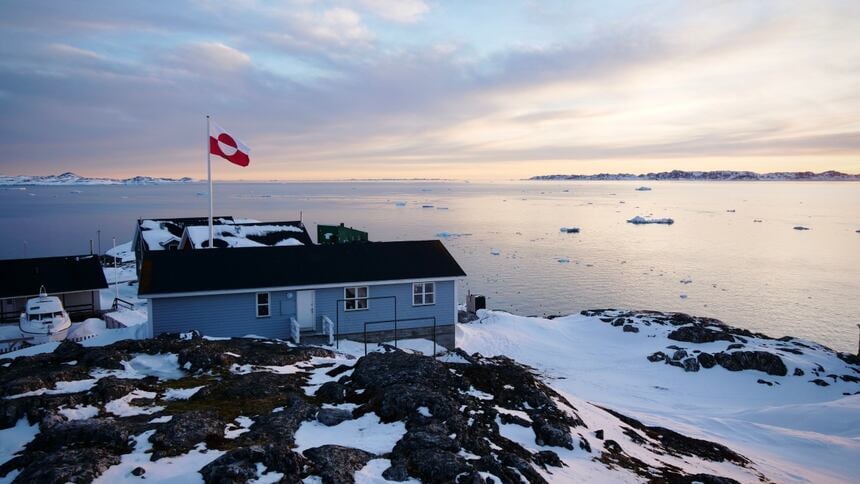
A Greenlandic flag flies above a building overlooking the Davis Strait in Nuuk, Greenland. (Matisse Harvey/Radio-Canada)
Rasmussen and Motzfeldt then held a news conference where they made it clear that U.S. control of Greenland is a “red line” that must not be crossed, meticulously poking holes in Trump’s arguments that it’s a national security necessity.
They pointed out that an agreement in place since the early days of the Cold War still allows the U.S. to station troops in Greenland. They offered to work with the U.S. to address Arctic security by strengthening the Danish and NATO military presence on the island.
And they walked away from the meeting with a U.S. promise to establish a high-level working group in the coming weeks to discuss common concerns.
‘Well-orchestrated diplomacy’
Rachel Ellehuus, director general of the Royal United Services Institute, an international affairs think-tank in London, says this week’s Danish-Greenlandic diplomatic effort could have ended badly without the right tactics.
“Denmark and Greenland’s relative success in Washington was not easily achieved,” Ellehuus wrote in a commentary on the institute’s website.
“Behind it lies months of careful, well-orchestrated diplomacy that validates the value of statecraft and offers important lessons on how to deal with the current U.S. administration and its single-minded president,” she said.
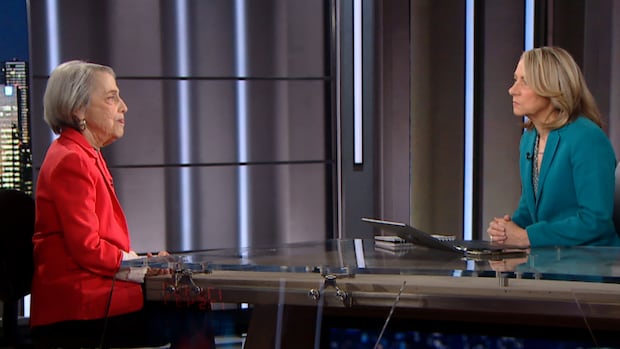
For The National, CBC chief correspondent Adrienne Arsenault asks Munk School of Global Affairs founding director Janice Stein how Canada should be watching the situation in Greenland as the U.S. angles to take control of semi-autonomous territory of Denmark.
Garrett Martin, a professor at American University’s School of International Service in Washington, says that by avoiding further ratcheting up of tensions, Denmark and Greenland scored something of a win this week and may have bought themselves some time.
“The key really is strategic patience,” said Martin in an interview. “I think that’s their best bet, to play the clock, put forward a positive case.”
He says Denmark and Greenland have been effective at mustering support in Congress and among the U.S. public.
Polling suggests only a tiny fraction of Americans would support taking Greenland by force, while acquiring the island through non-military means gets only lukewarm support.
Amid Trump’s threats, a bipartisan group in the House put forward a bill this week that would prevent military action against a NATO member without Congressional approval, while Republican and Democrat senators co-sponsored a bill that would explicitly outlaw any use of military resources to take control of a NATO member’s territory.
Martin says the fact that there appears to be no daylight between Greenland and the Danish on the issue of American control of the island helps their cause.
“It’s been very important to send a message of unity to the outside world, for that not to be exploited by Trump or others,” he said.