
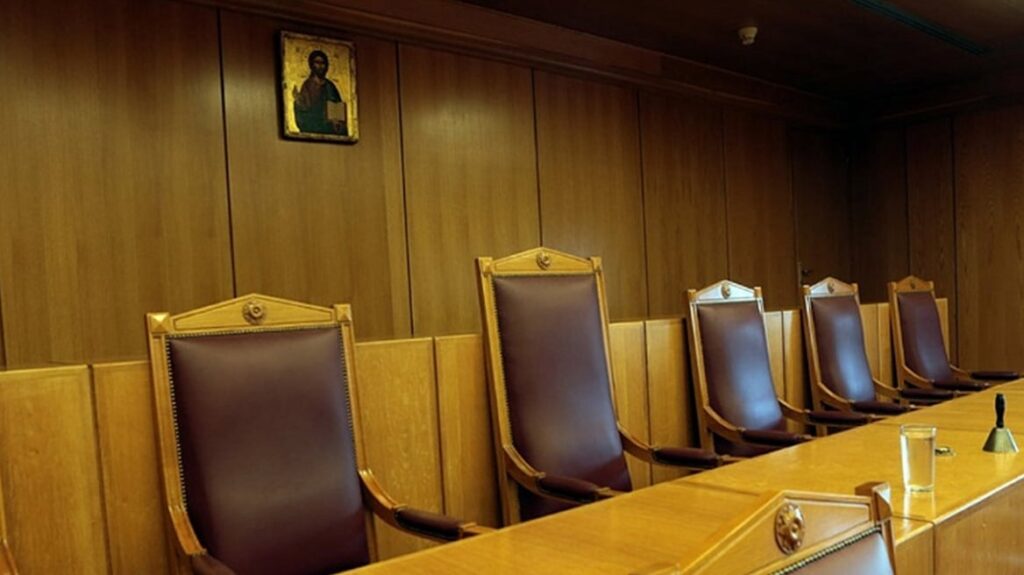
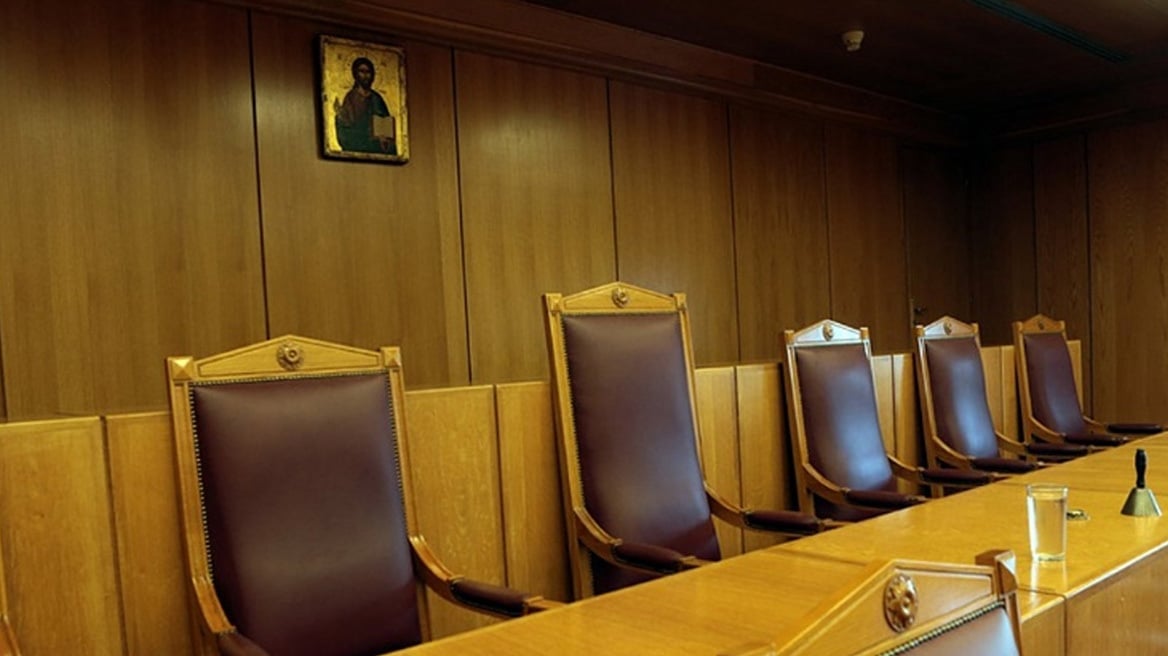
A Christian icon at a Greek court. Credit: AMNA
The European Court of Human Rights (ECHR) is preparing to issue a landmark ruling in the case of Union of Atheists v. Greece. The decision will determine whether Christian icons must be removed from Greek courtrooms, a move that would fundamentally alter the visual landscape of the Greek justice system.
Applicants argue that a courtroom should be a sanctuary of secular law. They contend that judging a citizen beneath a religious icon suggests that the court is not neutral, potentially violating Article 6 (Right to a Fair Trial) of the European Convention.
Proponents of the ban argue that for religious minorities or atheists, these symbols create a psychological sense of being “outsiders” before the law.
Greece defends icons in the court
The Greek state and third-party intervenors like ADF International argue that icons are “passive symbols.” They contend that an image on a wall does not “impose” beliefs or interfere with a judge’s logic.
They emphasize that the Orthodox Church is inextricably linked to Greek history. Removing the icons, they argue, would be a hostile act of “secular cleansing” rather than a move toward true pluralism.
The Italian case on icons in schools
The ECHR is considering the Greek case in light of its 2011 ruling in Lautsi v. Italy. In that instance, the court originally ordered the removal of crucifixes from Italian classrooms but reversed its decision after a massive appeal.
In the Italian case, the Grand Chamber ruled that the crucifix was a “passive symbol” that did not amount to indoctrination.
The court granted Italy a “margin of appreciation,” acknowledging that European states have the right to respect their own cultural and religious traditions in the public square.
However, the Greek case is more complex because it involves courtrooms rather than schools. Legal experts suggest that while a child in a classroom has their parents to counter “passive” symbols, a defendant in a courtroom is under the direct, coercive power of the state, making the requirement for visible neutrality much higher.
The ECHR has completed the review of third-party interventions and is currently in the deliberation phase. While a specific “calendar date” for the public delivery of the judgment has not yet been posted on the court’s official HUDOC portal, it is expected to be released in the first half of 2026.
The decision is being watched closely not just in Athens and Rome, but also in countries like Poland, Spain, and Romania, where the presence of religious imagery in government offices remains a point of cultural friction.