
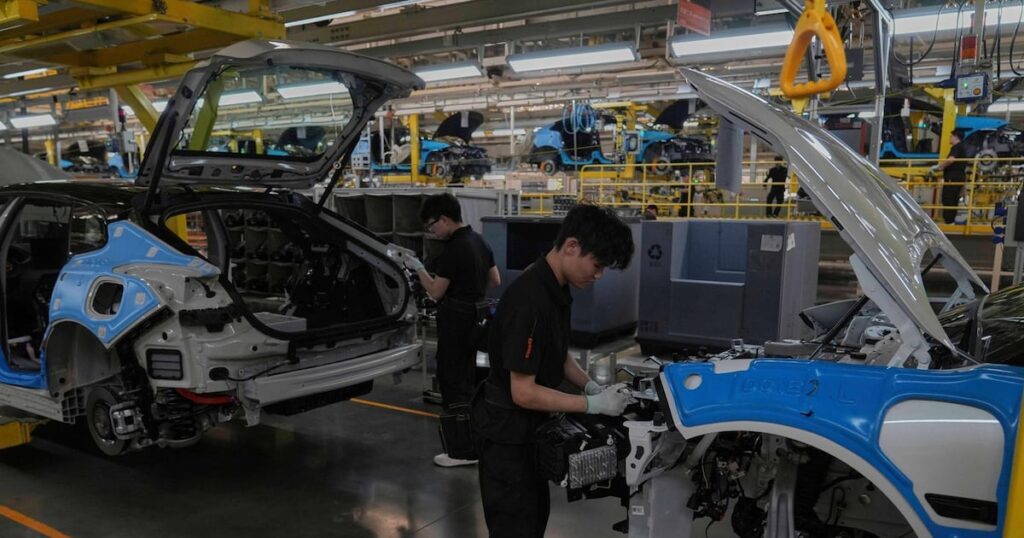
In almost every deal, there are winners and losers — and the Canada-China deal on electric vehicles appears to be no different.
While Canadian automakers are sounding the alarm — or honking the horn, in this case — that the deal could threaten Canadian auto jobs and the domestic EV supply chain, some Canadian car dealership owners believe it is a win for consumers, who could get good quality electric vehicles for an affordable price.
While Canadian automakers are sounding the alarm, or honking the horn in this case, that this is a deal that will threaten Canadian auto jobs and its own EV supply chain — some Canadian car dealership owners believe this is a big win for consumers who can now get good quality electric vehicles for an affordable price.
“I think having more options will bring the price down in the general market,” said Nazar Novolskyy, co-owner of Favorit Motors, a used-vehicle dealership in Toronto.
“I think there’s (going to) be a huge shift, but I think the consumer will win either way — whether the customer is looking specifically for a Chinese car or willing to explore that option, I think other manufacturers will be forced to react and drop their prices — and anytime anything is becoming cheaper and better for the consumer, the consumer is winning.”
Novolskyy says he has been exploring car shows around the world and has seen more and more Chinese electric vehicles enter the market, keeping up with technological advancement and challenging their historical reputation for lower quality and safety standards.
“This year, unlike any other year, there was a massive presence of Chinese cars so I already forecasted that they’re coming to North America,” Novolskyy said.
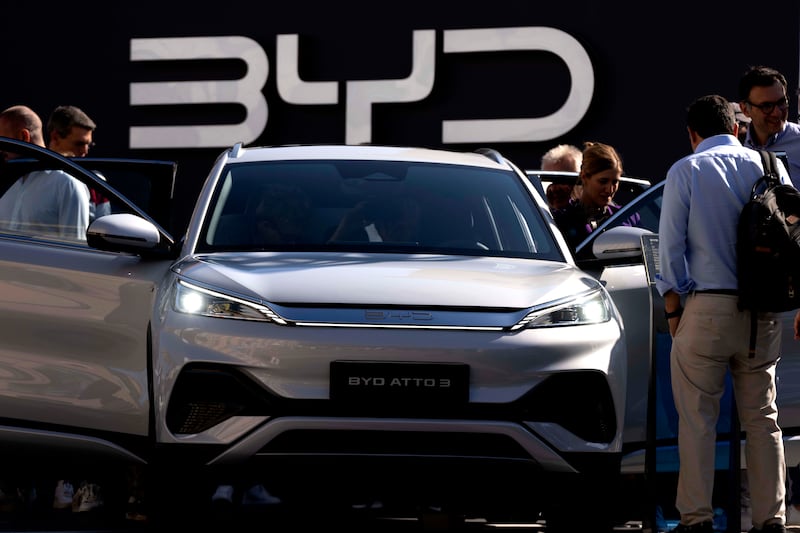 EV cars FILE – Visitors look at the Chinese made BYD ATTO 3 at the IAA motor show in Munich, Germany, on Sept. 8, 2023. (Matthias Schrader/AP)
“That was my first opportunity to experience that car firsthand, because most people know what we know historically: that Chinese products are cheap, that the quality wasn’t there, that the technology wasn’t there — now with my real experience, I got to touch and feel, I was absolutely blown away.”
Hamza Patel, manager of Planet Motors, a used-vehicle dealership in Toronto, agrees.
“Consumers will now have the option to choose between established brands and newer entrants such as BYD and Xiaomi, which are offering luxury-styled vehicles with advanced technology at a fraction of the cost of vehicles like a new Tesla Model Y,” he said.
“Brands like BYD, in particular, are already offering competitive range, more features, and newer technology compared to what is currently available in the Canadian market at similar or higher price points.”
Patel added that prospective EV buyers may begin to question the value of purchasing older used EVs when brand-new alternatives from China, with newer technology, longer range and more features, are available at similar or lower prices.
“From a broader perspective, increased affordability will also make it easier for governments to meet EV adoption mandates more quickly, as cost, one of the biggest barriers to EV ownership, will no longer be as significant a concern for consumers,” he said.
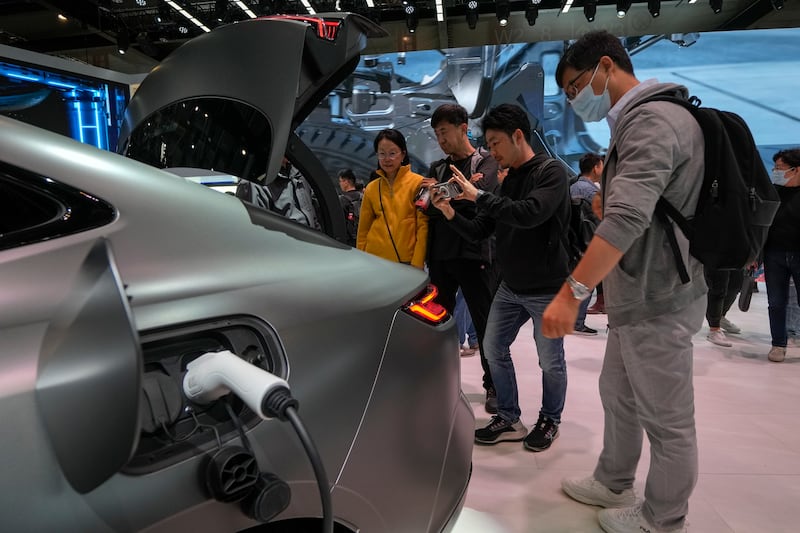 EV FILE – Visitors look at a Geely Galaxy E8 EV car model during the Auto China 2024 in Beijing on April 28, 2024. (Andy Wong/AP)
Canada previously set a legally binding zero-emission vehicle sales target for manufacturers, but the 20 per cent target for 2026 was delayed in response to slowing sales and industry pressure.
“Overall, I think it’s a positive,” said Devin Arthur, with EV Society, a Canadian non-profit organization of EV owners and enthusiasts, in a Zoom interview with CTV News.
“So having more choice in the market is obviously more beneficial,” he said. “It leads to better competition. Those prices will come down — and that makes vehicles more affordable for everyone in Canada.”
New details on Chinese EV imports
A senior government source told CTV News on Saturday that a new auto strategy, set to be released next month, will prioritize made-in-Canada vehicles and give companies that build vehicles domestically preferential market access.
The source said that in the first year — when 49,000 Chinese electric vehicles will be allowed to enter Canada at a reduced tariff rate of 6.1 per cent starting March 1 — the imports will likely not include EVs from Chinese manufacturers, as they are not certified by Transport Canada. Instead, the vehicles are expected to be manufactured by North American or Asian automakers with factories in China.
But the source said that will eventually grow, with the expectation that Chinese companies could eventually partner with Canadian automakers to build electric vehicles in Canada, using Canadian workers and for Canadian sales and export.
But some auto manufacturers question whether the deal will benefit Canadians.
“I think it’s highly unlikely to happen,” said Brian Kingston with the Canadian Vehicle Manufacturers’ Association in a Zoom interview with CTV News.
“I think it’s highly unlikely to happen,” said Brian Kingston with the Canadian Vehicle Manufacturers’ Association, in a Zoom interview with CTV News.
“(Chinese auto manufacturers) … achieve a price advantage because they’re building those vehicles in China with low or non-existent labour standards and extremely weak environmental standards. That business model doesn’t work in Canada,” he said.
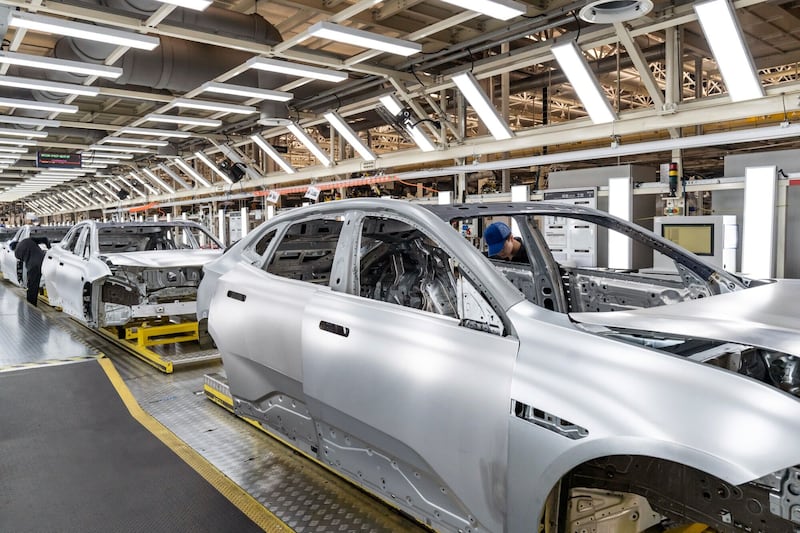 Operations inside Zeekr Intelligent Factory The production line at the Zeekr factory in Ningbo. Photographer: Qilai Shen/Bloomberg (Qilai Shen/Bloomberg)
“If you look at General Motors and Stellantis, they have unionized workforces. They pay about $44 an hour plus pension in benefits. A Chinese manufacturer pays on average about $4 an hour.”
Kingston added that Chinese manufacturers would provide less economic spinoff, as Canadian auto plants employ local workers who support businesses in surrounding communities.
Arthur, however, said Canada cannot depend on the United States to meet its EV manufacturing goals, citing uncertainty around the current U.S. administration.
“We’re already losing those manufacturing jobs,” Arthur said. “So I think it’s probably in our best interest as Canadians as a whole, to diversify, to find other options, to find other potential candidates that would come here and build out that manufacturing sector.”