
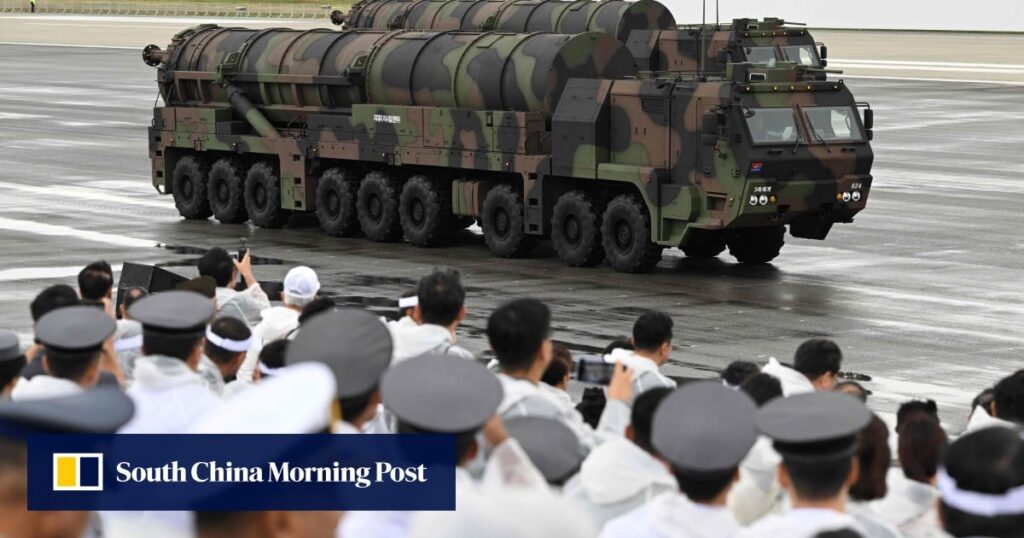
The ground-to-ground missile, capable of carrying a warhead of up to eight tonnes, began entering frontline units late last year and is expected to complete full operational deployment before the current administration leaves office in 2030, according to military officials. It is considered South Korea’s most powerful weapon to date.
Despite the missile’s power, analysts caution against overstating its ability to neutralise North Korea’s most hardened underground sites.
Lee Il-woo, director of the Korea Defence Network, said the Hyunmoo-5 represents the most strategically significant missile ever deployed in South Korea’s Hyunmoo series, but faces physical limitations.
“The Hyunmoo-5 carries an extremely high-yield conventional warhead, and by reducing payload it could theoretically extend its range to around 3,000km (1,864 miles), with some even comparing it to an intercontinental-class missile,” Lee said. “In terms of sheer power and strategic signalling, it is the strongest missile South Korea has fielded.”
From North Korea’s perspective, Lee said the missile poses a serious threat, particularly because Pyongyang’s missile interception capabilities remain limited. “The likelihood of North Korea successfully intercepting the Hyunmoo-5 appears very low,” he said, citing the mixed real-world performance of Russian-made S-300 and S-400 air defence systems, which are similar to those operated by North Korea.