
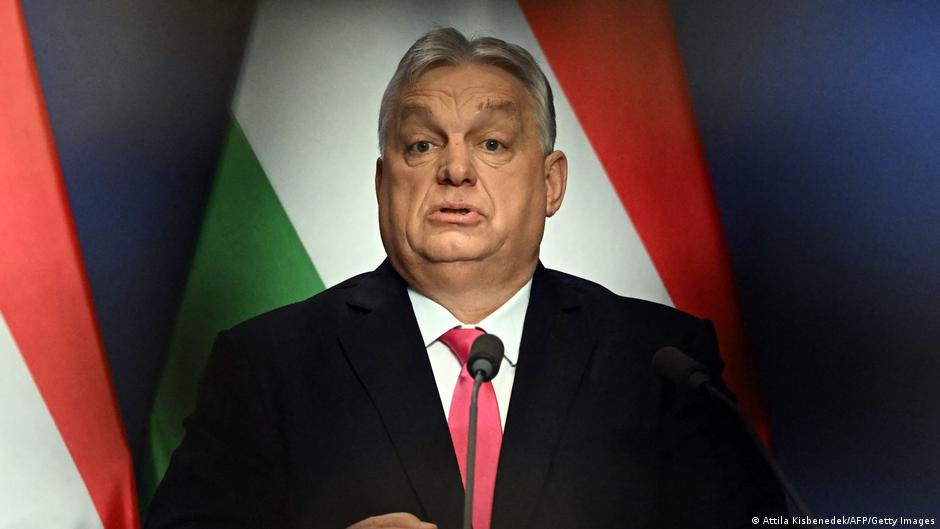
No country in the European Union has stricter immigration laws than Hungary. Nowhere in the bloc is it more difficult to attain refugee or protection status: EU statistics show exactly 10 people received either in 2025. Hungarian Prime Minister Viktor Orban is proud to claim that there are “zero” refugees, or as he generally refers to them, “illegal migrants,” in his country. That was how he framed his immigration policies and their impact during a November 2025 White House meeting with US President Donald Trump.
Still, in certain individual cases, Orban is quick to grant asylum, namely when it comes to high-ranking political friends. The Hungarian government has at times been accused of changing laws to accommodate their actions.
That is what is happening now in a case involving Poland, an EU ally and a country with which Hungary has maintained a deep historical friendship. Hungary has granted Zbigniew Ziobro, Poland’s former justice minister, political asylum. Ziobro, in a post on X earlier this week, said he had, “decided to take advantage of the asylum granted to me by the Hungarian government due to political repression in Poland.”
Hungary justified the move by claiming Ziobro was the victim of political persecution, adding that he had no chance of receiving a fair trial in his home country due to the grave problems Poland allegedly has when it comes to the rule of law.
While serving as Polish justice minister, Zbigniew Ziobro pushed for controversial judicial reforms based on a Hungarian templateImage: Art Service/PAP/picture alliance
Flight to Hungary to avoid arrest in Poland
While in government, Ziobro was responsible for pushing a controversial reform of Poland’s judiciary — a plan with which the rightwing-conservative Law and Justice (PiS) party, which was voted out of power in autumn 2023, sought to restructure the country’s justice system after a template provided by Orban.
Polish investigators have put Ziobro under suspicion of numerous crimes, including abuse of office, creating a criminal organization and embezzlement. In late 2025, Ziobro fled to Hungary to avoid arrest.
On December 12 last year, at the same time Ziobro was granted asylum, the Orban government changed a law regulating law enforcement cooperation with other EU member states. That amendment meant Hungary would no longer carry out European arrest warrants against persons to whom it has granted asylum.
Hungary drifting away from the EU
The case illustrates how far Hungary has veered from EU norms. Observers in both Hungary and Poland have voiced skepticism about whether Hungary’s legal tweaks conform to EU law, though an EU court will ultimately have to decide the matter.
But Hungary, under Orban’s leadership, has made little effort to uphold EU law or international treaties when these run counter to the prime minister’s interests. Orban and his inner circle stopped providing justifications for their actions, pivoting instead to the narrative that in Hungary alone do people enjoy rule of law and true freedom of expression.
Orban personally welcomed Ziobro during an October 2025 visit, taking to Facebook to report that the “pro-Brussels” government in Warsaw had, in his words, “launched a political witch hunt” against the Polish right. “The Polish government wants to arrest Ziobro,” he wrote. “All this is happening in the heart of Europe. Brussels remains silent. What a state of affairs!”
Not the first political refugee Orban has taken in
Ziobro’s case is the weightiest so far, but it is far from the first. In December 2024, Hungary granted asylum to Marcin Romanowski, a former Polish deputy justice minister charged, among other things, with corruption. Here, too, the Hungarian government changed its laws to avoid having to enforce a European arrest warrant, with part of the rewrite including a passage allowing attorneys general to veto arrest and extradition orders.
Back in 2018, Nikola Gruevski, the convicted ex-prime minister of Macedonia, fled to Hungary’s embassy in the Albanian capital, Tirana, from where Hungarian diplomats coordinated an escape through Montenegro and Serbia before delivering him to Hungary, where he was granted asylum. Macedonia declined to take legal action against the Orban government at the time, for fear Hungary would block its EU accession bid.
In March 2024, Brazil’s former president, Jair Bolsonaro, later convicted of planning a coup in his home country, hid in Hungary’s Brasilia embassy for two nights. For some time there have also been rumors that Milorad Dodik, the deposed president of the Republika Srpska or Serb Republic, a part of Bosnia and Herzegovina, could flee to Hungary. In February 2025, Hungary’s TEK anti-terror unit conducted training exercises in the area — possibly in anticipation of an extraction operation to get Dodik out of the country.
Rumors abound that the deposed president of Republika Srpska, Milorad Dodik, could soon be given asylumImage: Radivoje Pavicic/AP Photo/picture alliance
Shaking up the EU from the right
For years, Orban has been pushing to make an alliance of rightwing populists and rightwing extremists part of the EU mainstream. It is important that the Hungarian prime minister show allies they can count on him. However, the strategy of turning Hungary into a safe haven for politicians like Ziobro carries risks.
Hungary is holding parliamentary elections in April, when the opposition is campaigning largely on the alleged corruption in Orban’s political system, in the hope that undecided voters may be turned off by Orban granting asylum to politicians like Ziobro and convicted criminals such as Gruevsky.
Will Poland boot out Hungary’s ambassador?
By taking in Ziobro, many believe Orban has damaged Hungary’s already strained relations with Poland, the largest nation in the eastern EU. Poland’s Prime Minister Donald Tusk offered a sarcastic take on the situation on X: “Ziobro, who was the mastermind of the political corruption system, has asked the government of Viktor Orban for political asylum. A logical choice.”
“The asylum case could worsen Hungarian-Polish relations, which are already at a low point,” wrote the independent Hungarian news portal Telex.
In response to the Romanowski case, Poland temporarily recalled its ambassador to Budapest in December 2024, then permanently in July 2025. Poland has also been ignoring the Hungarian ambassador in Warsaw, pointedly refusing to invite Istvan Iigyarto to state gatherings, citing among other things, Polish opposition to Orban’s pro-Russian politics.
The Ziobro case could well see the Hungarian ambassador expelled. That would set a serious precedent — no EU nation has ever expelled the diplomatic representative of another EU member state.
This article was translated from German.