

As the fight against climate change becomes a global priority, the aviation sector must rethink itself to shrink its environmental footprint. With the rise of sustainable fuels, energy-efficient aircraft, and electric propulsion systems, the aerospace industry is firmly steering toward decarbonization. Among the most promising initiatives is the Gen-ee project by Eenuee, a startup from Saint-Étienne aiming to reinvent regional air mobility—tackling accessibility issues while minimizing environmental impact.
In a world facing escalating climate pressure, aviation is evolving to cut CO₂ emissions and operate more sustainably. Industry players are accelerating their shift toward innovative, cleaner technologies.
The use of sustainable aviation fuels (SAF) marks a key step, reducing greenhouse gas emissions while leveraging existing airport infrastructure.
At the same time, aircraft manufacturers are developing planes that consume less energy, introducing advanced systems that improve operational efficiency—optimizing flight paths to shorten distances and time, refining air traffic management, and even adjusting flight trajectories to reduce contrails, whose warming effect rivals that of carbon dioxide.
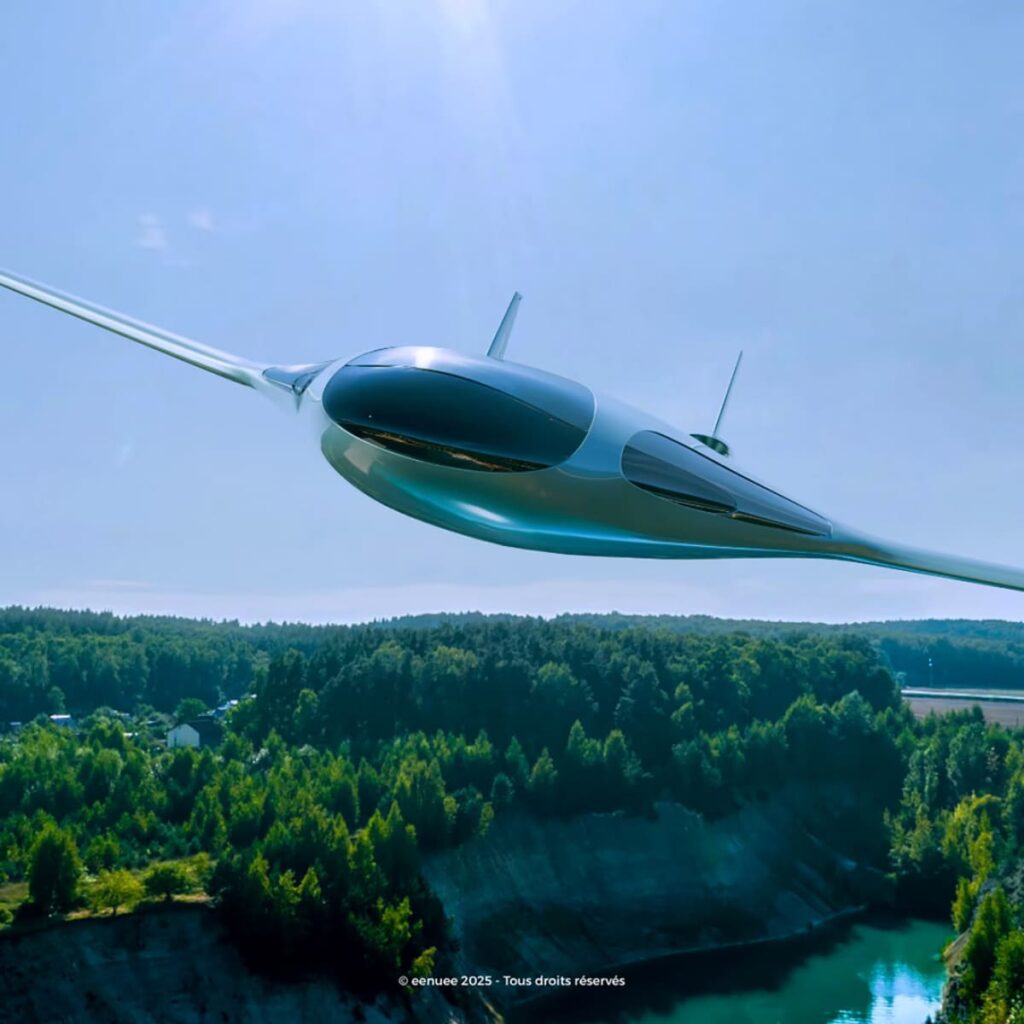
Eenuee is developing a 100% electric aircraft with a range of 500 kilometers, capable of carrying up to 19 passengers, while consuming 11 times less energy than a conventional aircraft. © eenuee 2025
Promising innovations: hydrogen and electrification
On the horizon, new technologies such as hydrogen propulsion and full electrification promise to transform air travel—making flights more efficient, quieter, and in line with global sustainability goals. This move toward zero-carbon aviation is essential for tackling environmental challenges and ensuring a livable future for the next generations.
The call for decarbonized air mobility
Despite major advances in rail and public transport, the demand for low-emission air travel remains strong—especially for remote or hard-to-reach regions. The need is clear: light, accessible, and eco-friendly transport that doesn’t require massive infrastructure investments. Fully electric aircraft could fill that gap.
The Gen-ee project by Eenuee
That’s exactly the ambition of the Gen-ee, a 100% electric regional aircraft by the Rhône-Alpes startup Eenuee. Founded in 2019, the company aims to electrify short-haul aviation with a certified, efficient, and low-noise solution. Recently, Eenuee announced a strategic partnership with Duqueine Group, a leader in composite materials, to accelerate development. The first flight is expected in 2029.
The goal: build a 19-seat electric plane with a 500 km range—ideal for routes that are currently unprofitable for airlines. It won’t require new heavy infrastructure and will offer exceptional efficiency, helping connect regions like Auvergne-Rhône-Alpes, where mountainous terrain makes transport a challenge.
Technological innovations
The all-electric design isn’t the only innovation on board. Eenuee and Duqueine are introducing a breakthrough with a lifting-body fuselage. Unlike the classic tubular design, this architecture improves aerodynamic performance and efficiency.
Even better, the Gen-ee won’t be limited to standard runways. Eenuee is also developing a version that can take off and land on water using hydrofoils—underwater wings that generate lift and sharply reduce drag at high speeds. The concept, reminiscent of high-speed racing boats, allows smoother takeoff from water surfaces.
A broader market for a multisurface aircraft
This hybrid design opens doors to a variety of markets, offering a multisurface aircraft that needs no modification—ideal for regions like Asia, Scandinavia, or Canada.
Unlike traditional floatplanes, which operate only on water and require costly maintenance, Eenuee’s aircraft stands out for its versatility and lower operating costs.
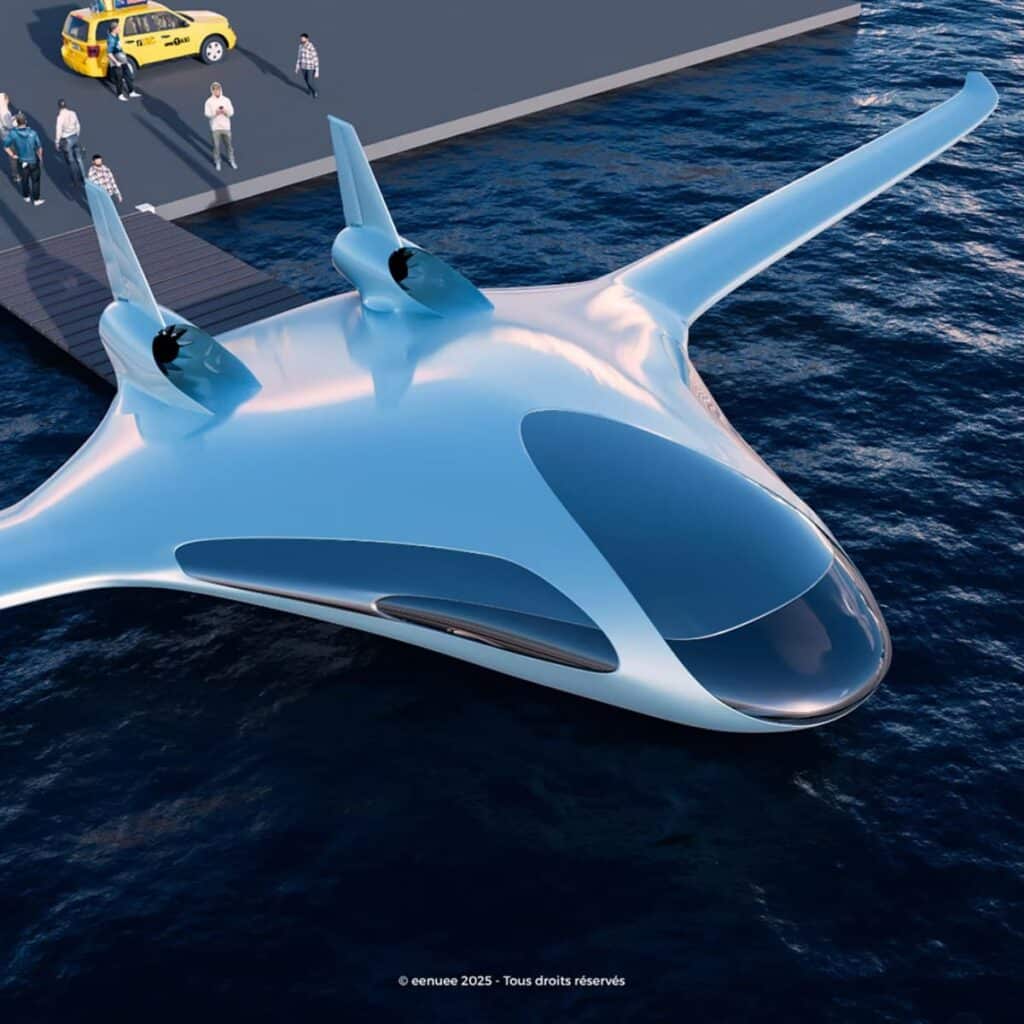
Eenuee’s electric plane will also be able to land and take off from a lake or river. © Eenuee 2025
Interview with Hugo Aveddo, R&D Engineer, and Gaspar Loury, Aeronautical Prototype Engineer
Futura: What are the main design and performance differences between a lifting-body fuselage and a conventional tubular one? What challenges have you faced?
Hugo Aveddo and Gaspar Loury: In a lifting-body aircraft, the fuselage itself acts like a wing. The transition between fuselage and wings is minimal. There’s usually no horizontal stabilizer—only elevons, like on certain military jets. That makes control more complex and requires careful optimization. The fuselage’s unique shape also lets us rethink the cabin layout and how components are integrated. It’s structurally very different from standard fuselages, even if the design principles are similar.
Futura: How does the aircraft achieve energy efficiency 11 times higher than conventional planes?
Hugo Aveddo and Gaspar Loury: Three things: aerodynamic efficiency, propulsion chain efficiency, and total mass.
The Blended Wing Body (BWB) design with a lifting fuselage drastically cuts drag. Its lift-to-drag ratio reaches 25—far better than most regional aircraft.
The fully electric propulsion system achieves up to 90% energy efficiency, with almost no loss compared to combustion engines. Lightweight composite materials, high-performance aluminum, and a non-pressurized design (about 40% lighter, with easier maintenance) keep takeoff weight at just 5.6 tons, well below the CS-23 limit of 8.6 tons.
Futura: What materials will be used for the fuselage and other components?
Hugo Aveddo and Gaspar Loury: Mostly carbon fiber composites. Every extra kilogram adds to lifetime CO₂ emissions. Using composites reduces weight and environmental impact. A lighter plane uses less energy and can fly farther—simple as that.
Futura: What steps are involved in the certification process?
Hugo Aveddo and Gaspar Loury: Risk analysis, simulations, extensive testing, and collaboration with European certification agencies under CS-23. We’re currently testing scaled models—1:7 now, 1:4 next. These trials help pinpoint technical challenges and improvements early, before industrialization begins.
Futura: What infrastructure will be needed for operation and maintenance?
Hugo Aveddo and Gaspar Loury: Just passenger facilities and basic safety amenities—nothing major. Maintenance centers, yes, but no heavy infrastructure. Our aircraft can already operate from standard airfields. Charging solutions will be similar to those used for electric vehicles. Broader charging deployment, for airport utility fleets as well, will involve multiple partners beyond Eenuee.
Futura: What milestones do you plan to reach before the first flight in 2029?
Hugo Aveddo and Gaspar Loury: Demonstrating the hydrofoil system (in progress), building the 1:4-scale demonstrator, then developing the first full prototype. Certification and DOA procedures will begin in 2027 to align with regulators early.
Futura: Do you plan to create other electric aircraft models?
Hugo Aveddo and Gaspar Loury: Absolutely. The lifting-body design’s efficiency benefits can scale to different markets—civil, humanitarian, cargo, even defense applications.
Futura: Why do you believe this project will actually take off when so many electric aircraft concepts never do?
Hugo Aveddo and Gaspar Loury: Because it’s ambitious but realistic. Regional and institutional support is key. Our philosophy is to continuously de-risk development while keeping costs low. We’ll gradually expand our team as the project evolves, scaling up production capacity over time.

Rémy Decourt
Journalist
Born shortly after Neil Armstrong’s first steps on the Moon in 1969, my journey into space exploration has been entirely self-taught. A military stay in Mururoa sparked my formal education in space sciences, and early sky-watching experiences in an astronomy club ignited my passion. I founded flashespace.com, transitioning from sky observation to a deep interest in space missions, satellites, and human and robotic exploration. Since 2010, I’ve been part of Futura’s editorial team, covering space news and working as a freelance writer with extensive international field experience in space-related sites.