
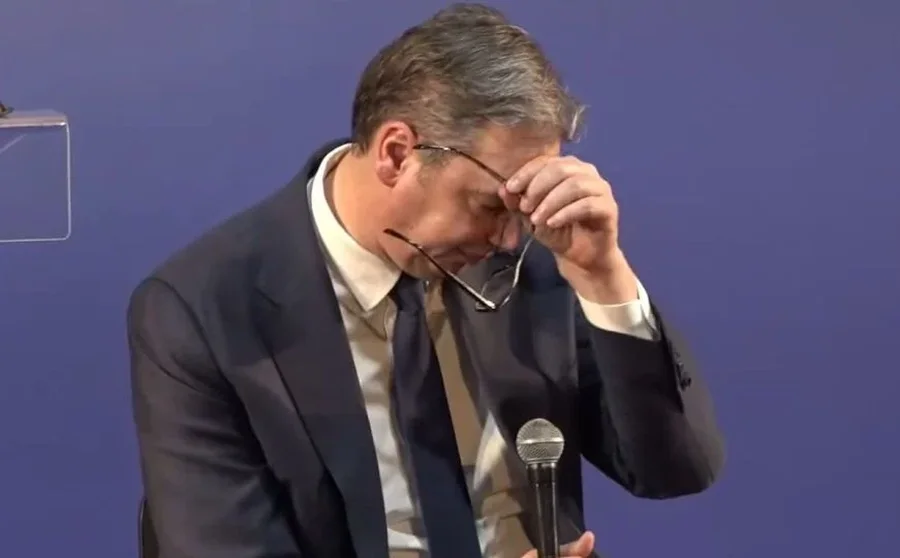
Following an extraordinary meeting of Serbia’s National Security Council held on January 4, 2026, Serbian President Aleksandar Vučić claimed that the Kosovo Security Force is being armed in violation of international law and that the Croatia–Albania–Kosovo alliance, according to him, directly undermines Serbia’s interests and security. Vučić described the situation as a threat to his country, stressing that Serbia is already preparing to defend itself.
These statements have only reinforced what security analysts and experts on disinformation describe as Serbian propaganda. Researcher Gurakuç Kuçi from the “Octopus” institute told KosovaPress that the Serbian president’s complaints are part of a psycho-propaganda strategy.
Although, according to Kuçi, Vučić knows that Kosovo is strengthening its military within the framework of NATO, he presents this as a threat to Serbia. Kuçi emphasized that Kosovo’s institutions must be prepared to confront this type of strategic communication from Serbia. As an immediate need for intervention, he pointed to social networks and the media, where public opinion is being manipulated.
“Aleksandar Vučić is among those people who, together with Serbian propaganda, leave no means unused against Kosovo. He knows very well that Kosovo is strengthening its military within the NATO framework, and there have been statements from NATO and the United States themselves that Kosovo’s armament is being carried out in accordance with the rules and up to 2028, which is when the transformation into an operational army is planned. Nevertheless, they use this issue, together with other recent developments, as a kind of strategy—a psycho-strategic operation carried out by Vučić,” Kuçi said.
Kuçi reiterated that Kosovo’s institutions must be ready to face this type of strategic communication from Serbia. As an immediate area for intervention, he again highlighted social media and the media landscape, where, according to him, the public is being manipulated.
“Security bodies in Kosovo, together with all other institutions, must have a strategy that takes into account how Serbia’s STRATCOM, or strategic communication, functions. Based on that, a counter-strategy should be created, which—together with civil society, the media, and other stakeholders with an interest in Kosovo—would keep the public protected from this kind of propaganda and from this form of hybrid warfare that is taking place. Perhaps the most immediate need for intervention concerns social networks and the media, where many unidentified or ownerless media outlets, as well as various social networks, are manipulating the public. We have observed extremely high levels of shares, likes, and comments that are dividing the public and advancing Serbia’s interests against Kosovo,” he added.
Researcher at Hibrid Info, Festim Rizanaj, assessed that Vučić’s statements have contributed to the spread of dangerous narratives that create panic among the Serbian community in Kosovo. He advised citizens to verify such narratives and to rely on credible sources of information.
“When Vučić stated that Kosovo is arming itself to attack Serbia, these narratives were amplified by other figures and media outlets, aiming to influence domestic consumption and create a sense of victimization—that Kosovo is deliberately arming itself. At the same time, narratives circulated claiming that this also harms the security of Serbs in Kosovo. These are dangerous because they create panic, primarily among the Serbian community in Kosovo, as they mainly receive information from media in Serbia and do not use credible media in Kosovo. This can create panic and also misinform Serbs in Serbia about developments in Kosovo. These narratives must be verified, and more sources of information on security-related topics should be used,” Rizanaj said.
Meanwhile, Kosovo’s Ministry of Defense described the Serbian president’s statements as untrue and tendentious. The ministry’s spokesperson, Liridona Gashi, told KosovaPress that the development of the Kosovo Security Force has no threatening plans.
“The Kosovo Security Force is developing its capacities for defensive purposes, in accordance with the Constitution of the Republic of Kosovo and NATO standards, and in full coordination with our international partners. The KSF is not and will not be oriented toward threatening or attacking any state. Our commitment to Western values and peace is also demonstrated by the fact that all military procurements are carried out transparently with NATO member states, unlike Serbia.”
At Serbia’s National Security Council, Vučić stated that the process of transforming the Kosovo Security Force is being carried out with support from major Western powers and Turkey, which he claimed violates UN Security Council Resolution 1244.
“What particularly concerns us is the further arming of Pristina, in violation of the UN Charter. Resolution 1244 has been suspended de facto, even if not de jure; de facto it has been suspended by major Western powers and by some regional actors such as Turkey. They are arming Pristina rapidly, while a particular threat to Serbia’s security, territorial integrity, and sovereignty is posed by the newly created alliance or coalition of Pristina, Tirana, and Zagreb, which includes joint production of complex combat systems—from four-wheel-drive vehicles to ideas for more powerful means and weapons in the future,” Vučić said.
Kosovo’s institutions emphasize that UN Security Council Resolution 1244 does not prohibit the creation or development of the Kosovo Security Force and that its development is being carried out in accordance with the Constitution of the Republic of Kosovo and in coordination with international partners, including NATO.
On the other hand, Serbia continues to regard the Security Council resolution as a legal document still in force, using it as a basis to oppose Kosovo’s statehood and to argue that transforming the Kosovo Security Force into an army contradicts that resolution.