
Published on
January 18, 2026
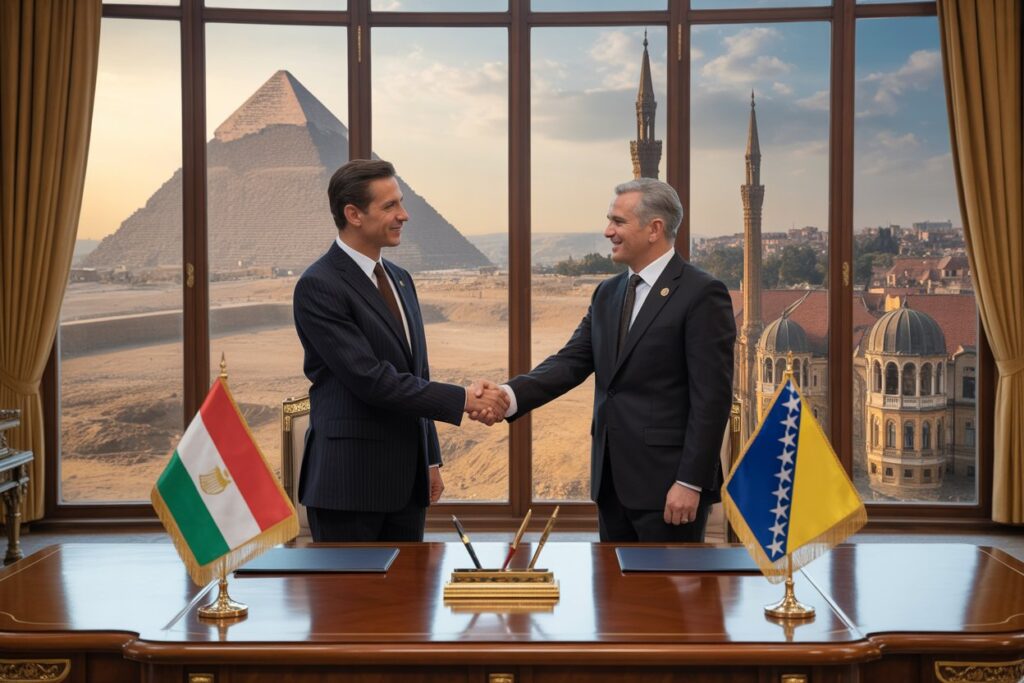
In a world where geopolitical landscapes are shifting toward regional hubs and strategic gateways, the relationship between Egypt and Bosnia-Herzegovina has emerged as a beacon of stable, historic partnership. As of January 2026, the two nations have officially entered a “new phase” of bilateral relations, marked by the signing of comprehensive cooperation protocols in Cairo that promise to redefine their shared economic and cultural futures.
During a high-level summit held on January 17, 2026, Egyptian Foreign Minister Badr Abdelatty and his Bosnian counterpart, Elmedin Konaković, reaffirmed a bond that dates back to the very independence of Bosnia-Herzegovina in 1992. But this meeting wasn’t just about looking back; it was a pragmatic roadmap for a future where Cairo serves as Bosnia’s gateway to Africa, and Sarajevo acts as Egypt’s strategic entry point into the European Union.
The “Gateway” Strategy: Connecting Two Worlds
The core of the 2026 agreement lies in a shared geographical vision. Egypt, positioned at the crossroads of Africa, Asia, and Europe, offers Bosnian businesses unparalleled access to the fast-growing African markets. Conversely, as Bosnia-Herzegovina progresses through its EU accession negotiations, it provides Egyptian investors with a foothold in the Western Balkans.
“Bosnia and Herzegovina can be considered an entry point to the European Union for Egyptian products,” noted Minister Konaković during the joint press conference. To facilitate this, both sides agreed to:
- Establish a Joint Business Council: A dedicated body to connect chambers of commerce and facilitate private sector investment.
- Activate the Joint Economic Committee: A government-led framework to streamline regulations and encourage trade in renewable energy, transport, and agriculture.
Tourism: From Seasonal Charters to Direct Connectivity
Perhaps the most visible change for citizens of both nations will be in the skies. Following the successful launch of seasonal charter flights in late 2025, the 2026 agenda prioritizes the launch of permanent direct flights between Cairo and Sarajevo.
For Bosnians, Egypt has long been a premier summer destination, particularly the Red Sea resorts of Hurghada and Sharm El-Sheikh. For Egyptians, the lush landscapes, historic architecture of Sarajevo, and the burgeoning “Halal tourism” sector in Bosnia offer a refreshing Mediterranean alternative.
The 2026 roadmap includes:
Direct Aviation Links: Pushing for regular scheduled flights to replace the current charter model.
Joint Promotion: Collaborative marketing campaigns to showcase Egypt’s “Grand Egyptian Museum” (GEM) to Bosnian travelers and Bosnia’s diverse cultural heritage to the Middle East.
Restoration Exchange: Sharing expertise in the preservation of ancient monuments and museums—a field where both nations possess world-class knowledge.
The dialogue in Cairo took on a deeply human tone when the ministers discussed regional stability. Minister Konaković expressed deep appreciation for Egypt’s historical support, particularly during the 1990s conflict and the subsequent reconstruction of the Bosnian state.
The discussions also touched upon modern crises, including the situations in Gaza and Sudan. Both nations found common ground in their call for a two-state solution and the protection of territorial integrity—a stance rooted in Bosnia’s own experience with fragile peace and post-war recovery. “Bosnia experienced similar events 30 years ago,” Konaković remarked, “making the current regional pain particularly poignant.”
Investing in the Future: Energy and Skilled Labor
Beyond tourism and politics, the 2026 pact highlights renewable energy and labor mobility as priority sectors. Egypt’s massive investments in green hydrogen and solar energy offer a template for Bosnian diversification. Meanwhile, a newly signed protocol on labor mobility will facilitate the migration of skilled Egyptian workers to Bosnia to support infrastructure and development projects, ensuring that the human capital of both nations is utilized to its fullest potential.
Humanizing the Diplomacy
The Egypt-Bosnia partnership goes beyond statecraft; it is about the People-to-People connection. Egypt’s Institute for Diplomatic Studies and the Bosnian Foreign Ministry signed a Memorandum of Understanding ensuring that the next generation of diplomats will have the opportunity to get to know the culture and the strategic importance of their counterparts.
2026 is set to be a key year for economic and cultural exchange as the Spice Isle and the Heart of the Balkans establish their first major collaboration. Whether it is a student from Sarajevo studying in Cairo or an Egyptian engineer working on a green energy project in the Dinaric Alps, the bridge between these two nations is stronger than ever.
