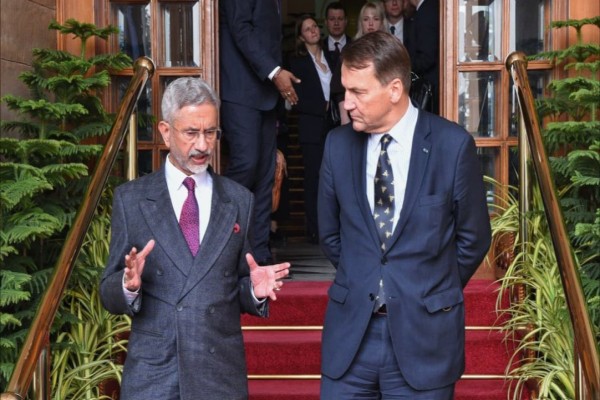
 External Affairs Minister Dr S Jaishankar with visiting Polish deputy Prime Minister and Foreign Minister Radosław Sikorski in New Delhi on Monday, January 19, 2025.
India on Monday delivered a pointed diplomatic message to Poland over its expanding engagement with Pakistan, with External Affairs Minister S. Jaishankar urging Warsaw to maintain zero tolerance on terrorism and avoid steps that could strengthen militant networks in South Asia.
During delegation-level talks with Poland’s Deputy Prime Minister and Foreign Minister Radosław Sikorski in New Delhi, Jaishankar publicly raised concerns about Poland’s recent outreach to Islamabad, including Sikorski’s October visit to Pakistan that resulted in a joint statement referring to Kashmir.
“Poland should display zero tolerance for terrorism and not help fuel the terrorist infrastructure in our neighbourhood,” Jaishankar said in his opening remarks, delivered in the presence of the visiting foreign minister.
He noted Sikorski’s familiarity with South Asia and said cross-border terrorism remained India’s foremost regional security challenge.
While avoiding a direct reference to the Kashmir language, Jaishankar’s remarks came against the backdrop of Poland’s widening political and economic engagement with Pakistan. Warsaw has recently sought to expand cooperation with Islamabad across trade, energy, defence, education and counterterrorism.
Indian officials view such engagement as problematic as Pakistan continues to face international scrutiny over terror financing and support for militant groups operating in the region.
Sikorski, in response, agreed on the need to counter transnational terrorism, citing Poland’s own experiences with attacks on infrastructure and acts he described as “attempted state terrorism.”
The talks also covered global developments, including the Ukraine conflict and trade tensions. Jaishankar reiterated India’s objections to what he described as the “selective targeting” of New Delhi for its independent foreign policy choices.
“In recent months, in New York and Paris, I have candidly shared our views on the Ukraine conflict and its implications. While doing so, I have repeatedly underlined that the selective targeting of India is both unfair and unjustified. I do so again today,” he said.
Although he did not name any country, the remarks referred to punitive trade measures against India, including tariffs linked to New Delhi’s purchase of Russian oil.
Sikorski echoed concerns about wider global trade disruptions, noting that Europe has also faced economic pressure. He warned of broader turbulence in global trade and welcomed India’s expanding diplomatic engagement across Europe as a sign of its commitment to ties with the European Union.
Jaishankar later said India’s concerns over selective targeting extended beyond tariffs, pointing to political and strategic pressures.
Despite the firm exchanges, both sides highlighted progress in bilateral relations since India and Poland elevated ties to a Strategic Partnership during Prime Minister Narendra Modi’s visit to Warsaw in August 2024.
The ministers agreed to review the Action Plan for 2024–28, covering trade and investment, defence and security, clean technologies and digital innovation.
Poland is among India’s largest trading partners in Central Europe, with bilateral trade at about $7 billion, nearly three times the level a decade ago. Indian investments in Poland exceed $3 billion and have generated local employment.
“Our bilateral relationship has progressed steadily, but it needs constant tending,” Jaishankar said, also pointing to cultural links, people-to-people exchanges and historic ties, including the legacy of the ‘Dobry Maharaj.’
Monday’s talks underscored India’s effort to deepen strategic and economic cooperation with Poland while drawing clear lines on terrorism and Pakistan.