

The first official scientific observations taken from the summit of Whiteface Mountain probably occurred in 1872 when Verplanck Colvin left his card in the form of a metallic disk embedded in the rock. Colvin returned seven years later, and his report on a topographical survey indicates he used barometers and thermometers along with his spirit levels and graduated rods. It was early October, and gale force winds “swept the summit… Sleet and ice enwrapped the station until the signal became a fantastic pyramid of beautiful frost work.”
Scientists today face similar challenges, especially during colder seasons when they visit the summit at least once a week to calibrate instruments and knock off rime ice. The number and variety of measurements has grown significantly since Colvin’s time, with more than 36 parameters monitored – some in real time. Other tools sense clouds and send up cylinders to collect droplets for analysis, while the weather station at the old Marble Mountain Ski Lodge contributes data to the state’s Mesonet, a network of 127 weather stations across the state.
Measuring pollution and its impacts
Under the direction of Sara Lance, the Whiteface Mountain Field Station, part of State University of New York at Albany’s Atmospheric Sciences Research Center (ASRC), is engaged in several studies from measuring PFAS (per- and polyfluoroalkyl substances) to microplastics, organic carbons (think wildfires, though that is not the only source) and the sulfides and nitrogen oxides that cause acid rain and ozone.
Lance joined the ASRC in 2016 as a research associate. She became director of the Whiteface Mountain Field Station in 2023, but her interest in the effects of pollution goes back to when she was growing up in Arizona.
“Phoenix is in a bowl. The pollution stagnates, and there’s often a brown cloud you can see against the horizon which can be really bad for people with asthma.”
Related reading: Catching clouds from NYS’s highest weather station
Tracking the unexpected
At Whiteface, organic carbon in cloud water has more than doubled in the past 10 years. This finding by ASRC researchers was recognized in 2023 with the Atmospheric Chemistry and Physics Paul Crutzen Publication Award, named after the Nobel Prize laureate known for his part in discovering the processes behind the destruction of stratospheric ozone that protects the Earth from the sun’s ultraviolet radiation.
The award-winning paper, “Long-term Monitoring of Cloud Water Chemistry at Whiteface Mountain,” shows trends in cloud water chemistry from 1994 to 2021.
Although the study showed that sulfates, a byproduct from coal fired power plants and a source for acid rain, decreased as expected, the increase in organic carbon was a surprise. “Sulfates have been increasingly regulated with positive results,” Lance said. “But we didn’t predict a change in the organic carbon going in the opposite direction, and that’s one of the big things we’re trying to understand. We know there’s smoke impacts [from wildfires], but there’s something going on that’s not understood.”
Lance’s former graduate student, Chris Lawrence, has been working to finalize a paper on the subject. “We believe there are a mix of factors,” Lance said including increased wildfire smoke, increased biogenic emissions, and enhanced oxidation of organics due to changing man-made emissions. Even reduced SO2 emissions from coal fired power plants may be playing a role.
Another graduate student, Archana Tripathy, used a State University of New York College of Environmental Science and Forestry grant that ended in 2025 to focus on cloud water organic acid measurements for a paper in review at the journal Atmospheric Chemistry and Physics.
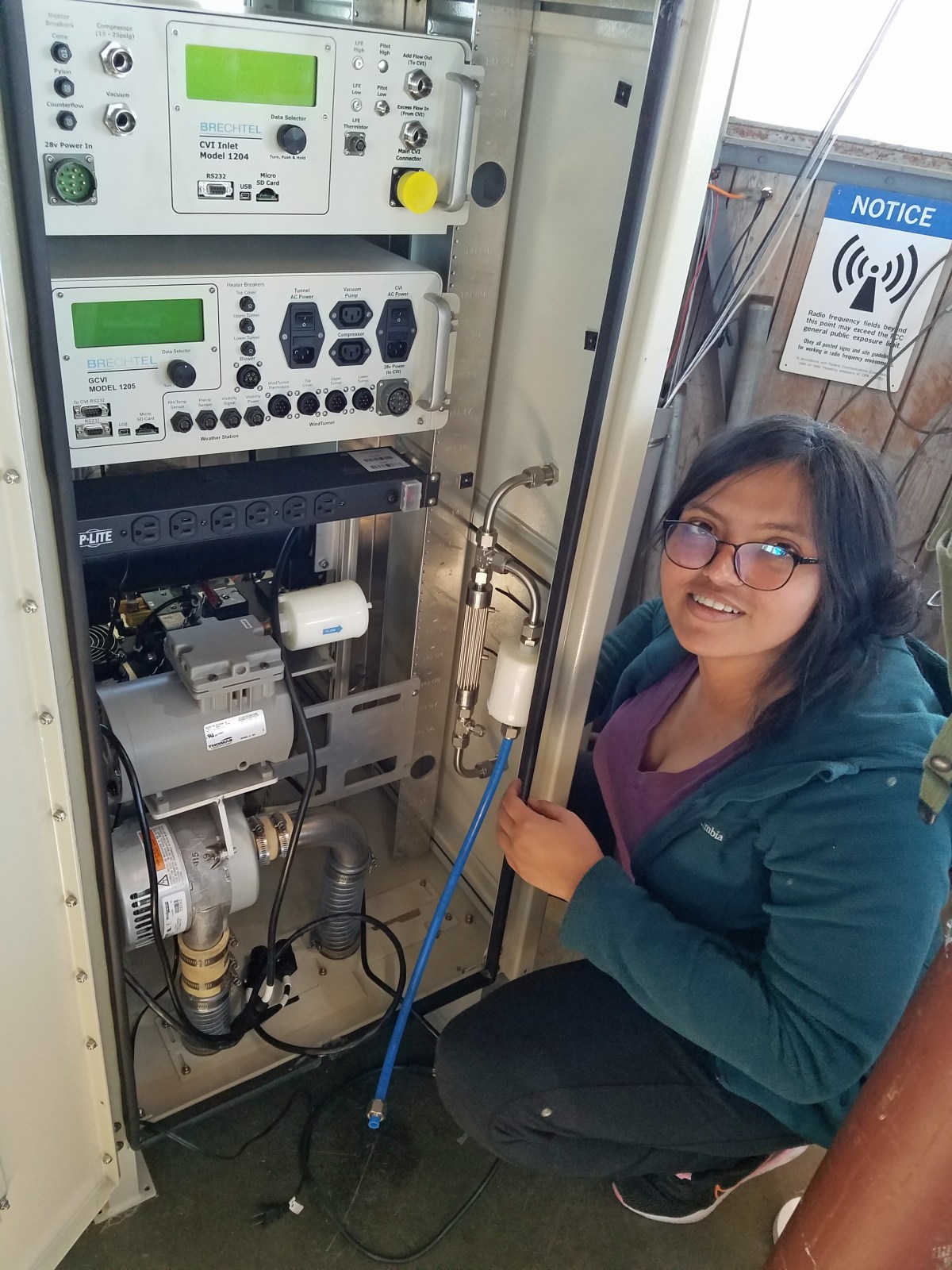 UAlbany PhD student Archana Tripathy re-assembles new equipment for sampling cloud droplet residuals (the particulate matter left behind when cloud droplets evaporate) after having brought individual components up a ladder and through a hatch to the top floor of the atmospheric research observatory at the summit of Whiteface Mountain. Photo Courtesy of ASRC
Funding is an ongoing challenge and often done piecemeal through monies from the university, government sources, and grants. Some government agencies request data without providing financial support, and grant work has to be specific to the parameters of the grant.
Hourly sampling that began in 1994 was cut at some point to every three hours and then 12. New York State Energy Research and Development Authority (NYSERDA) monies for cloud water chemistry were lost in 2022, but fortunately Lance was able to supplement the program with funding from an National Science Foundation (NSF) Faculty Early Career Development Award.
Other ongoing studies
Another long-term project that Lance inherited, funded by a NYSERDA (New York State Energy Research & Development) grant, focused on gas phase chemistry and trying to understand how particles and gases interact and change during the course of the day and night. Such research can influence policy decisions impacting air quality and ecosystem health.
“Ecosystems can be sensitive to deposition of any kind of chemistry from the atmosphere.”
The project looked at nitrogen oxides, often associated as pollution from tailpipes and acid rain. Nitrogen oxides are a reactive oxygen species, a form of free radicals, that can be detrimental to human health – a reason antioxidants are often promoted for better health. Results of this work can be found in multiple publications.
“Environmental Protection Agency (EPA) regulations for air quality revolve around ozone and particulate matter because they know those have human health impacts,” Lance said. “But these chemicals are not always emitted directly from tailpipes, they also get produced downwind from gas phase emissions. So we measure those gases that end up becoming particulate matter or ozone down the road, sometimes many days downwind of the sources. The EPA regulations have definitely made an impact, but we’ve found that ozone has been very stubborn and hasn’t dropped very much in remote regions like Whiteface Mountain.”
Forever chemicals reach the clouds
Forever chemicals (PFAS) in cloud water are another issue that the ASRC has begun studying. “We grabbed some archived samples, a very small number from 2018 to 2021 (in a pilot study in partnership with University of Wisconsin and the EPA). We definitely saw PFAS in the cloud water collected at the summit. We are planning to do more PFAS analysis with collaborators at the University of Toronto this spring. Whiteface is about one day downwind from Toronto, so we can compare observations with theirs.”
RELATED READING: New York’s PFAS plan: targeting “forever chemicals” in wastewater, biosolids
PFAS are ubiquitous in today’s world from nonstick pans to water-resistant fabrics, stain-resistant carpets, and dental floss. The EPA set the first-ever national limits for PFAS in drinking water in 2024 because of links to increased risk of cancer, liver and kidney disease, reproductive issues, developmental delays in children, decreased fertility, immunodeficiencies and hormonal disruptions.
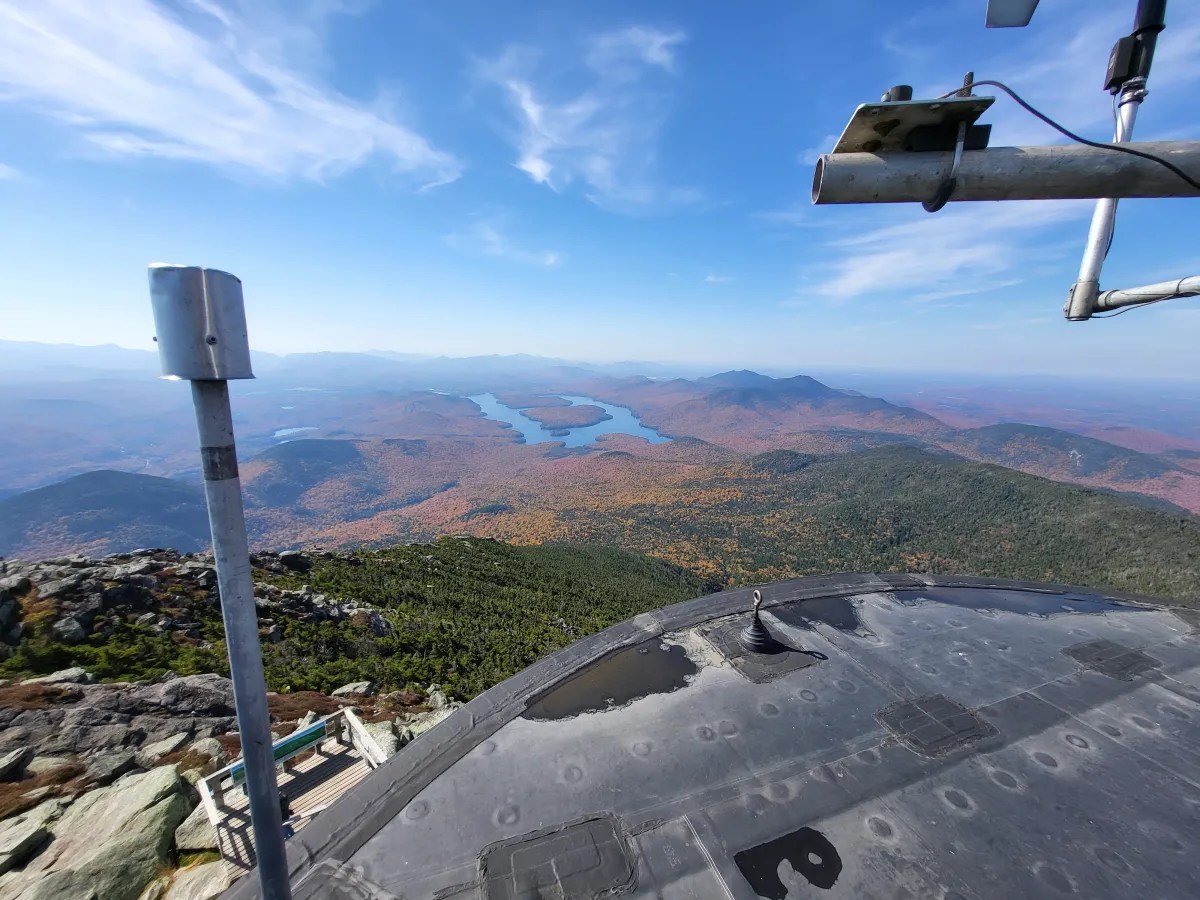 View from the roof of the Whiteface Mountain Summit Research Observatory with Lake Placid in the distance. Photo courtesy of ASRC
Plastic in the air we breathe
Nanoplastics, or even larger microplastics, are another growing concern. Recent studies indicate they are floating around in the atmosphere for thousands of miles, affecting cloud formation, and landing in our lungs where they may exacerbate vascular diseases and have other health impacts.
The ASRC hopes to add the study of aerial nano- and microplastics contamination to its portfolio. Lance’s team has analyzed atmospheric nanoplastic particles in the former Marble Mountain Lodge, current home for the Whiteface Mountain Field Station where some original furniture made with polyurethane foam dates back to 1960s and has degraded over the decades. Lance’s student, Adam Deitsch, won a poster award for a presentation on the topic at the American Association for Aerosol Research Conference in Buffalo in October 2025.
“It’s such a new field and very tricky to clearly identify man-made plastics from natural organic aerosols. We have a high-resolution aerosol mass spectrometer that can be used to distinguish between different types of organic aerosols (like motor vehicle exhaust versus meat cooking), but a method hasn’t been established yet using this instrument to clearly fingerprint nanoplastic particles. Some fancier instruments are pushing the envelope on nanoplastics, and people are dedicating their whole careers to it, but it requires a huge investment of money and time. There’s just a lot we need to learn.”
So far, cuts at the federal level have not impacted research at the ASRC, and a proposal is pending with the NSF. “I was invited to submit a full proposal in March, which is the furthest I’ve gotten in the process in over six years of trying,” Lance said. “The proposal would fund the cloud chemistry work and a lot more aerosol measurements than we’ve ever had at Whiteface Mountain.”
Lance’s graduate student, Sara Lombardo, has also been initiating new research in the microbiological analysis of the cloud water samples and received a National Aeronautics and Space Administration (NASA) graduate student fellowship to continue that work for the next 3 years.
More information about ASRC’s research can be found at: https://research.asrc.albany.edu/facstaff/lance/News.html