
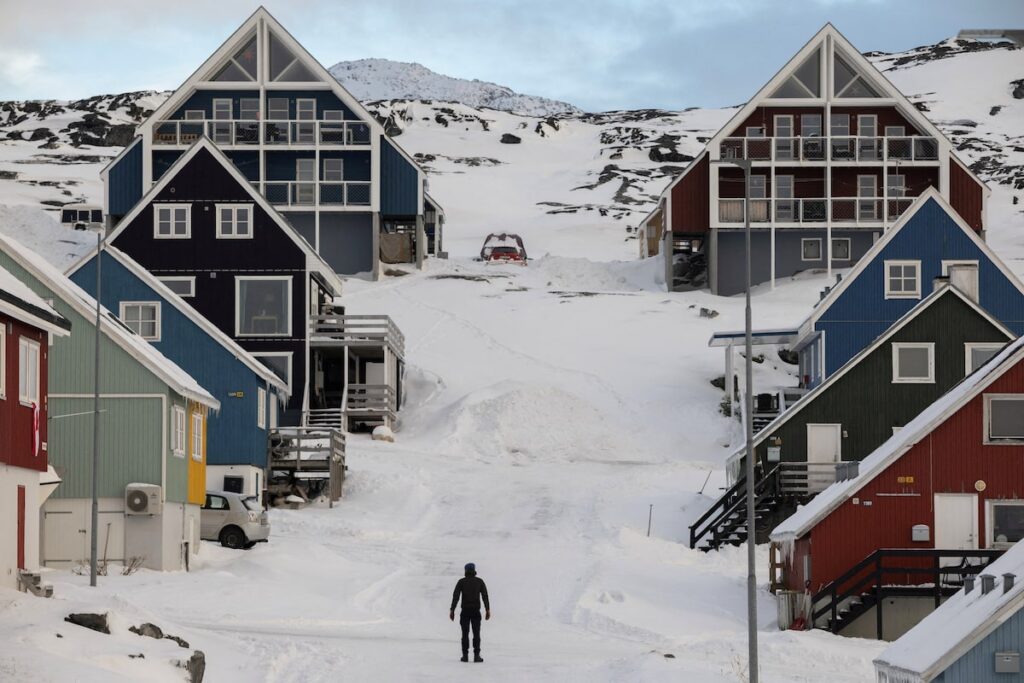
A man stands on a street on the day of the meeting between top U.S. officials and the foreign ministers of Denmark and Greenland, in Nuuk, Greenland, Jan. 14, 2026.Marko Djurica/Reuters
Fen Osler Hampson is a professor of international affairs at Carleton University and the co-chair of the Expert Group on Canada-U.S. Relations.
NATO is facing one of its gravest internal crises since its founding, and Canada is facing its own moment of truth.
President Donald Trump’s demand that Denmark hand over Greenland to the United States goes far beyond his late-night posts on Truth Social. It is a deadly serious attempt by the alliance’s dominant power to carve up the territory of a fellow NATO member.
This is not the first time NATO has been shaken by internal division. But unlike past crises, this one strikes at the very rule that has underpinned Western security for 80 years: that borders are not revised by coercion.
After Egyptian president Gamal Abdel Nasser nationalized the Suez Canal in 1956, Britain and France secretly conspired with Israel to take it back with force of arms without informing Washington. Furious at being blindsided, U.S. president Dwight Eisenhower threatened to block British access to International Monetary Fund loans and sink the British pound if London did not back down.
Opinion: Greenland may be our first, best, and last chance to stand up to Donald Trump
Opinion: It is time to invoke the NATO Treaty’s Article 4
For the French, America’s refusal to support their effort to reassert control over a strategic waterway was a betrayal. The Soviet Union hinted that it might intervene on Egypt’s behalf, and, for a moment, the fate of the NATO alliance hung in the balance.
Canada played the adult in the room. Lester B. Pearson’s diplomacy produced the first armed United Nations peacekeeping force and defused the crisis, earning him a Nobel Peace Prize and solidifying Canada’s role as the indispensable middle power.
A decade later, another crisis struck from within. French president Charles de Gaulle, ever wary of U.S. dominance, pulled France out of NATO’s integrated military command. NATO was forced to move its headquarters from Paris to Brussels. Many worried that France’s defection would punch a gaping hole in the alliance’s defences and start a domino effect as others reconsidered their commitments.
In the case of both Suez and de Gaulle’s revolt, however, NATO survived and no one doubted that Washington ultimately accepted its commitment to defend Europe.
This time, the threat emanates from Washington itself. An American President is openly asserting territorial ambitions against an ally. That violates the core norm of the post-1945 international order: the inviolable sovereignty of states. It also shreds the moral logic of Western support for Ukraine. If the United States claims the right to bully a partner into surrendering territory, why should others accept Western lectures about imperial aggression?
For Canada, the stakes could not be higher: Is Canada prepared to jeopardize its relationship with its most important trading and defence partner to defend the principle of territorial sovereignty?
If Canada sides with Europe and implements economic retaliatory measures if diplomacy fails, Mr. Trump will almost certainly up the ante, piling more sanctions on our besieged economy.
Mr. Trump has long shown disdain for Canada’s economic significance and a trigger-happy readiness to weaponize trade policy. New tariffs and non-tariff barriers would be almost guaranteed. The USMCA’s fate would almost certainly be sealed. NORAD and even Five Eyes intelligence co-operation could be terminated by a President who sees alliances as leverage, not as shared commitments.
Yet the alternative – succumbing to Mr. Trump’s demands – is even more dangerous. This is not just about the fate of 50,000 Greenlanders and their country in the North Atlantic. For Canada, a northern country whose sovereignty has been questioned, the principle at stake is existential. If Denmark can be pushed around over Greenland, what is to stop Mr. Trump from turning his attention to Canadian Arctic islands, shipping routes or resources? (Steve Bannon, a former Trump strategist, has said Mr. Trump’s “next big thing is going to be Canada.”)
Nor can Canada credibly support Ukraine’s fight for survival while turning a blind eye to U.S. pressure on Denmark. There should not be a millimetre of daylight between Canada’s position and that of its European allies on this question.
Ottawa needs to say clearly and unambiguously that any attempt to coerce territorial concessions from a NATO partner is unacceptable and will carry massive and irreversible economic and diplomatic consequences for Washington.
This is the moment to draw a line in the snow. Canada’s security, prosperity and very independence depend on pushing back hard against a bully, not supplicating before him. If Greenland falls, the next domino could indeed be Canada. NATO has survived internal crises before, but never one in which the primary threat to the alliance’s founding principles comes from the Oval Office itself.
Canada and Europe must hang together in defence of Greenland’s territorial sovereignty and right to self-determination, or risk hanging separately.