
WASHINGTON DC – As world leaders converge on Davos to talk about global stability, artificial intelligence and the future of capitalism, a far more elemental dispute is threatening to blow open a rift between Washington and its closest allies – over an icy Arctic island.
Brussels is bracing for a showdown that few diplomats ever imagined: a transatlantic trade conflict sparked not by steel, semiconductors or climate rules – but by Greenland.
Follow our coverage of the war on the @Kyivpost_official.
EU leaders are meeting Thursday to debate how to respond to US President Donald Trump’s threat to impose sweeping tariffs on a cluster of European countries unless they acquiesce to his push to acquire the Arctic island, a self-governing territory of Denmark.
US Treasury Secretary Scott Bessent on Monday warned European nations against responding with tariffs of their own.
At stake is more than trade. For Brussels, the crisis cuts to the core of sovereignty, alliance politics – and how far Trump is willing to push transactional diplomacy into uncharted territory.
“Offensive to the Danes”
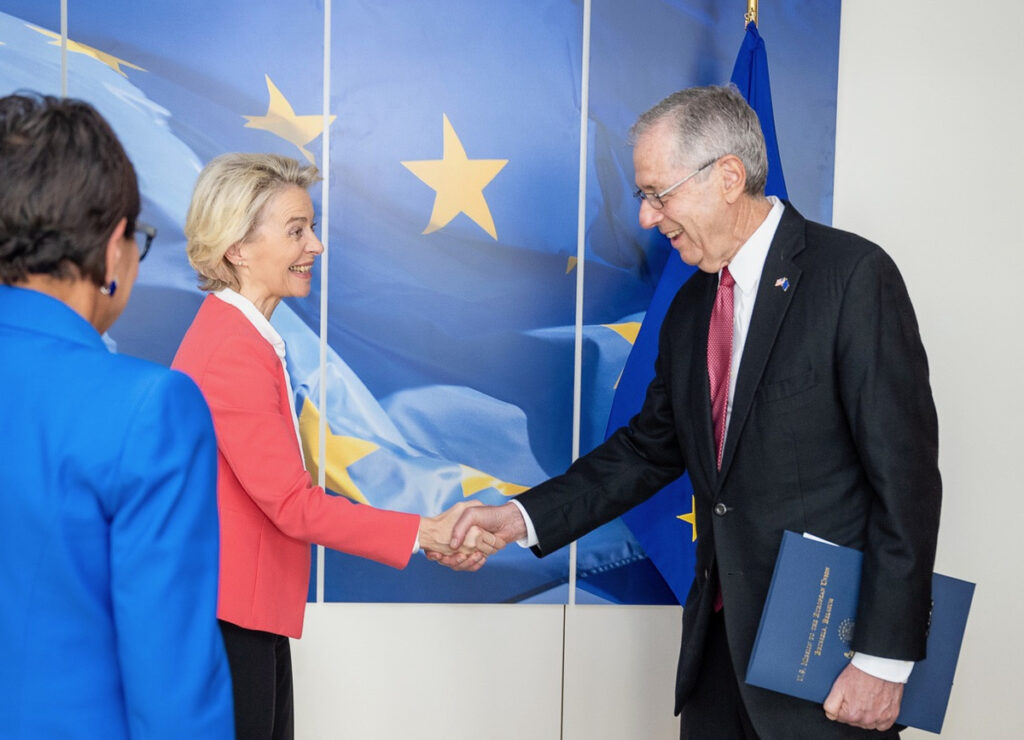
For Mark Gitenstein, the former US ambassador to the EU and a longtime adviser to former President Joe Biden, the idea that Washington would pressure Denmark in this way is not just misguided – it is insulting.
“The notion that the Turnberry Agreement would be agreed to at this point is ludicrous,” Gitenstein told Kyiv Post, referring to a proposed framework for trade negotiations. “It cannot be moved at this point. And Trump needs to understand that this is the case, and the Europeans need to stand together.”
Other Topics of Interest
Stop ‘Appeasing’ Bully Trump, Amnesty Chief Tells Europe
The US president has taken “a range of decisions that have led to the demise of many rules around the world,” while Russia was destroying the system “through its aggression in Ukraine,” she said.
He drew a blunt analogy: “It would be like the Chinese saying they’re going to hold Hawaii hostage … We would have to defend Hawaii. And the EU has to defend Denmark.”
For Gitenstein, the issue cuts especially deep given Denmark’s record. “I was looking at the Danes as the most stalwart supporters of the US on military and on economic issues,” he said. “And for us to do this to the Danes is offensive.”
That sense of affront is now being echoed across European capitals. Ursula von der Leyen, the European Commission president, told a bipartisan group of US lawmakers on Monday that Washington must “unequivocally respect” the sovereignty of Denmark and Greenland.
“This is of utmost importance to our transatlantic relationship,” she wrote on X, adding that “tariffs run counter to these shared interests.”
Maximalist bargaining – or something more?
Is Trump’s Greenland gambit merely a negotiation tactic?
“You may do that in real estate,” Gitenstein said, “but you don’t do that in diplomatic relations with a friend.”
Pressed on whether the move reflects a genuine strategic shift in US priorities, he was unsparing.
“I don’t understand why he can’t do everything he needs to do under the ‘51 treaty,” Gitenstein said, referring to the long-standing US-Denmark defense agreement governing Greenland. “He’s made no effort to explain that, at least publicly.”
Trump, however, has framed Greenland as essential to US national security and argued that Washington would do a better job defending the Arctic than Copenhagen.
In a reported letter to Norwegian Prime Minister Jonas Gahr Støre, Trump went further, linking his pursuit of Greenland to resentment over not receiving the Nobel Peace Prize and declaring: “The world is not secure unless we have complete and total control of Greenland.”
The rhetoric has sparked protests in Nuuk and Copenhagen – and alarm among European leaders who see a direct challenge to postwar norms regarding borders and sovereignty.
Gift to the Kremlin
The fallout is already reverberating beyond Europe.
Russia has openly celebrated the transatlantic rift. Kremlin spokesman Dmitry Peskov said it was “hard to disagree” with analysts who believe Trump’s Greenland push could secure him a place in history.
For Gitenstein, that reaction is a warning sign.
“I think it’s definitely at risk,” he said when asked whether the dispute could undermine Western unity against Moscow.
“Very hard for me to assess” the depth of the damage, he added, but the stakes are clear: “If Trump is serious about reaching a settlement with Russia, he cannot do it without the Europeans. So Trump needs to understand that we need the Europeans, and the Europeans need us.”
The spectacle of NATO allies feuding over Greenland, he said, is “unnecessarily provocative,” and “may work in New York real estate. It will not work here.”
Brussels Weighs Retaliation
Behind closed doors, EU officials are debating a package of counter-tariffs reportedly worth up to €93 billion. President Macron is pushing to deploy the Anti-Coercion Instrument. Germany’s leadership is urging unity.
And several European NATO allies have already sent troops to Greenland for joint exercises under Denmark’s Operation Arctic Endurance, a signal of solidarity – and of shared concern about Russian and Chinese activity in the Arctic.
Yet there is no consensus yet to trigger the EU’s toughest tools.
“We were strongly supportive of the EU when they passed the anti-coercion statute,” Gitenstein said. “I don’t think there’s consensus to use that statute now in this case, probably. I understand that.”
What he does not understand is the logic of escalating now. “The Trump administration needs to understand the consequences of this action,” he said.
Diplomacy under strain
For working-level diplomats, the crisis is a nightmare scenario.
“I’ve never had an experience anything like this,” Gitenstein said, adding, “If you don’t agree on the importance of the alliance, I don’t know how you function.”
He said he was “terribly sympathetic” to his successor in Brussels, and also singled out von der Leyen and European Council President António Costa as being under enormous pressure.
“I have total confidence in all of them to come up with a sensible solution,” he said – but acknowledged that the political terrain has shifted dangerously.
The Ukraine shadow
The Greenland crisis is unfolding against a fraught backdrop: uncertainty over US support for Ukraine and the future of NATO.
Gitenstein warned that a fractured transatlantic front would weaken leverage over Russia. Yet he also pointed to Europe’s growing military role.
“They just sent $90 billion to Ukraine. That’s not insignificant,” he said. “There are very competent militaries in Europe. By the way, the most competent military in Europe is the Ukrainian military.”
But he was clear that Europe cannot simply replace the US. “It’s not the same without the US,” he said. “There’s no doubt about that.”
A Dangerous Precedent
The immediate question for Brussels is how hard to push back – and how publicly.
Von der Leyen has warned that tariffs threaten shared prosperity. Chancellor Merz has urged firmness. Macron wants retaliation. Bessent says don’t even think about it.
Gitenstein’s advice is blunt: Europe must draw clear red lines – and stand together.
“The European Union has to defend Denmark,” he said.
Because if Greenland becomes a bargaining chip, the precedent won’t stop at the Arctic.
In the rarefied air of Davos and the frozen politics of Greenland, Europe is discovering a sobering truth: when alliances become transactional, even the bedrock of sovereignty can start to crack.