
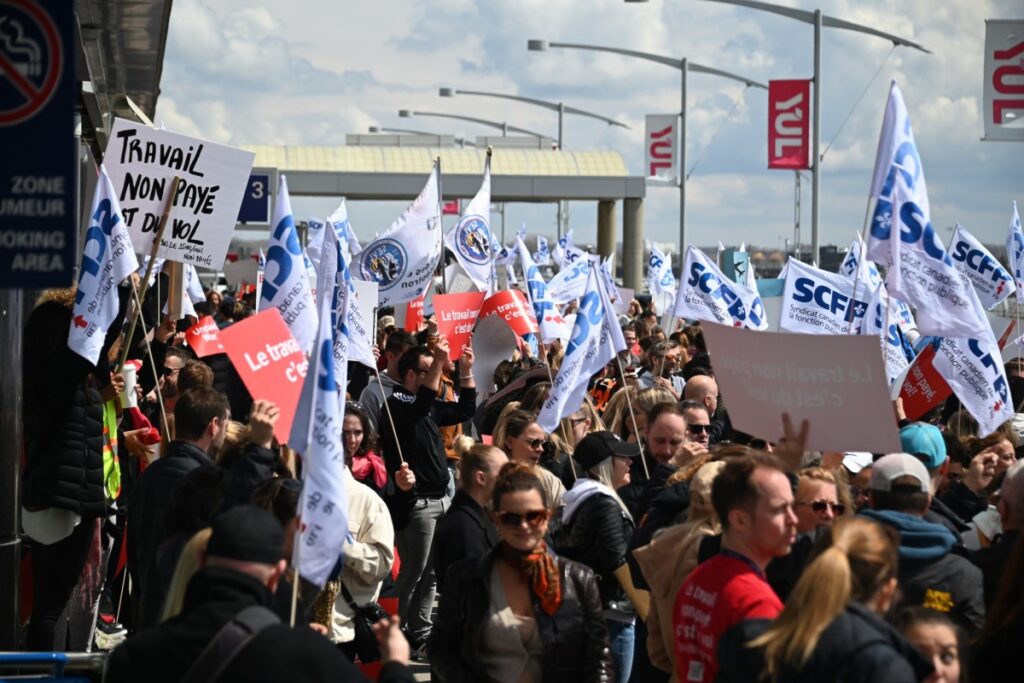
Air Canada workers on the picket line, August 2025. Photo courtesy Air Canada Component of CUPE/Facebook.
I have worked as a letter carrier at Canada Post for eight years. It’s the only union job I’ve ever had, and I have had plenty of jobs. Gas jockey. Dishwasher. Telemarketer. Burger flipper. You name a low-paying, thankless career and I have probably worked it. So, I am acutely aware, and thankful for, the reasonably good pay, job security and work conditions which I have enjoyed thanks to the Canadian Union of Postal Workers.
That is why it is so disheartening to see the current state of the labour movement, where government, corporations, and to some extent even the unions themselves, are committed to a neoliberal philosophy which increasingly diminishes the ability of workers to stand up to the powers that be.
My disillusionment about the state of the labour movement began with my own union. In December 2024, CUPW had an opportunity to do something historic. We were nearly a year into our latest contract negotiations, and the corporation was insisting on massive rollbacks to the working conditions for letter carriers. Canada Post claimed it was suffering major losses, though such accounting has been the subject of some debate, and to offset those losses we would need to adopt the ways of our competitors like Amazon. Essentially it boiled down to cramming a heavier workload into the days of labourers who were already highly susceptible to on-the-job injuries due to their strenuous workdays. In Canada, postal workers represent one of the top-four sectors that routinely suffer the highest number of disabling injuries, according to the most recent federal data from Employment and Social Development Canada.
Rightly, the union would not abide these impositions. When it was clear the corporation would not budge on their demands, union membership overwhelmingly voted to strike. For several weeks on the picket line we made our stand, buttressed by a good deal of public support. Morale amongst the picketers was strong despite the oncoming deepfreeze of a Canadian winter. Everything was as it should be when a group of workers decide to stand firm against deteriorating working conditions.
The cynics amongst us knew what was coming as December rolled around. We had seen this the last time CUPW had dared to strike during the Christmas rush, and we had also seen it imposed upon rail workers by the Trudeau government just a few months before our strike. Back-to-work legislation was coming which would effectively end our labour action.
Sure enough, that is exactly what the Trudeau Liberals did. Some may argue that in this particular case, it only paused the strike so that an industrial inquiry could be conducted to determine the best course of action to secure the future of the post office. But such arguments are naïve, especially considering the unsurprising result of the inquiry only granted Canada Post a mandate to claw back working conditions even further. The point is that the back-to-work legislation broke the strike’s momentum, diminishing public support and erasing the union’s leverage.
But it didn’t have to be that way. Union members were ready to defy the back-to-work order and decried it as an unconstitutional subversion of our right to bargain with our employer. Many voices called for CUPW to stay on the picket line and show that our right to negotiate a fair contract on our own terms was not to be compromised by the whims of the government. We will never know exactly how much support there was for such an initiative, because the union neglected to conduct an official poll amongst membership to ascertain what the appetite for such action was. Instead, CUPW meekly followed the back to work order, tacitly accepting that we can only conduct collective bargaining at the convenience and under the conditions of the very institutional powers we are bargaining against.
Many of CUPW’s 55,000 members were aghast at the union leadership’s decision to stand down. Historically, the power of the labour movement has always been derived from a willingness to engage in civil disobedience. But if the union leadership will not stand with you, the movement fractures, and what hope do you have?
Months later there appeared to be a glimmer of hope for people who believed that unions could still take such revolutionary actions. The flight attendants who worked for Air Canada, represented by the Canadian Union of Public Employees, similarly had their strike broken through back to work legislation, this time under current Liberal Prime Minister Mark Carney. But the flight attendants, seemingly with the support of CUPE, did what postal workers did not. They defied the back to work order and their strike continued.
For a couple of days it was an inspiring scene. Union leaders boldly declared that not only were they undeterred by any fines which might be imposed upon them, they were even willing to go to jail if need be. Picketers held the line and the public largely marvelled at the brave stand they were taking, now not only for fair treatment from their employers, but from a government far too zealous about interfering in labour disputes as well.
It did not take long, however, for the heroic words of CUPE leadership to be shown as largely performative. A hurried deal was struck between union leadership and the employer that would immediately send the flight attendants back to work, even though it did not achieve the working conditions which the vast majority of the workers were striking for. The strike revolved around a demand to end the policy of only being paid for labour performed during the flight, but union brass caved and agreed to a deal which would still see significant amounts of unpaid labour on the ground.
Worse, the deal was structured in such a way that the union would not have an opportunity to vote to ratify the contract with respect to working conditions. They were only allowed to vote on the proposed wage scale in the deal, which was rejected by a staggering 99 percent of voting members—a figure which we can reasonably presume demonstrates discontent not only with the wage scale, but with the entire contract being forced upon them. And after such a show of displeasure, under the deal they would still not be allowed to resume their strike. Union leadership agreed to terms whereby this massive rebuke could only result in sending the matter of the wage scale to binding arbitration. Workers had no choice but to return to work under similar working conditions to those they had been fighting against. Union leadership had quashed their own strike action and then celebrated it as a victory.
CUPE and CUPW failed their memberships, and it is clear they did so out of fear for treading against the institution they were principally founded to oppose. These unions have grown old and large, institutions unto themselves, and have forgotten that the grassroots civil disobedience on which they were founded often required straying outside the legal framework the powers that be employ to quell the unrest of the labour movement.
This is unacceptable, because we need unions to be dynamic in this climate where governments largely serve the corporate class. The idea that a union can rely on the government to be a fair arbitrator between labour and capital has always been somewhat naïve in any jurisdiction. But now especially in Canada, where not only the federal, but also provincial levels of government have shown that they are ready to bust a union’s labour action.
Take the draconian way that Alberta Premier Danielle Smith ended the teacher’s strike in her province, by invoking the “notwithstanding clause” which allows a government to override certain Charter rights for up to five years. Smith used this measure to shield a bill passed by her government from legal challenges. The bill imposed a contract onto the teachers that they had already rejected during the bargaining process, rendering the union unable to go on fighting for better terms.
Or rather, it rendered them unable to fight on the terms set by the very government they were bargaining with. It has become clear that here in Canada, and anywhere that governments and corporations conspire to prop up the endless growth model of corporate capitalism by scaling back working conditions and wages for workers, that unions need to be willing to take more drastic actions. They need to be ready to defy back-to-work orders. Willing to engage in acts of civil disobedience which acknowledge that what is legal is not always what is right. Prepared to endure a public relations assault which casts them as lazy, greedy and disruptive.
In the wake of the Alberta teachers being forced back to work, there were grumblings amongst local unions of organizing a general strike. These, unsurprisingly, turned out to be performative bluster, with union leadership deciding instead to conduct a survey about how much appetite there was for some future hypothetical mass walkout. This is another sign that union leadership shares the mindset of the governments they are supposed to oppose, who love nothing more than to conduct studies and consultations on initiatives they have no interest in addressing any more seriously than kicking the can down the road.
Our unions have become sluggish and scared when we need them to be decisive and fearless. Unions were founded as a way for labour to stand up to the institutions that exploit them. But if they reject the subversive tactics of the past then they are in danger of becoming yet another appendage of those same oppressive institutions. It’s time for them to remember their roots.
Alex Passey is a writer from Winnipeg.