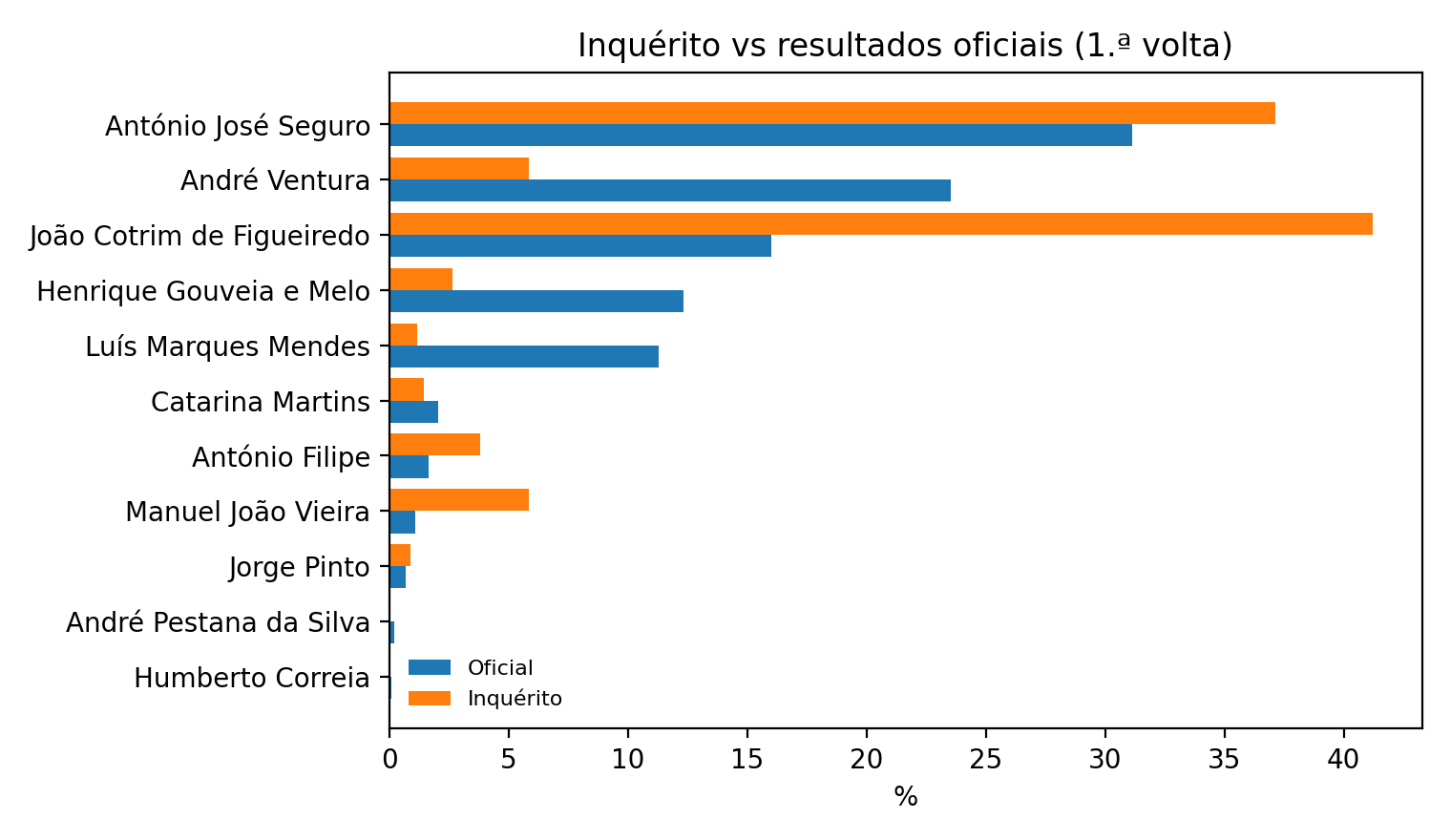
I did a “for fun” survey here at r/portugal on who they voted for in the Presidential Elections (1st round).
- Sample: 356 responses
- Form window: 18/01/2026 18:50–19:59
- Valid votes in the survey (excludes “White” and “I didn’t vote”): 342
Obvious but important note: this is not representative of the country (self-selection + Reddit demographics). It is a photograph of subset of users who responded.
Survey results
Valid votes (excludes “White” and “I didn’t vote”)
| Candidate |
Votes |
% |
| João Cotrim de Figueiredo |
141 |
41.23 |
| António José Seguro |
127 |
37.13 |
| Andre Ventura |
20 |
5.85 |
| Manuel João Vieira |
20 |
5.85 |
| Antonio Filipe |
13 |
3.80 |
| Henrique Gouveia e Melo |
9 |
2.63 |
| Catarina Martins |
5 |
1.46 |
| Luís Marques Mendes |
4 |
1.17 |
| Jorge Pinto |
3 |
0.88 |
Comparison with official results (SGMAI) — % in valid votes
| Candidate |
Survey (%) |
Official (%) |
Difference (pp) |
| João Cotrim de Figueiredo |
41.23 |
16.00 |
+25.23 |
| António José Seguro |
37.13 |
31.11 |
+6.02 |
| Andre Ventura |
5.85 |
23.52 |
-17.67 |
| Manuel João Vieira |
5.85 |
1.08 |
+4.77 |
| Antonio Filipe |
3.80 |
1.64 |
+2.16 |
| Henrique Gouveia e Melo |
2.63 |
12.32 |
-9.69 |
| Catarina Martins |
1.46 |
2.06 |
-0.60 |
| Luís Marques Mendes |
1.17 |
11.30 |
-10.13 |
| Jorge Pinto |
0.88 |
0.68 |
+0.20 |
| André Pestana da Silva |
0.00 |
0.19 |
-0.19 |
| Humberto Correia |
0.00 |
0.08 |
-0.08 |
Main differences
- O r/portugal (who responded) it became much more IL than the country: Cotrim +25.23 pp vs official
- Ventura appears far below the country: -17.67 pp.
- Insurance appears above the country: +6.02 pp.
- Brands Mendes e Gouveia e Melo appear far below the country: around -10 pp each.
Sample profile (to notice bias)
Age
| Age |
n |
% |
| 25 – 34 |
223 |
62.6 |
| 35 – 44 |
64 |
18.0 |
| 18 – 24 |
63 |
17.7 |
| 45 – 54 |
5 |
1.4 |
| 55 – 64 |
1 |
0.3 |
Sex
| Sex |
n |
% |
| Masculine |
309 |
86.8 |
| Feminine |
42 |
11.8 |
| I prefer not to say |
5 |
1.4 |
Marital status
| Marital status |
n |
% |
| Single |
248 |
69.7 |
| Married |
49 |
13.8 |
| De facto union |
49 |
13.8 |
| I prefer not to say |
5 |
1.4 |
| Widower |
3 |
0.8 |
| Divorced |
2 |
0.6 |
Educational qualifications
| Literary Qualifications |
n |
% |
| Master’s degree |
151 |
42.4 |
| Degree |
106 |
29.8 |
| University Attendance |
44 |
12.4 |
| 12th year |
30 |
8.4 |
| Ph.D |
22 |
6.2 |
| 9th year |
2 |
0.6 |
| Primary |
1 |
0.3 |
Vote by demographics (top 3 by group)
Percentages within the group and calculated on valid votes (excludes “White” and “I didn’t vote”). Very small groups can give “weird” results.
Sex
| Sex |
n |
1.º |
2.º |
3.º |
| Feminine |
42 |
António José Seguro (47.6%) |
João Cotrim de Figueiredo (28.6%) |
Manuel João Vieira (11.9%) |
| Masculine |
295 |
João Cotrim de Figueiredo (43.7%) |
António José Seguro (36.3%) |
André Ventura (6.1%) |
| I prefer not to say |
5 |
António Filipe (40.0%) |
Manuel João Vieira (20.0%) / Catarina Martins (20.0%) / Luís Marques Mendes (20.0%) |
— |
Age
| Age |
n |
1.º |
2.º |
3.º |
| 18 – 24 |
60 |
João Cotrim de Figueiredo (35.0%) |
António José Seguro (33.3%) |
André Ventura (11.7%) |
| 25 – 34 |
214 |
João Cotrim de Figueiredo (46.3%) |
António José Seguro (36.0%) |
Manuel João Vieira (4.7%) |
| 35 – 44 |
62 |
António José Seguro (48.4%) |
João Cotrim de Figueiredo (29.0%) |
Manuel João Vieira (9.7%) |
| 45 – 54 |
5 |
João Cotrim de Figueiredo (60.0%) |
Henrique Gouveia e Melo (20.0%) / André Ventura (20.0%) |
— |
| 55 – 64 |
1 |
André Ventura (100.0%) |
— |
— |
Marital status
| Marital status |
n |
1.º |
2.º |
3.º |
| Single |
240 |
João Cotrim de Figueiredo (40.4%) |
António José Seguro (40.0%) |
Manuel João Vieira (5.0%) |
| De facto union |
48 |
João Cotrim de Figueiredo (41.7%) |
António José Seguro (37.5%) |
Manuel João Vieira (10.4%) |
| Married |
44 |
João Cotrim de Figueiredo (47.7%) |
António José Seguro (27.3%) |
André Ventura (11.4%) |
| Divorced |
2 |
João Cotrim de Figueiredo (50.0%) / André Ventura (50.0%) |
— |
— |
| Widower |
3 |
Manuel João Vieira (33.3%) / André Ventura (33.3%) / Luís Marques Mendes (33.3%) |
— |
— |
| I prefer not to say |
5 |
João Cotrim de Figueiredo (40.0%) |
Manuel João Vieira (20.0%) / Catarina Martins (20.0%) / António José Seguro (20.0%) |
— |
Educational qualifications
| Qualifications |
n |
1.º |
2.º |
3.º |
| Master’s degree |
148 |
João Cotrim de Figueiredo (43.2%) |
António José Seguro (41.9%) |
António Filipe (4.1%) |
| Degree |
100 |
João Cotrim de Figueiredo (39.0%) |
António José Seguro (31.0%) |
Manuel João Vieira (7.0%) / António Filipe (7.0%) / André Ventura (7.0%) |
| University Attendance |
41 |
João Cotrim de Figueiredo (51.2%) |
António José Seguro (34.1%) |
Manuel João Vieira (7.3%) |
| 12th year |
30 |
João Cotrim de Figueiredo (46.7%) |
António José Seguro (40.0%) |
André Ventura (6.7%) |
| Ph.D |
20 |
António José Seguro (40.0%) |
André Ventura (20.0%) |
Manuel João Vieira (15.0%) / João Cotrim de Figueiredo (15.0%) |
| 9th year |
2 |
Henrique Gouveia e Melo (50.0%) / Manuel João Vieira (50.0%) |
— |
— |
| Primary |
1 |
Luís Marques Mendes (100.0%) |
— |
— |
Methodology
- Voluntary survey (Google Forms), without weighting and without strong control of multiple responses.
- Correct interpretation: preferences of those who responded in the r/portugalnot “country survey”.
Analysis
The difference compared to the national result is not surprising: the sample here was very masculine (86.8%), very concentrated in 18–34 (80%+) and with high education (typical profile of r/portugal). This tends to strongly favor certain voting profiles and push others away.
The three clearest conclusions: – Cotrim dominates the survey (41.23% of those valid) and is far above of the country (+25.23 pp), especially in 25–34.
– Ventura fica far below of the country (-17.67 pp) in this sample. – Insurance appears above of the country (+6.02 pp) and is particularly strong in 35–44 and no female vote.
https://i.redd.it/5ktb5bmbnjeg1.png
Posted by TitusRex

8 Comments
[Post do Inquérito](https://www.reddit.com/r/portugal/s/sp1KahoM6b)
Inquérito e análise interessante mais a janela foi muito pequena, apenas 1h para responder e logo no próprio dia das eleições não dá um resultado muito representativo na minha opinião.
Obrigado pela partilha, é sempre bom relembrar que o sub é uma bolha desfasada do país.
Boa partilha OP, obrigado
que comédia ahaha
O meu sonho é saber mexer num programa assim para analisar estatística, o que usaste? SPSS?
Acho que o mais interessante disto para mim é a desigualdade de géneros, que se ouve falar muito lá fora e parece ter chegado aqui também (ou já existia e eu não sabia?): homens votam mais à direita, mulheres votam mais à esquerda (se bem que há 6x mais homens do que mulheres aqui, portanto não é exatamente representativo). Se o sub tivesse o mesmo número de homens e mulheres, o Seguro tinha 42% e o Cotrim 36%.
Não percebo a atração dos jovens com educação superior pelo Cotrim. É uma questão essencialmente tributária?