> Your household income must usually be £36,000 a year or less.
Of course.
MetalBawx on
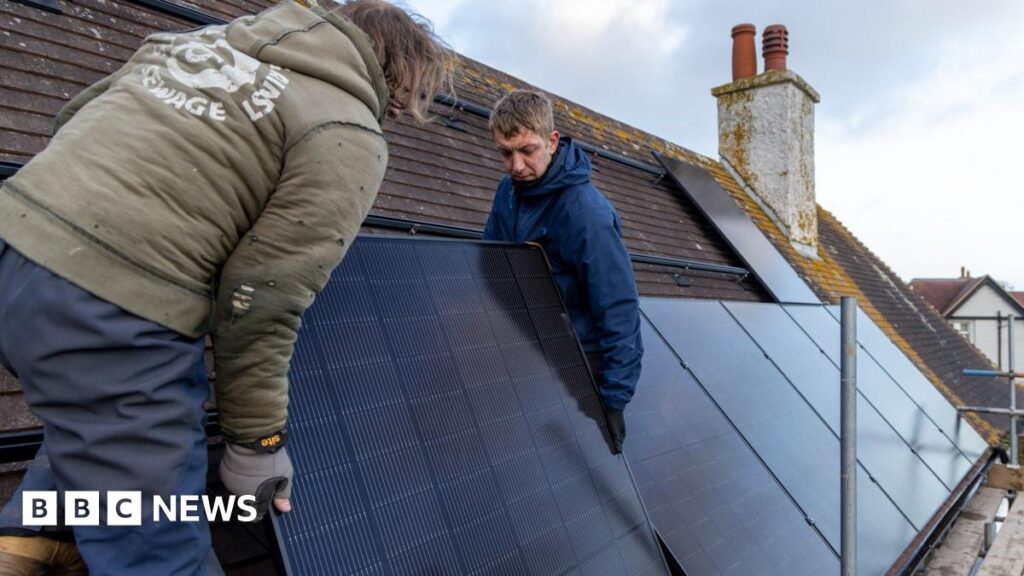
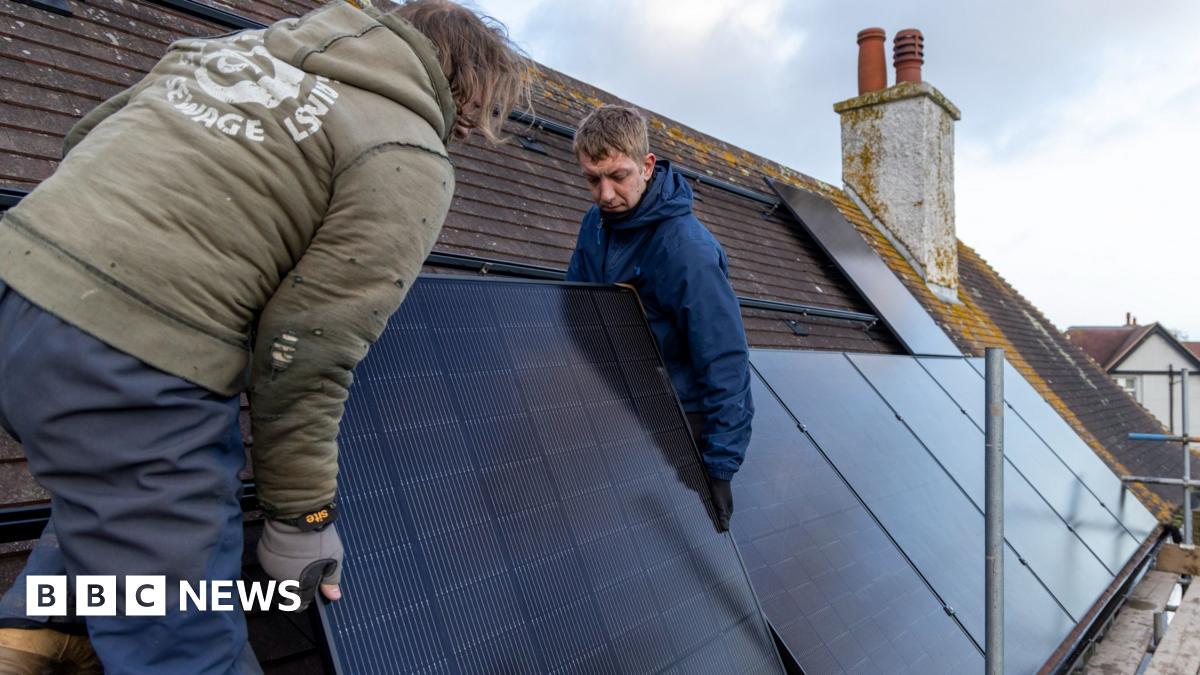
Our local council started putting these up on some of the houses that haven’t been swallowed up by landlords. Panels last 20-25 years and pay for themselves in 10.
FelisCantabrigiensis on
Most of this can’t apply to anyone in a Conservation Area (which is 5% of all housing and more of old inefficient housing) and very little of it to anyone in a Listed building.
Strict_Pie_9834 on
With all the wind turbines off coast you’d think that would bring down prices…
TomorrowFinancial468 on
Our landlord installed ours years ago, plugged directly into the grid instead of energy for us to use. Robbing bastard
candidate881255 on
We have some of the world’s most reliable and readily utilisable wind resources whereas household solar is basically greenwashing – liked by politicians because it’s visible and enables the public to “join in” but as most electrical engineers will point out is a massive folly built on incredibly misleading output figures.
Energy output stats with a 1 dimensional “X kW” figure are entirely meaningless. The absolute bare minimum should be “X kWh per annum”, but even that isn’t a particularly realistic indicator of actual assistance in reducing CO2 based energy requirements (ie, all requirements: electricity, heating and transport – the latter two being the biggest challenges).
The problem with household solar in the UK will always be that it only produces significant ouput for the middle ~6 hours of clear/lightly-clouded summer days when staggering percentages of that stated “X kW” output is simply wasted and does nothing to help reduce our most CO2 intensive energy issues (for all the main 3 types: electricity, heating and transport).
Storing electrical energy for weeks or months is many decades away from reality and the infrastructure would inevitability entail extremely large CO2 output in itself.
Solar farms do have a part to play but household solar is of extremely dubious environmental benefit.
We have some of the world’s most reliable winds offshore in the North Sea, but the problem is that goes unseen (apart from the pylons which are extremely politically toxic) and so is being cancelled (or “on hold” …indefinitely) for gimmicks that won’t actually reduce our CO2 energy output (electricity, heating and transport).
Permaculture_hings on
I guess I’m happy that people on the breadline will benefit from this but I also know a lot of people who are far from rich who will not be eligible for this.
Is this Starmers plan? To come up with a load of policies that don’t quite do enough? To look out for the 10% of poorest and the 10% of richest in the UK and fvck everyone else?
Professional-Bear857 on
They’d certainly get more uptake by offering interest free loans, I don’t understand why these things cant just be added to the mortgage, then you’d be paying it off as you save on energy bills and aren’t any worse off upfront or on a monthly basis, due to this offset.

8 Comments
Got excited then. Looked it up on gov.uk.
> Your household income must usually be £36,000 a year or less.
Of course.
Our local council started putting these up on some of the houses that haven’t been swallowed up by landlords. Panels last 20-25 years and pay for themselves in 10.
Most of this can’t apply to anyone in a Conservation Area (which is 5% of all housing and more of old inefficient housing) and very little of it to anyone in a Listed building.
With all the wind turbines off coast you’d think that would bring down prices…
Our landlord installed ours years ago, plugged directly into the grid instead of energy for us to use. Robbing bastard
We have some of the world’s most reliable and readily utilisable wind resources whereas household solar is basically greenwashing – liked by politicians because it’s visible and enables the public to “join in” but as most electrical engineers will point out is a massive folly built on incredibly misleading output figures.
Energy output stats with a 1 dimensional “X kW” figure are entirely meaningless. The absolute bare minimum should be “X kWh per annum”, but even that isn’t a particularly realistic indicator of actual assistance in reducing CO2 based energy requirements (ie, all requirements: electricity, heating and transport – the latter two being the biggest challenges).
The problem with household solar in the UK will always be that it only produces significant ouput for the middle ~6 hours of clear/lightly-clouded summer days when staggering percentages of that stated “X kW” output is simply wasted and does nothing to help reduce our most CO2 intensive energy issues (for all the main 3 types: electricity, heating and transport).
Storing electrical energy for weeks or months is many decades away from reality and the infrastructure would inevitability entail extremely large CO2 output in itself.
Solar farms do have a part to play but household solar is of extremely dubious environmental benefit.
We have some of the world’s most reliable winds offshore in the North Sea, but the problem is that goes unseen (apart from the pylons which are extremely politically toxic) and so is being cancelled (or “on hold” …indefinitely) for gimmicks that won’t actually reduce our CO2 energy output (electricity, heating and transport).
I guess I’m happy that people on the breadline will benefit from this but I also know a lot of people who are far from rich who will not be eligible for this.
Is this Starmers plan? To come up with a load of policies that don’t quite do enough? To look out for the 10% of poorest and the 10% of richest in the UK and fvck everyone else?
They’d certainly get more uptake by offering interest free loans, I don’t understand why these things cant just be added to the mortgage, then you’d be paying it off as you save on energy bills and aren’t any worse off upfront or on a monthly basis, due to this offset.