

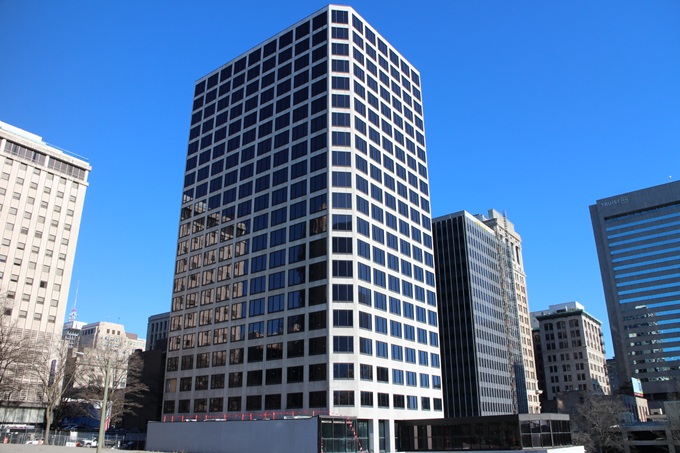
The 20-story Eighth & Main tower is being converted to apartments and a hotel. (Jonathan Spiers photo)
A $158 million makeover of a former Dominion Energy office building downtown is marking the first use in Richmond of a state incentives program for energy upgrades that’s been years in the works for the city.
Douglas Development’s conversion of the 20-story Eighth & Main tower at 707 E. Main St. into hundreds of apartments and hotel rooms is being funded in part with a $38 million loan administered by the Virginia PACE Authority through its Commercial Property Assessed Clean Energy (C-PACE) Financing Program.
The loan is the first application of C-PACE in Richmond since city council adopted an ordinance opting into the state program three years ago. The program, which is sponsored by the Virginia Energy department, provides commercial property owners with financial incentives to include clean energy and water efficiency upgrades in redevelopment or new-construction projects.
The fixed-rate loans the program provides through a network of registered lenders are placed as a special assessment lien against the property. The loans are repaid through property taxes, and the assessments carry over when a property is sold.
Douglas Development’s loan is being financed through Nuveen Green Capital, a national lender that focuses on C-PACE financing. The loan will cover exterior LED lighting, low-flow plumbing and energy-efficient HVAC systems that will be installed as part of the project, which is converting the 50-year-old building into 290 market-rate apartments above a 200-room hotel carrying Marriott’s AC Hotels brand.
Isaac Rudin, Douglas’s capital markets and investments manager, said the D.C.-based developer has used C-PACE loans on other projects, most recently a hotel in Georgetown, and had the program in mind when it purchased the Eighth & Main building in late 2024 for over $19 million.

Isaac Rudin
“When we were going about the underwriting process, it didn’t pencil out with traditional financing, so we turned to this hotel that we had done in Georgetown and said: We were able to use C-PACE to finance this hotel; would C-PACE work on this adaptive reuse deal?” Rudin recalled.
“It turns out that it was the exact program that we needed,” he said. “It filled the hole in our capital stack and really made it a reality.”
The rest of the financing for the project, which Rudin put at $158 million, consists of a mix of equity and debt, the latter to be covered by a loan from Bank Hapoalim out of Israel. The project also involves state and federal historic preservation tax credits.
The financing closed Dec. 30. Rudin said the deal wouldn’t have been possible without the C-PACE loan.
“Doing any sort of adaptive reuse of a historic building is incredibly expensive. There’s this level of respect for all of the historic elements in a building that you have to have, and the way that we do it is governed by the National Park Service and by the state of Virginia ensuring that we are preserving the character of the building,” Rudin said.
“A lot of what we’re doing is retrofitting the existing structure of the building with new plumbing, new electrical, new HVAC, and those are all things that C-PACE is designed specifically to finance,” he said. “We had a wealth of C-PACE improvements here and easily financed that full amount.”
The program’s rollout in Richmond has been a decade in the making, going back to 2016, when council directed city staff to look into developing a C-PACE program for Richmond.
Three years later, at the urging of then-members Kristen Nye and Parker Agelasto, council adopted its own C-PACE program, but held off on implementing it in 2020 in light of the General Assembly approving the state program that year. City leaders favored the cost savings that would come from using the state program, which is administered uniformly by Virginia PACE, a nonprofit.
Abby Johnson, Virginia PACE’s executive director, said the program’s implementation in Richmond has been slowed by the lending market for commercial real estate projects in recent years, as well as by awareness of the program that she expects will catch on with Douglas’s project leading the way.

Abby Johnson
“The two main hurdles to using C-PACE are being enabled and getting the consent of senior lenders,” Johnson said.
“I have to say, ’23 and part of ’24 were kind of rough, particularly ’24 from a lending perspective. The banks pulled back a lot and they weren’t lending as much and were very cautious, and so when they don’t, if the senior lender doesn’t come in and do it, there’s no PACE,” she said, “because PACE is not covering the whole (project financing).”
Richmond joins 20 other localities in Virginia that have passed enabling legislation to participate in the program. Others locally include Chesterfield and Henrico counties and the City of Petersburg. Johnson said localities can use the program as a tool to advance economic development while also promoting clean energy policies.
Of the awareness that could come from Douglas’s project, Johnson added, “We do really hope this is going to help.”
As for the project itself, work on the building conversion started last year, with interior demolition getting underway in the fall.
Rudin said Douglas is aiming for the bulk of the apartments and hotel rooms to be finished in mid-2027. CBG Building Co. is the general contractor, and Fillat+ Architecture is the architect.
The project is across the street from Douglas’s Residences at Richmond Trust, a 200-unit redevelopment of the 12-story building that was once offices for the Virginia Department of Environmental Quality.
Print Article