
My name is Tyler Boland, and I’m a 22-year-old college student majoring in history at a liberal arts college in Reading, PA. Growing up there in Berks County, there was a strong culture and proud heritage in a working-class made up of family members of World War veterans. Both of my Great-Grandfathers served proudly in their service during World War II, one in the Navy, the other in the Marines. But there were several key elements that stirred my interest in history.
[Ed Note: When I heard what Tyler Boland was doing to preserve the voices of WWII veterans, I had to reach out. Here he is with two veterans’ stories about WWII Jeeps; they’re short, but any new story from a WWII veteran is as good as gold. Thank you eBay for enabling this piece as part of The Autopian’s WWII Jeep build series. -DT].


The first influence was close to home. My mother began her career in education as a history teacher. Growing up, my interest in American History centered around the major events that shaped our Nation’s role in the defense of liberties across the globe. At first, wanted to learn about early American history, but as I got older my interests started to change.
In the fall of my freshman year of high school, 2019, my third-period class was history. We were supposed to meet a Veteran who served in Iwo Jima in the Marine Corp. As my interest in WWII started to grow at this time, I was very excited. But the day before he was supposed to come into our school, he passed away, at the age of ninety-four. This was devastating, but it pushed me to find a WWII veteran whom I could speak with about the War.
After doing admittedly amateur research, I found a local D-Day veteran in my hometown of Reading named Joseph Zebertavage. I went to this 95-year-old’s house, very nervous, armed with only a pen and paper, not certain what I was going to ask this gentleman. After talking with him, I realized that what was delayed on that first visit to my school only proved to be the experience that launched my drive to learn everything I could about World War II history.
This first encounter with the Veteran took place in April of 2019. Later that Spring, in June, I decided to attend The Mid-Atlantic Air Museum’s World War II Weekend, the premier event of its kind for honoring our history through D-Day remembrance, vehicles and aircraft displays, war Veterans and speakers, battle simulations, and vintage aerial planes and flight demonstrations.
That year marked the 28th annual event. It was a formative experience that forever shaped my drive to learn firsthand, from those who served and were still living, what occurred during the trying time that was World War II. At the show, I met another WWII veteran, Matt Gutman, who was from the Allentown, PA area. He served as a Higgins Boat driver for the 1st Marine Division. Coincidentally, he served with one of my great-grandfathers, who served in WWII as a Marine. These proud and inspirational men helped fill the void of not meeting my great-grandfathers, who both died before I was born. “Why did you get started? What got you interested in this?”
The fact that I had two family members whom I had never met who were heroes drove me crazy. Since that realization, I made a promise I would interview as many WWII veterans as I could, regardless of their story and where they are located.
At first, it was hard finding them, but over time, I found more. My goal was to meet one hundred, and at this point, I have well passed that. What started off as a high school project has evolved into something more. I interview at least one to two WWII veterans every week. Not only do I interview them, but I do many events with them. I host dinners, take them to veteran events, and even partner up with veteran organizations to take them back to their battlefields.
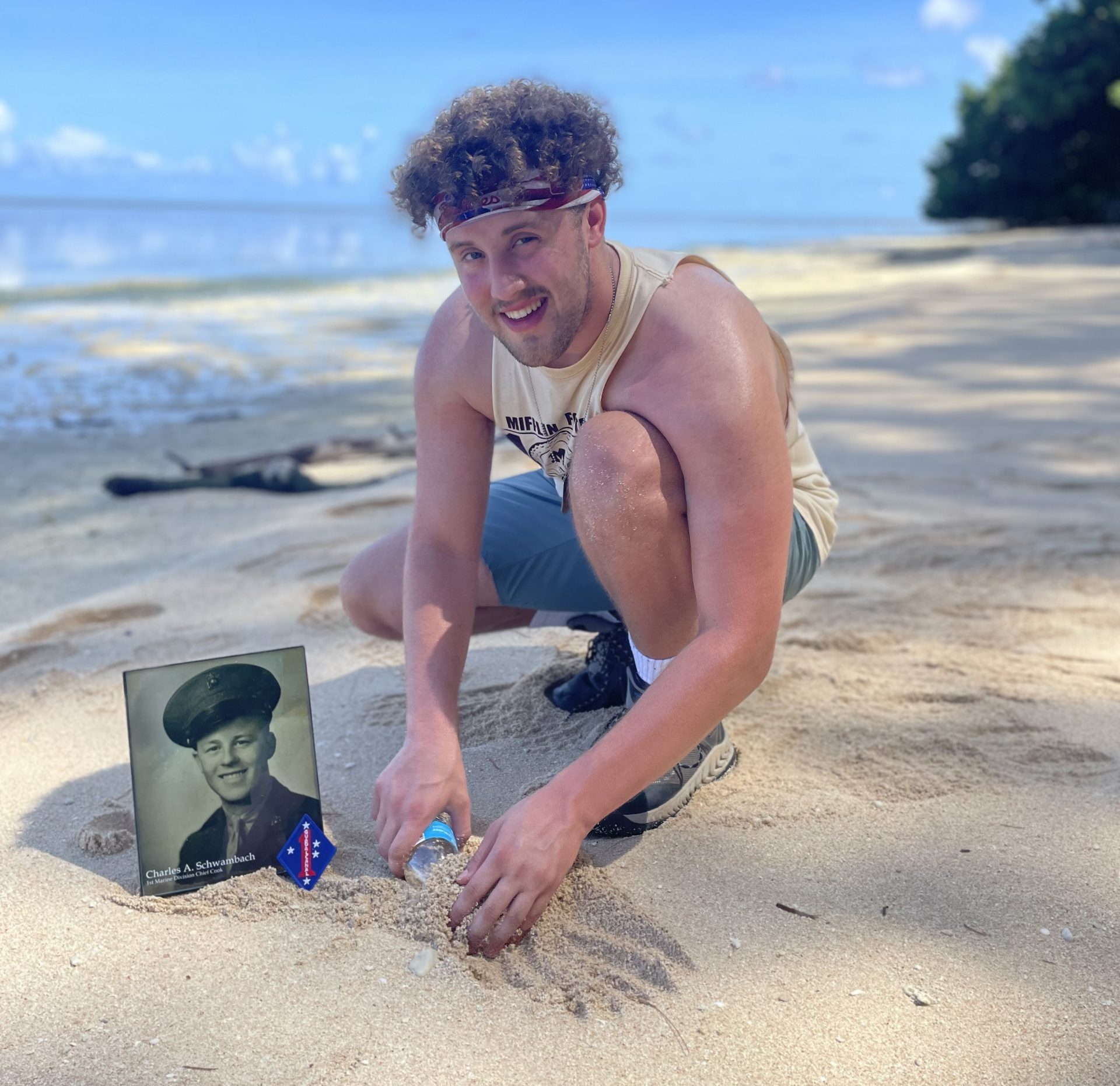
I could write hundreds of pages about the adventures I’ve had with this growing WW2 “hobby.” But the most impactful was the 42-hour trip I took this past May. I went across the world and traveled to the country of Palau. Within this island nation, I traveled to the island of Peleliu. Today it’s a peaceful, beautiful, hot paradise, but 80 years ago it was the site of one of the bloodiest battles in all of WWII. A battle that should’ve lasted three days took two months. It was so important for me to get there because of my great-grandfather. He had served with the 1st Marine Division and landed on Orange Beach. On this island, he received two Purple Hearts, which ended his fighting during WW2.
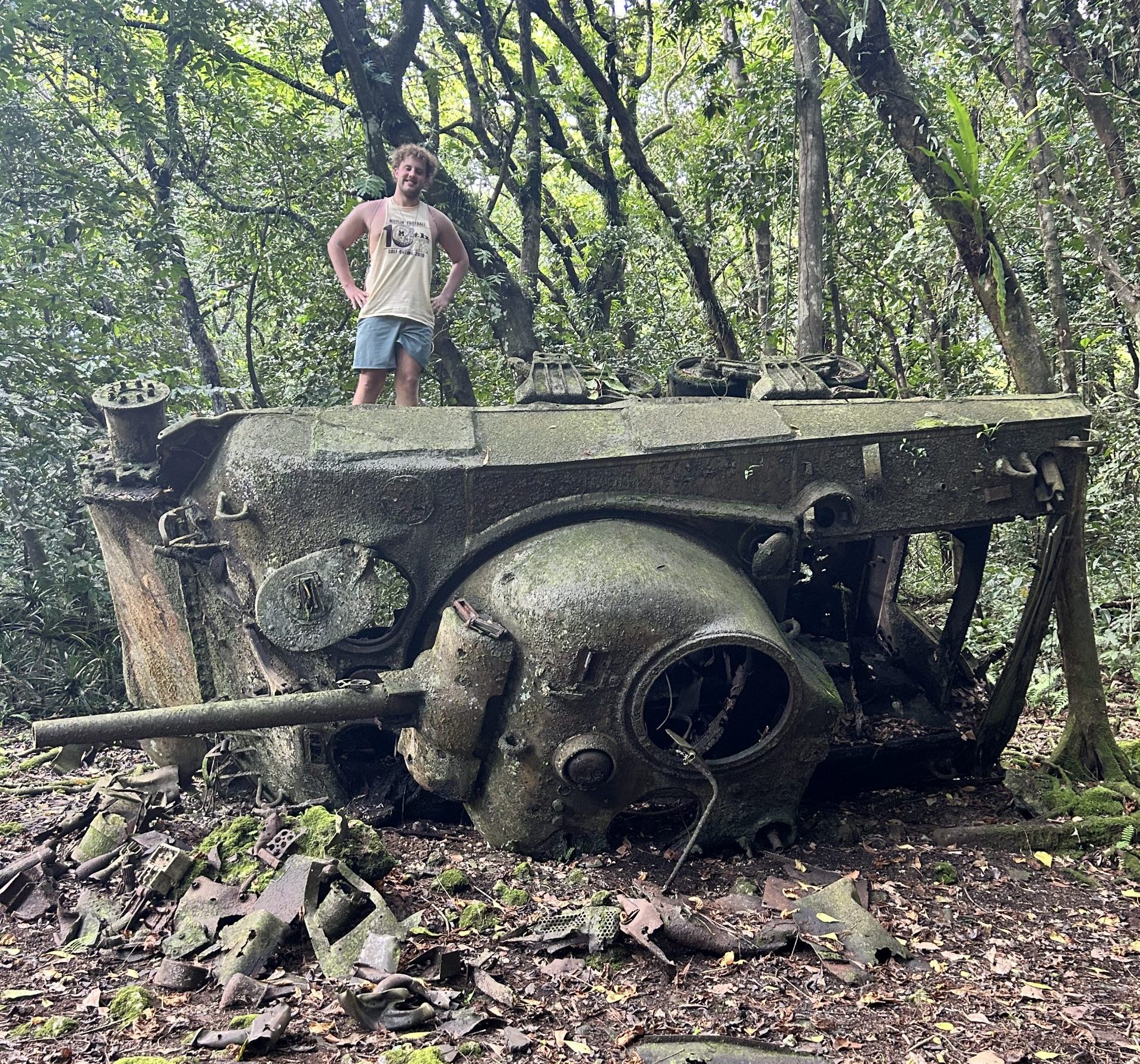
On this island, you can still see war relics that remain—tanks, planes, bombs, etc. I always say it’s like the war happened yesterday, but everyone just went home and left everything behind. It was a very emotional experience to go to this island, because I was the only family member of my great-grandfather to return there.
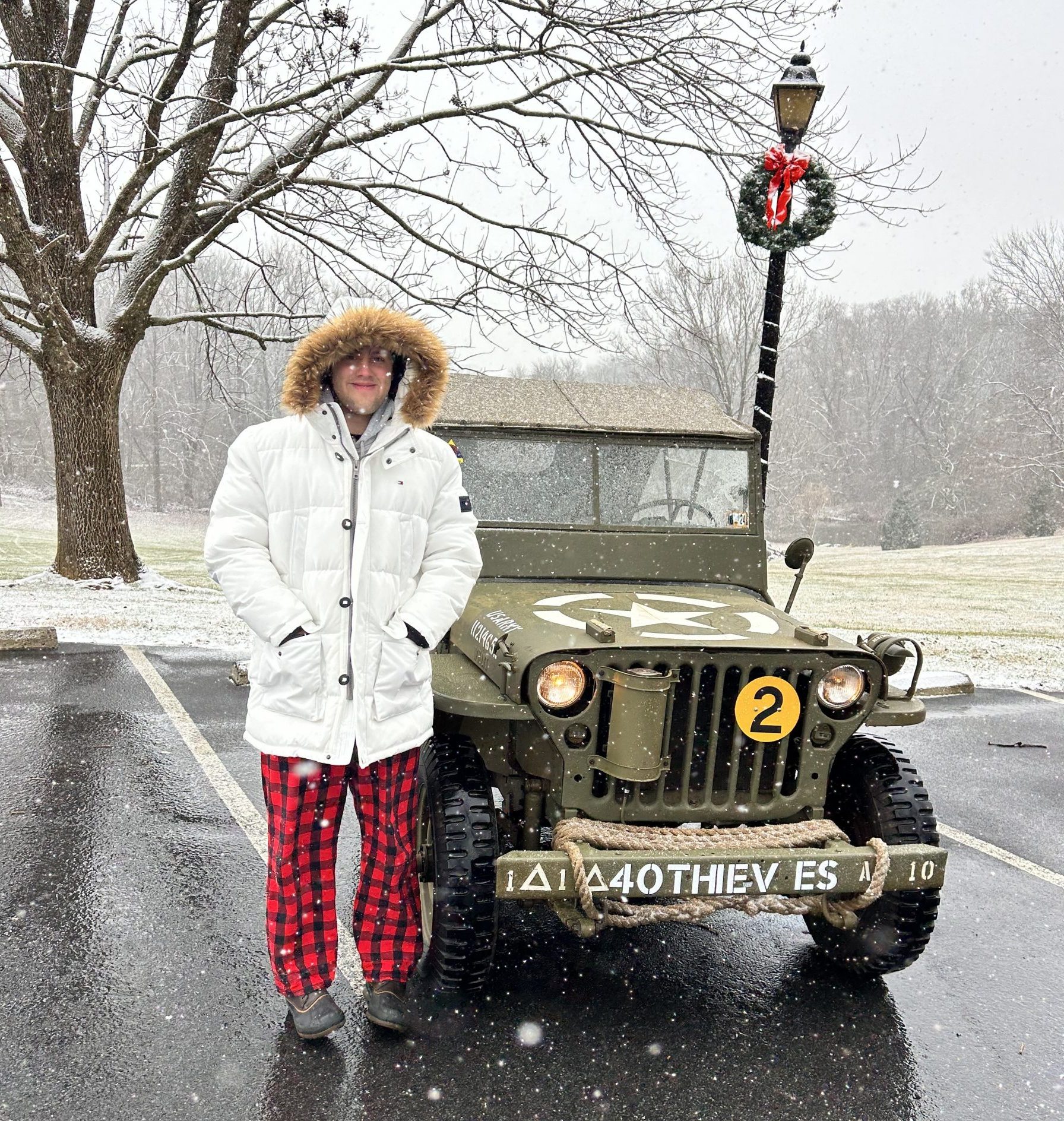
Within this journey, I bought a WWII jeep (Willys MB ’45). About two years ago, my father and I drove up to upstate New York and bought this beautiful jeep. But the jeep did not run. I had a vision that I was going to name my WWII jeep after my great-grandpa and restore it to drive my heroes around. After a year and a half, I did just that, and every 4th of July, Memorial Day, and Veterans Day, I take dozens of WWII vets in my Jeep, ride and honor them in parades in honor of my Great-Grandfathers.
It has been a good run so far. I now have a Facebook with 115,000 followers, a YouTube channel, and a website all called “Keeping History Alive.” I have interviewed hundreds of WWII veterans, traveled the world with them, and documented their stories to preserve them for history books. Along the way, my work has been featured on national news four times, and I even reunited two WWII veterans after 81 years, one of the craziest and most meaningful moments of my life.
As I always say, I am nothing special — I am just on a mission to find these heroes. A college kid with a camera. Anyway, let’s get to two of my more recent interviews in which I asked — on behalf of The Autopian’s WWII Jeep build backed by eBay — for some WWII Jeep-related stories:
Truman Christian (106th Infantry Division): One Jeep, Two Friends, and the Cost of War
 Image: Truman Christian
Truman told me this happened around mid-March 1945, when he was with the 106th Division, 424th Regiment, Heavy Weapons Company D, holding a position along the Siegfried Line in the Ardennes. That’s here:
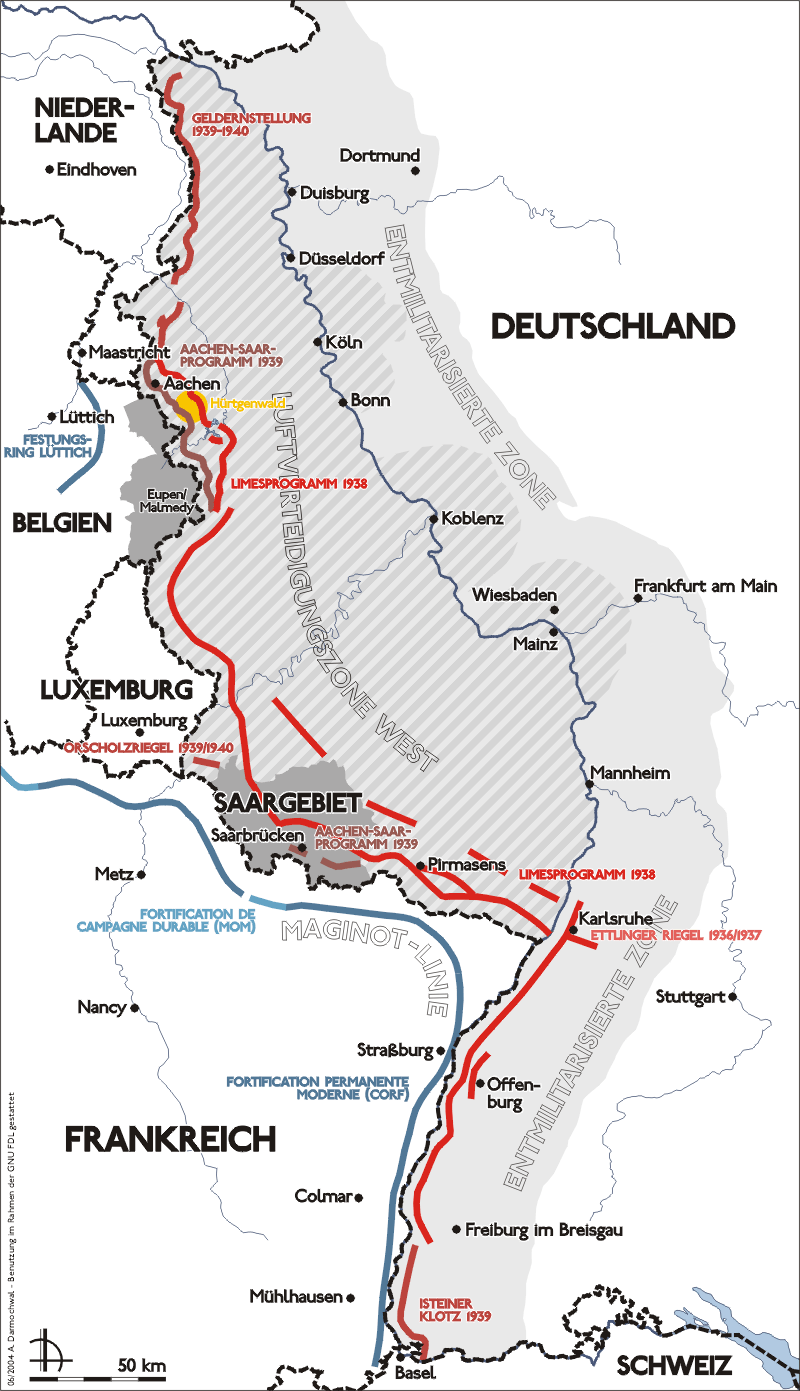 Image from Wiki/creative commons
Conditions were rough, and the Germans watched every move the Americans made. Truman had become close friends with a motor pool guy named Tony Rudge — the Jeep driver who brought mail and chow up to the line. One day, Tony asked Truman to help him turn his jeep around on a narrow, snow-covered road so he could make a fast run over a hill before the Germans opened up on him. They had tried to hit him many times before. But this time, the Germans were ready.
As soon as they got the Jeep positioned and started moving, machine-gun fire tore into them. Tony hit the gas. Truman was sitting in the passenger seat, and the two of them drove out of there just in time. As they were speeding away, they could actually see the bullet holes appearing in the windshield, the gun rack, and the side panels — shots that missed them by inches.
Later, when they went back, Truman saw a bullet lodged in the metal of the passenger seat right at gut level — exactly where he had been sitting. Another was stuck in the canvas top bow near his head. Another had ripped through the gun rack inside the windshield, a shot that could’ve hit either man.
 Image: Truman Christian
A week later, tragedy struck. Tony and the Jeep were disintegrated instantly when the wheel hit a hidden mine. The engineers had removed the top mines, but the tracks had worn down far enough to trigger a second one — a German trick. With that, they lost their mail, their chow, and Truman lost a friend he really cared about.
Even in war, Tony had a sense of humor and heart. Seventy years later, at a reunion in 2006, Truman’s old buddy Sam told him that Tony often kept small animals, like rabbits, under his jeep seat. He used them for trading or just to bring a little life to the soldiers along the line — a tiny reminder of home in the middle of the fighting. Truman imagines there were probably a rabbit or two under the seat the day of that attack, hidden among the chaos.
 Image: Truman Christian
“Oh, the terrible price of war,” Truman told me. Even at 100 years old, he still remembers Tony Rudge — a guy who carried more than just mail and chow in that Jeep. He carried a little piece of humanity in the middle of a brutal war.
Russell Sattazahn (1st Infantry Division): Held Onto The Jeep By One Hand!
 Image: Russell Sattazahn
Russell joined the 1st Infantry Division — the Big Red One — in late January 1945 as a replacement, right at the end of the Battle of the Bulge. He was assigned to the 18th Infantry Regiment, G Company, and pushed straight into the cold and the mud as they headed toward Germany. For about two and a half months, Russell fought his way forward with the division. But on March 24th, 1945, everything changed for him.
Outside of Bonn, there was a little town called Uckerath that his company was ordered to take. They gathered in a barn, got the word, and moved out across an open field. By this point in the war, most towns barely had any Germans left in them. But for whatever reason, this town was different. The Germans gave it everything they had.
As soon as Russell stepped into that field, a German machine gun opened up. He dove into a bomb crater with another GI, but the shots were getting closer and closer, kicking up dirt right at their feet. Russell looked at the other guy and said, “I’m getting out of here.” And he stood up and ran. At that moment, he was the only man left moving across the field.
He could actually see the machine-gun rounds hitting the dirt at his boots as he sprinted. Russell finally reached an abandoned house and dove into the basement. German 88s were hitting all around them. As he stood up and pushed into another room in the basement, an artillery shell came straight through the house and exploded. The blast blew off his right hand almost to the elbow.
Russell lay there the entire night calling for a medic. No one came until the morning of March 25th. Two medics finally reached him. They asked, “Can you run?” And Russell said yes. He ran outside and threw himself onto a stretcher.
 Image: Russell Sattazahn
A medical Jeep pulled up — two stretchers strapped across the hood and two on the back. Russell was put on the first stretcher on the hood. The shelling started again, so the driver hit the gas. They hit a big bump, and Russell’s stretcher slid right off — but with his left hand, he grabbed onto the jeep and somehow held himself there. “Hey, take it easy!” he yelled at the driver.
Russell could have easily fallen off and been killed by a Jeep, the same vehicle that was trying to save him, if it hadn’t been for a check. After what felt like forever, they made it to the 96th Evac Hospital. From there, Russell was sent to Paris for more treatment and eventually sent home.
Now at 99, Russell is a proud WWII Army veteran. He wears his Purple Heart, Presidential Unit Citation, Bronze Star, and two battle stars with the kind of quiet pride you only see in men who truly earned it.