
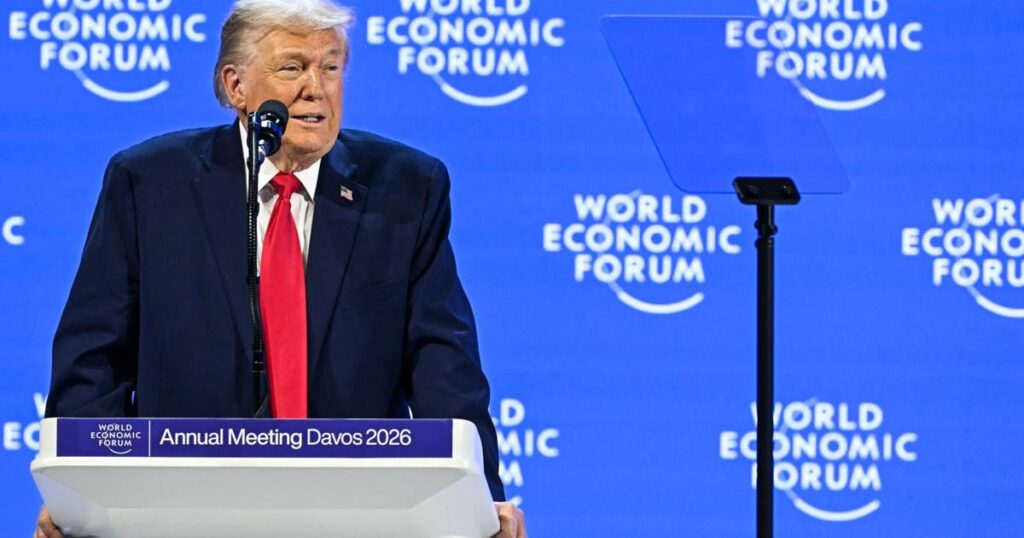
PARIS — U.S. President Donald Trump says there are talks underway on a “forever” deal over Greenland, the Danish island he has said America must acquire to protect against national and international security threats.

After an aggressive speech to the World Economic Forum in Davos, in which Trump laid out his country’s need for ownership of Greenland but ruled out threats of a military invasion, Trump posted the news about the terms of a possible Greenland deal on social media.
“We have formed the framework of a future deal with respect to Greenland and, in fact, the entire Arctic Region,” he wrote. “This solution, if consummated, will be a great one for the United States of America, and all NATO Nations.”
Based on the progress made at a bilateral meeting with NATO Secretary General Mark Rutte, Trump said he was suspending a series of tariffs that were to be levied against countries which had sent military support to Greenland last week to bolster its territorial sovereignty.
He added that U.S. Vice-President J.D. Vance, Secretary of State Marco Rubio and Steve Witkoff, his special envoy, would be handling the negotiations.
No details of the potential deal were offered, but Trump told reporters in Switzerland that the two sides were looking at “a long-term deal.”
He did not say whether it would allow the U.S. to acquire Greenland, which has been a red line for Danish and European leaders, one over which they were considering the imposition of major European Union trade sanctions intended to deter foreign economic aggression.
For the Danes, there were expressions of relief after weeks and months spent in Washington’s crucible.
Foreign Minister Lars Lokke Rasmussen just a few hours earlier had been relieved upon hearing Trump’s Davos speech that there was no intention to use American military force to annex Greenland.
“We welcome that (Trump) has ruled out to take Greenland by force and paused the trade war,” he said. “Now, let’s sit down and find out how we can address the American security concerns in the Arctic while respecting the red lines of the (Kingdom of Denmark).”
The tone from the Danes suggests there are still big issues to be resolved, while Trump gave the impression of a deal that is mostly wrapped up but for the signing ceremony.
“It gets us everything that we needed to get,” Trump said, a little cryptically, adding, “I think it puts everybody in a really good position, especially as it pertains to security and minerals and everything else.”
Asked how long the proposed deal would last, he said it would be “infinite.”
“There is no time limit … It’s a deal that’s forever.”
Aaja Chemnitz, a Greenlandic politician, was more insulted than optimistic. “NATO in no way has a mandate of its own to negotiate anything without us from Greenland,” she said.
“Nothing about us, without us,” she wrote on Facebook, taking a slogan used by Ukraine about in efforts to reach a peace deal to end its war with Russia. “And that NATO should have anything to say about our country and minerals is completely out of the question.”
The development capped a hectic day that featured Trump boasting to political and business leaders about American superiority and lashing out at increasingly wary world leaders.
Chief among them was Prime Minister Mark Carney who, a day earlier, delivered a keynote speech at Davos that denounced “great power” bullying and called for middle powers like Canada to forge new partnerships based on shared values and interests.
Carney never mentioned Trump or the United States by name, but the target of his defiant address was clear to all, including the American president himself.
Trump said that, despite Carney’s strong words condemning the new world order, Canada is totally dependent on America.
“Canada lives because of the United States,” he said.
The sharp jibe felt across the Canada-U.S. border was a very brief detour on a lengthy diatribe spelling out America’s need and determination to acquire Greenland, an autonomous territory that belongs to the Kingdom of Denmark. Trump said the U.S. needed to own Greenland in order to build and operate the Golden Dome missile defence system that is planned to protect North America.
“We’re going to build the greatest golden dome ever built,” Trump said. “It’s going to just by its very nature be defending Canada.”
He then criticized Canada for not being “grateful” for America’s protection.
“Canada gets a lot of freebies from us,” he said. “I watched your prime minister yesterday. He wasn’t so grateful, but they should be grateful to us, Canada. Canada lives because of the United States. Remember that Mark, the next time you make your statements.”
Questioned about Trump’s jibe before making his way back to Ottawa from Davos, Carney declined to comment.
Matt Lebo, a professor at the University of Western Ontario, said in an interview that Carney has taken the risky step of being among the first to step forward and stand up to the bully in the White House.
“If everybody takes a step forward then you’ve done something successfully and banded the kids together to be a united front against the bullying,” he said. “And if all the kids take one step back, then you’re screwed.”
It clearly raises the temperature, though, in an already testy Canada-U.S. relationship that is strained by American tariffs and headed into a renegotiation of the Canada-U.S.-Mexico trade agreement later this year.
But Canada-U.S. relations were a distant distraction from the main focus of Trump’s visit to the European continent, which has grown distinctly less indulgent of the White House’s political tempers and whimsy in recent weeks.
After Trump once again ramped up his threats to acquire Greenland, Denmark last week launched military exercises to beef up its presence on the Arctic island and assert territorial sovereignty.
Trump initially threatened tariffs against Denmark and those countries standing in solidarity with it, while dismissing the show of might.
He said in his Davos speech that if the U.S. decided to deploy the military to take Greenland “we would be, frankly, unstoppable.” This, even as he ruled that option out, saying, “I don’t have to use force, I don’t want to use force, and I won’t use force.”
In a bid to counter Trump’s Greenland plans, the European Union on Wednesday froze implementation of an EU-U.S. trade deal reached last year. Countries were also discussing the use of anti-coercion trade measures designed for combat nations that employ economic pressure against countries in the 27-member bloc.
In reaction to news of a potential deal, Italian Prime Minister Giorgia Meloni said she welcomed the development.
“As Italy has always maintained, it is essential to continue fostering dialogue between allied nations,” she wrote on social media.
Swedish Foreign Minister Maria Stenergard also celebrated the news that Trump had “backed away from tariffs against we who have supported Denmark and Greenland.”
“The demands for relocated borders have received well-deserved harsh criticism. That is also why we have repeatedly stated that we will not let ourselves be blackmailed,” she wrote on social media. “It seems that our work together with allies has had an effect.”
The announcement of a deal followed a chilling takeaway message from Trump: give me what I want, or else.
“We want a piece of ice for world protection,” he said of Greenland. “So they have a choice. You can say ‘yes,’ and we will be very appreciative, or you can say ‘no,’ and we will remember.”
It may be yet another example of Trump’s blustery, over-the-top approach to deal-making — one that casts disdain on the sanctity of previous deals, even those that have been in place for decades.
For example, he referenced a 1941 agreement between the Americans and the exiled government of Denmark, which was occupied by Nazi forces. The deal had the U.S. agreeing to defend Greenland against attack or invasion while stating that “the sovereignty of Denmark over Greenland is fully recognized.”
A subsequent 1951 agreement allows the U.S. military to operate in Greenland alongside and with the permission of the government of Denmark, its NATO ally.
But Trump said American leaders were “stupid” to have given control of Greenland back to Denmark after the war. He referred to the island as “a big, beautiful piece of ice” that is “actually part of North America.”
He also referred to Greenland at several instances in his speech as “Iceland.” It was not clear if the U.S. president was attempting to make a joke about Greenland being mostly covered by ice, or if he was confounding it with the smaller island nation off the east coast of Greenland in the North Atlantic Ocean.
Nevertheless, Trump said Greenland was “on the northern frontier of the Western Hemisphere,” was “our territory,” and was “a core national security interest of the United States of America.”
“Every NATO ally has an obligation to be able to defend their own territory. And the fact is, no nation or group of nations is in any position to be able to secure Greenland other than the United States,” Trump said. “We’re a great power, much greater than people even understand.”
Then he proceeded to attack various other nations in virulent fashion.
Trump reduced his Swiss hosts in Davos to little more than talented watchmakers while remarking that “without the U.S. they wouldn’t make anything.”
Trump told his European audience that “you’d all be speaking German and a little Japanese, perhaps” if the U.S. had not joined the Second World War. And he claimed that the American economy “is keeping the whole world afloat.”
“Without us, most of the countries don’t even work. And then you have the protection factor with our military, which is the greatest in the world by far,” Trump continued. “Without our military you have threats that you wouldn’t believe. You don’t have threats because of us.”