
Ottawa signals auto plant investments as leverage in $43b Korea–Germany submarine race
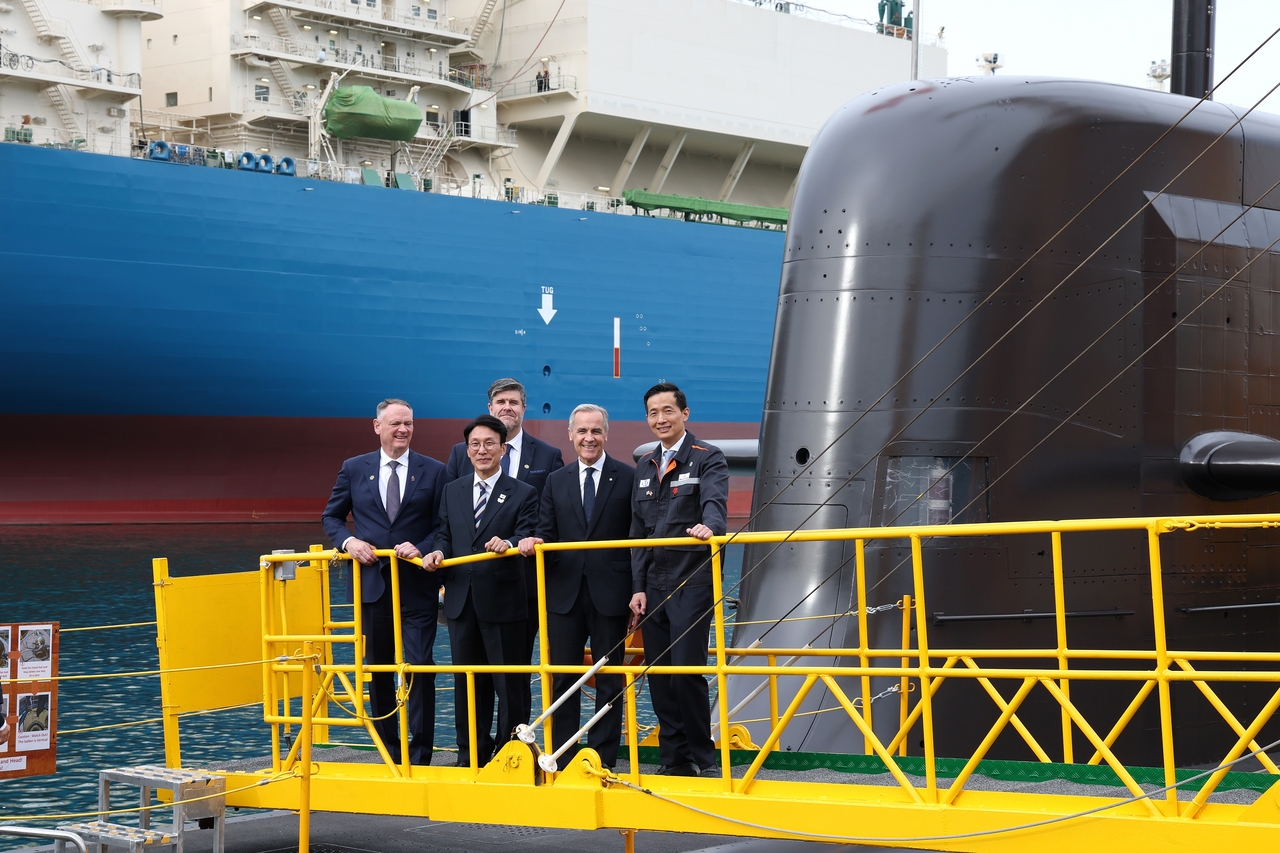 Canadian Prime Minister Mark Carney (front row, third from left), South Korean Prime Minister Kim Min-seok (front row, second from left) and Kim Dong-kwan, vice chair of Hanwha Group (front row, fourth from left), pose aboard the Jang Yeong-sil, a submarine built by Hanwha Ocean, in Geoje, South Gyeongsang Province, on Oct. 30. (Hanwha Ocean)
 Hyundai Motor Group has become an unexpected “wild card” in South Korea’s all-out bid to win Canada’s multibillion-dollar submarine contract, after Ottawa signaled it wants not only warships, but also major industrial investments, including the possibility of a Hyundai auto plant on Canadian soil.
According to defense industry officials, Canada has floated a condition for its Canadian Patrol Submarine Project — a planned purchase of up to 12 new diesel-powered submarines to replace the country’s aging fleet — that would require auto investments from Hyundai, representing Korea, and Volkswagen, representing Germany.
The CSPS is one of Canada’s largest defense acquisitions in recent decades, with the contract valued at around 60 billion Canadian dollars ($43.39 billion). Should South Korea secure the deal, it would mark the largest single export order in the country’s defense industry history.
South Korea, led by a consortium of Hanwha Ocean and HD Hyundai Heavy Industries, is up against Germany’s Thyssenkrupp Marine Systems, the world’s largest maker of non-nuclear submarines. Canada is expected to receive final proposals by March 2, with plans to choose a preferred bidder in the first half of the year.
With the two final countries seen as comparable in terms of core capabilities, observers say the outcome may hinge on industrial offsets, referred to as Industrial Technological Benefits, which require companies winning major defense procurement to reinvest in Canadian industry. Canada has reportedly asked Germany to ramp up Volkswagen’s auto production in the country.
In addition to automobile facilities, Canada has also requested investments in sectors spanning liquefied natural gas infrastructure, rare earth mining, small modular reactors and high-speed rail, according to local reports.
That push has now turned Hyundai into a key variable in this submarine deal. Presidential chief of staff Kang Hoon-sik, who serves as Korea’s special envoy for strategic economic cooperation, said Canadian officials directly raised the issue of bringing Korean auto production to Canada.
Citing a recent conversation with Canada’s Industry Minister Melanie Joly, Kang said that Canada emphasized its need for car manufacturing and sought Hyundai Motor’s participation, during an interview on the YouTube channel hosted by political commentator Kim Ou-joon.
“They’re making a demand saying, ‘We’re buying weapons, and this is what we need.’ And Germany says Volkswagen is willing to do more, trying to pit us against each other,” he said.
According to sources, senior executives from Hyundai Motor and Hanwha Ocean will join Kang and Industry Minister Kim Jung-kwan on a trip to Canada next week to meet with Canadian Prime Minister Mark Carney and other senior officials to discuss the project.
Hyundai Motor declined to comment on the visit or the prospect of a manufacturing facility.
Facing sudden pressure, Hyundai now faces a dilemma over whether to consider building a new manufacturing facility in Canada.
Hyundai previously established a manufacturing plant in Bromont, Canada, in 1989 with an annual production capacity of 100,000 units, but closed after four years of operation. Due to this past experience, any decisions regarding the new facility will likely need to be approached with careful deliberation.
Hyundai has been growing steadily in the country, posting record annual sales of 146,185 vehicles last year, up 11 percent from the previous year to become the fourth-largest automaker. Including its smaller affiliate Kia and luxury brand Genesis, the carmaker sold a combined 249,028 vehicles.
Most vehicles Hyundai sells in Canada are exported from South Korea, with some supplied from its plant in Mexico.
Despite market growth, experts say that Canada’s domestic market may still be too small to justify a costly new manufacturing base on its own. Together, Hyundai and Kia hold just 13 percent of Canada’s roughly 1.9 million-vehicle auto market. In addition, the group has already made major commitments elsewhere, including its Metaplant in the US, and pledged about $26 billion in nationwide investments.
With investment capacity constrained, observers say establishing a new facility would be difficult without clear assurances of sustained local demand.
“Building a factory would only make commercial sense if Hyundai could use it not only to serve Canada, but also to export to the US or Mexico to absorb enough volume,” said Kim Pil-su, an automotive engineering professor at Daelim University. “But under the current situation, that’s not as simple.”
Kim pointed to increased uncertainty under the protectionist policies of US President Donald Trump and renewed trade friction between Canada, the US and Mexico, saying there is no guarantee that the North American trade environment will remain stable.
“From Hyundai’s standpoint, this could require an investment of several trillion won, and it appears inefficient in the current environment,” said Kim, noting labor, operating costs and construction costs are all high.
Observers say that Hyundai’s participation would require concrete compensation arrangements or government incentives to justify constructing the facility. Some observers also point out that the company could present investment opportunities or partnerships that go beyond traditional car manufacturing, capitalizing on its diverse business portfolio spanning robotics, hydrogen and future mobility.
sahn@heraldcorp.com