
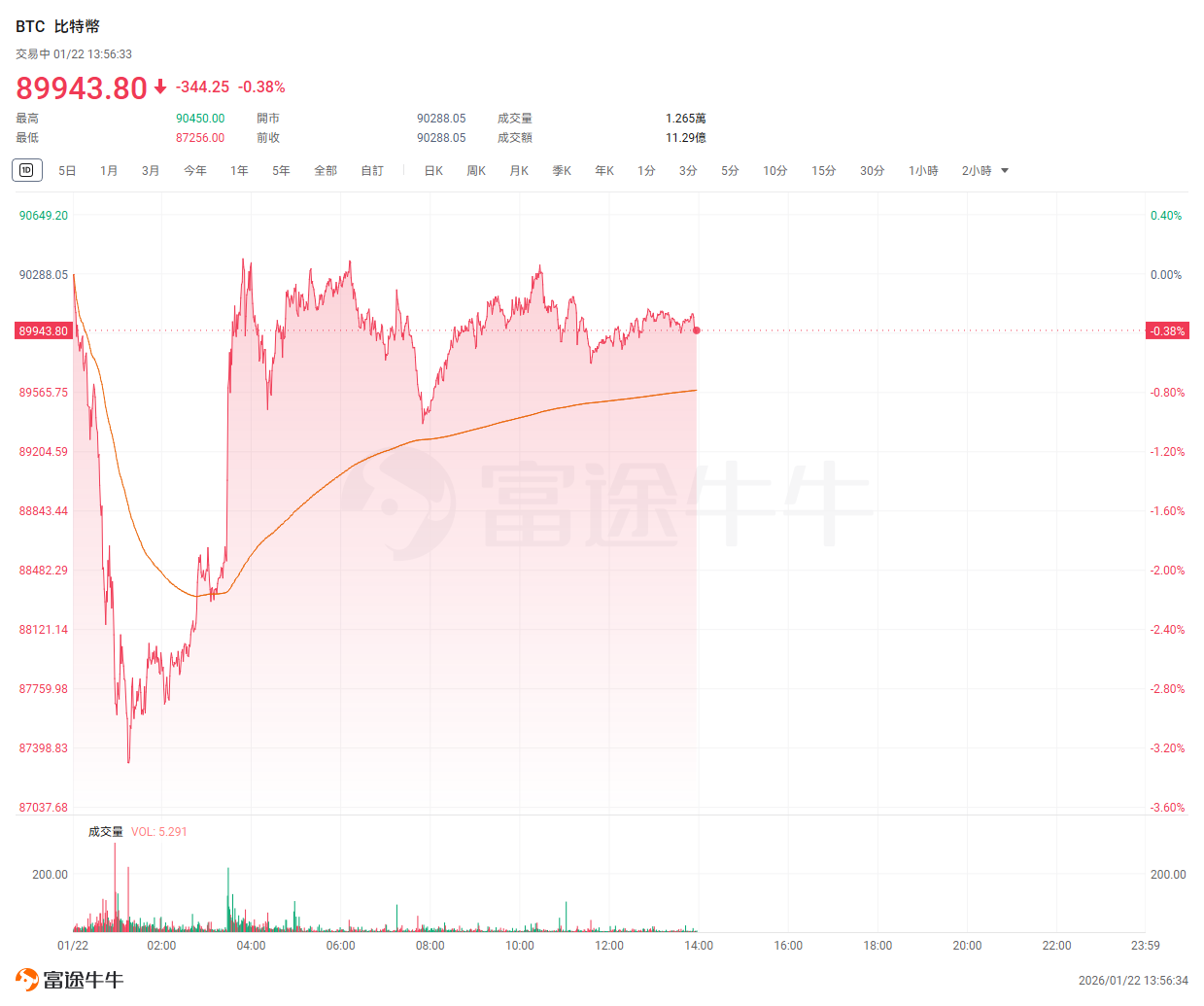
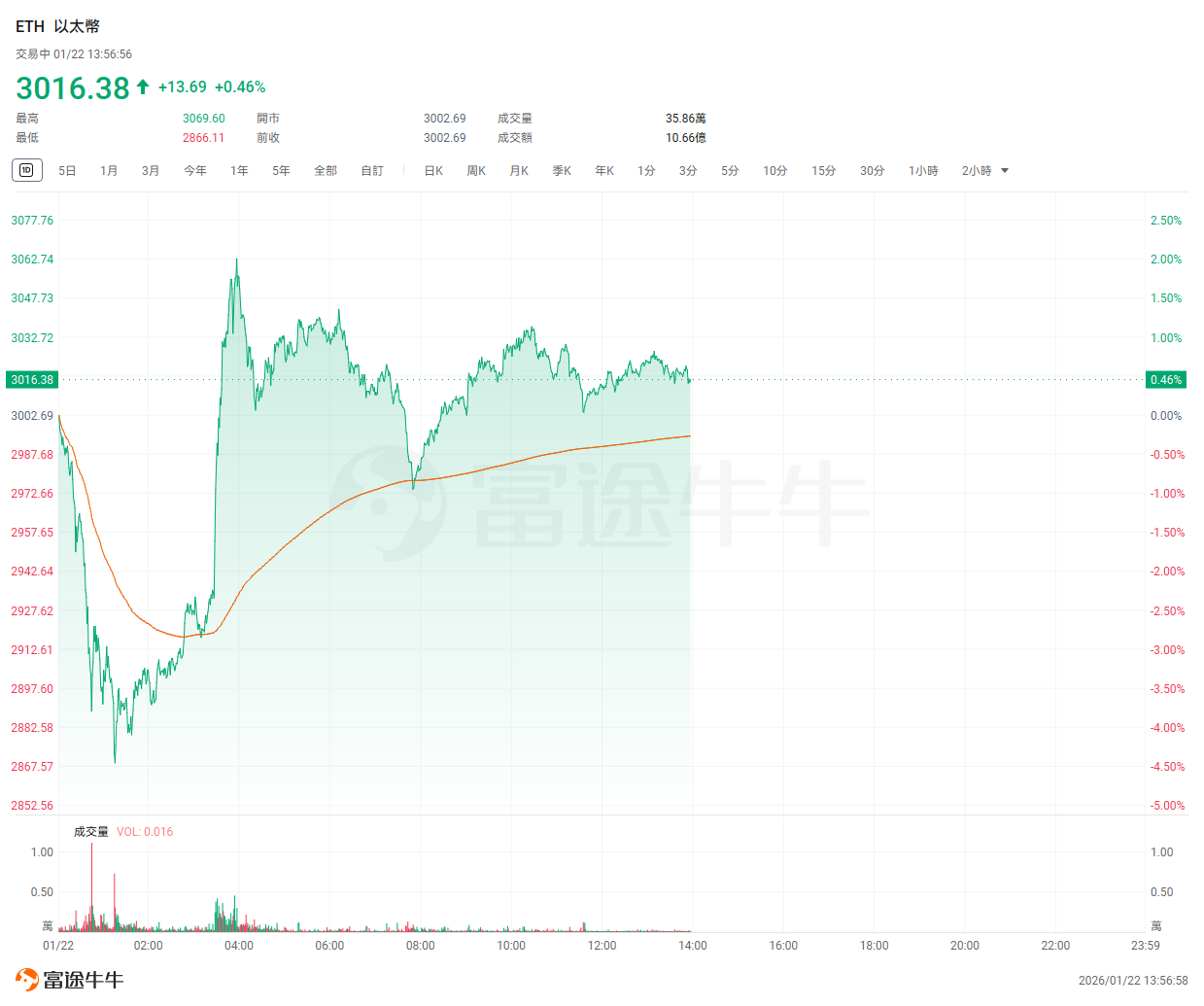
January 22 report: The cryptocurrency market experienced fluctuations. As of press time, $Bitcoin (BTC.CC)$Bitcoin fell by 0.38%, trading at $89,943.8; $Ethereum (ETH.CC)$ Ethereum rose by 0.46%, trading at $3,016.38.
Key Focus
 The review process for cryptocurrency regulation in the U.S. may be postponed for at least several weeks as key lawmakers are now focusing on housing-related legislation to implement President Trump’s affordable housing agenda. Despite cryptocurrencies being a priority for Trump and his administration, housing remains the largest monthly expense for most Americans and a major contributor to inflation.
Regarding the crypto bill, according to sources familiar with the matter, the committee might delay the consideration of significant digital asset legislation again (after already postponing it last week) until late February or early March. This has raised new questions about whether the Senate’s efforts to establish new regulatory frameworks for the cryptocurrency market will ultimately succeed. However, last week, Coinbase publicly stated that the revised version of the Senate’s regulatory framework for the cryptocurrency industry had “too many issues,” resulting in the postponement of the legislative work after Coinbase unexpectedly withdrew its support.
Coinbase CEO Brian Armstrong explained that the company could not support the bill due to its “numerous issues,” including a de facto ban on tokenized stocks, prohibitions on decentralized finance, and potential measures that could “stifle stablecoin rewards.” This legislative delay may provide stakeholders in the financial and cryptocurrency industries more time to lobby for a consensus-based legislative agreement that garners broad support.
-
BitGo’s U.S. IPO is priced at $18 per share, above the expected range, valuing the company at over $2 billion.
January 22 report: According to Bloomberg, crypto custody firm $BitGo Holdings (BTGO.US)$priced its U.S. IPO at $18 per share, surpassing the initially expected range of $15 to $17. The company and existing shareholders sold a combined 11.8 million shares, raising approximately $213 million. Based on the current issued capital, the valuation exceeds $2 billion. Led by Goldman Sachs and Citi as the main underwriters, BitGo will list on the NYSE this Thursday under the ticker symbol “BTGO,” becoming the first crypto company to complete an IPO in 2026.
According to Bloomberg, F/m Investments has applied to the U.S. Securities and Exchange Commission (SEC) for an exemption to record part of its $6.3 billion three-month U.S. Treasury ETF (ticker: TBIL) on the blockchain, creating a testbed for the tokenization of traditional assets. This application does not alter the ETF’s portfolio structure or trading method; it only implements on-chain registration of shares in the backend, ensuring consistency with existing shares in terms of fees, rights, and disclosures. If approved, this case will serve as a key test for integrating blockchain technology into the U.S. asset management system.
According to a Binance Wallet announcement, SENT tokens will officially begin circulation at 18:00 (UTC+8) on January 22, 2026. Users who have claimed their Prime Sale Keys can check balances and participate in trading through Binance Alpha immediately after SENT goes live.
According to an announcement by Uniswap Labs, the Continuous Clearing Auction (CCA) feature has been officially deployed on the Base chain. Any developer can conduct fully on-chain token auctions via CCA on Uniswap v4, discovering real market prices and initiating liquidity. The feature is permissionless and free to use. Uniswap has also provided a configuration guide to assist project teams with quick integration.
According to Lookonchain monitoring, Tom Lee’s cryptocurrency investment firm$Bitmine Immersion Technologies (BMNR.US)$allegedly purchased 34,954 ETH from Kraken and BitGo within the past two hours, with a total transaction value of approximately $105.5 million.
According to Bloomberg, OpenAI CEO Sam Altman recently met with top investors in the Middle East, including Abu Dhabi’s state-owned fund, seeking a new round of financing of at least $50 billion, with a valuation target of $750 billion to $830 billion. This financing will be used to support the high costs of chips, data centers, and talent required for its AI system development. OpenAI has previously collaborated with Abu Dhabi-based investment institutions MGX and G42 and plans to invest over $1.4 trillion in AI infrastructure construction in the coming years. The current round of financing is still in its early stages, and the amount may still be adjusted.
-
Whale 0xfb7 Purchases Additional 10,000 ETH and Transfers to FalconX, Potentially Increasing Holdings
According to Onchain Lens monitoring, address ‘0xfb7’ purchased an additional 10,000 ETH (approximately $28.9 million) from WinterMute and transferred approximately $58.13 million to FalconX, likely continuing to buy ETH. The address currently holds 60,098 ETH, valued at approximately $179 million.
CZ announced on social media that he will participate in a panel discussion at the World Economic Forum (WEF) in Davos at 08:30 CET on January 22 and appear on CNBC at approximately 15:00 the same day. The corresponding Beijing times are around 15:30 and 22:00 on January 22, respectively.
Category Labs (formerly MonadLabs) announced on X platform that it may repurchase up to $30 million worth of MON tokens on the open market in the first half of 2026, subject to applicable regulations. The company stated that any repurchase activities will be at its discretion, which can be initiated, suspended, or terminated at any time. This announcement does not constitute a commitment to repurchase a specific number of tokens but indicates that Category Labs will consider opportunistic repurchases based on market conditions.
According to CoinDesk, David Sacks, a White House advisor on cryptocurrency and artificial intelligence, stated that once new market structure legislation is passed, the U.S. banking sector will widely adopt cryptocurrencies, particularly stablecoins. He predicted that the boundaries between banks and the cryptocurrency industry will disappear, eventually merging into a ‘digital asset industry.’ Sacks noted that many large banks are currently taking a wait-and-see approach due to unclear regulations, but the legislation will provide a clear framework for institutional participation.
He believes that banks may view issuing stablecoins as a way to generate returns and compete with fintech companies. Although the banking industry is currently lobbying against allowing companies to offer returns on stablecoins, Sacks expects that banks will eventually also tend to pay returns through stablecoin operations.
Garrett Jin, agent of ‘1011 Insider Whale,’ posted on the X platform stating that Tuesday’s decline in the U.S. stock market was not strongly related to the Greenland incident. Although U.S. stock indices fell on Tuesday, sectors related to artificial intelligence led the declines. In principle, this is merely a fundamental-driven rotation within the technology sector,Sector Rotationwhich belongs to micro-level logic and does not indicate any obvious panic selling driven by macro factors. The main driver of asset price fluctuations on that day was the sell-off in the global bond market. The decline in European and American bonds was related to the Greenland incident, while the drop in Japanese government bonds was triggered by an independent event where the Prime Minister proposed canceling the food consumption tax.
Today, Japanese financial institutions have announced market stabilization operations, and the Finance Minister has also held talks with the U.S. side to calm the market, leading to a rebound in Japanese bonds. The main reason for the volatility in European and American bonds was a report by Deutsche Bank analysts being bearish on the U.S. dollar and U.S. Treasury bonds, which sparked concerns about the re-allocation of dollar assets. Subsequently, the U.S. Treasury Secretary responded, stating that the CEO of Deutsche Bank had called to express disagreement with the report’s views, aiming to prevent a potential credibility crisis for the dollar due to a sharp selloff in U.S. Treasuries.
Later, Trump stated that he would not use force against Greenland, and the stock market rebounded accordingly. Based on the above analysis, attributing the short-term decline in ETH to the Greenland incident lacks a solid basis: the decline in U.S. stocks was mainly due to internal rotations within the technology sector; Trump has already begun to reassure the stock market; and both the U.S. and Japanese finance ministers have taken actions to stabilize the government bond market.
According to The Block, startup Cork announced the completion of a $5.5 million seed funding round co-led by Andreessen Horowitz (a16z), CSX, and Road Capital. Other investors include 432 Ventures, BitGo Ventures, Cooley, DEPO Ventures, Funfair Ventures, G20 Group, Gate Labs, Hyperithm Gate, IDEO Ventures, PEER VC, Stake Capital, and WAGMI Ventures.
Cork is dedicated to building a ‘programmable risk layer’ aimed at making risks implicit in real-world assets transparent and tradable through tokenization. Its infrastructure allows asset managers, issuers, and others to create customized swap markets, enhancing redemption liquidity, risk transparency, and market confidence for on-chain assets. The tool can also be used to evaluate risks associated with crypto-native products such as stablecoins and staking tokens. The team plans to launch its first production-grade risk markets in the coming months and expand collaborations with vaults and asset issuers.
According to Crypto in America, the U.S. Senate Agriculture Committee is expected to release the latest text of its cryptocurrency market structure bill by the end of today, preparing for next Tuesday’s committee review meeting. This release will reveal key consensus points reached after two additional weeks of bipartisan negotiations. Key contentious issues of the bill include whether meme coins should be included in the definition of ‘digital commodities,’ overall listing standards, classification methods for different tokens, and commodities.Futures Exchange,Funding for the committee’s oversight and ethical provisions, among others.
A strong bipartisan agreement in the Agriculture Committee could pave the way for a similar legislative process in the Senate Banking Committee. On the other hand, deliberations in the Banking Committee have yet to be rescheduled after being postponed last week. Current pressure is primarily on Coinbase, whose sudden withdrawal of support for the bill led to the suspension of discussions. The company now needs to reach a consensus with the banking sector on the terms of stablecoin yields to bring all parties back to the negotiating table. The Executive Director of the White House Crypto Council hinted on social media that delaying the legislation might invite stringent regulations from a future administration less favorable toward cryptocurrencies.
According to Watcher.Guru, U.S. President Trump stated at the Davos Forum that he hopes to sign the cryptocurrency bill (namely, the Crypto Market Structure Bill) as soon as possible.
According to a CoinDesk report, Ondo Finance announced the expansion of its tokenized stocks and ETF operations to the Solana blockchain, bringing over 200 tokenized US stocks and ETFs to the network for the first time. This will further expand its platform, Ondo Global Markets, beyond Ethereum and BNB Chain.
According to an official announcement,$Coinbase (COIN.US)$Spot trading for Seeker (SKR) will be launched. If liquidity conditions are met and the trading-supported regions comply with requirements, the SKR-USD trading pair will open later today.
-
Architect, founded by former FTX US President, Plans to Introduce Crypto-Style Perpetual Futures to the AI Computing Power Market
According to a report by The Block, Architect Financial Technologies, founded by former FTX US President Brett Harrison, plans to introduce perpetual futures contracts popular in cryptocurrency markets to the AI computing power market. The company’s AX exchange is about to launch perpetual futures contracts pegged to GPU rental prices and memory prices, pending regulatory approval. These contracts aim to provide AI companies, data center operators, and hardware suppliers with tools to hedge against price volatility and depreciation risks of computing infrastructure. The contracts will be developed in collaboration with computing power index provider Ornn Data, whose indices are based on real-time GPU trading data. Positions can be margined in US dollars or USD stablecoins.
Editor/Vincent