
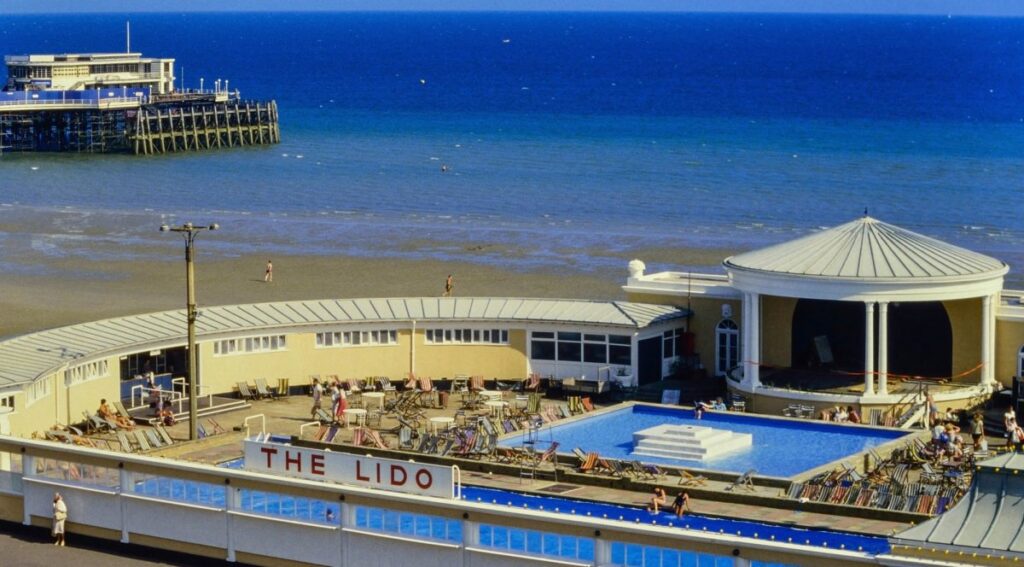
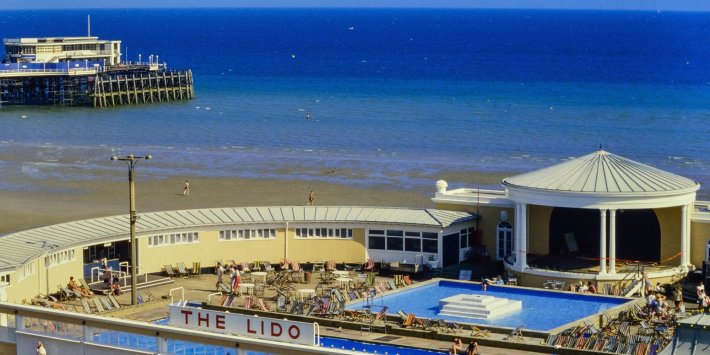
Worthing pier bandstand and lido, West Sussex, UK, circa 1980s (Alamy)

4 min read22 min
Not many people would associate politics with lidos, yet they are steeped in political history.
In the 1930s, as first commissioner of works, Labour’s George Lansbury green-lit the transformation of the Serpentine bathing area in London’s Hyde Park into an iconic outdoor swimming area. This was an influential moment in British outdoor swimming culture, which saw the term “lido” introduced into the British vernacular. A surge in outdoor pool construction followed during the Depression, with a record 300 lidos in use across the country.
In more recent times, Alastair Campbell, former director of communications at No 10 for then Prime Minister Tony Blair, spoke of how the lido inspired him when he wrote some of New Labour’s most memorable speeches.
And only last week, the Mayor of London, Sadiq Khan, announced plans for a brand-new world-class lido in Canary Wharf’s Eden Dock that will integrate into the capital’s financial district while being open to the general public 364 days a year.
Lidos are a monument to cultural, civic and local pride. There are over 160 lidos dotted across the UK, and since 2021 over 30 new lido schemes have been delivered.
In my constituency of Worthing West, the lido has long been both a much-loved feature of our seafront and a marker of our community. Originally built as a bandstand in 1897, it was transformed into a swimming pool 60 years later.
Although popular, it was allowed by successive Conservative councils to fall into decline and by 1988 was being used to temporarily house dolphins before finally being filled in. I am campaigning for its restoration to its former glory.
It now serves as a family entertainment centre but is in dire need of structural and aesthetic repair. Although there is clear public enthusiasm for restoring the building to its original role as a swimming pool, a number of technical considerations may limit this option. Coastal erosion could pose serious challenges and as a result any decision will need to be informed by specialist structural engineering advice. Lessons can be drawn from recent successful refurbishments elsewhere, such as the Morecambe and Bristol lidos.
As a former council leader and now as an MP, I’ve campaigned relentlessly to bring the lido back to life, and am now working with the borough council, English Heritage, local businesses and stakeholders to do just that. I do so not only out of a desire to see this unique Grade II-listed structure returned to its former glory as a major attraction for residents and visitors, boosting both the town’s economy and identity, but also from the point of view of public health.
As a doctor and chair of the Healthy Places APPG, I know the vital contribution outdoor activity and exercise makes to our physical and mental health. Yet research has found that the average UK person spends just seven per cent of their time outdoors during the work week. We need to develop more areas that are conducive to changing that figure – and lidos are the perfect example of where regeneration can work hand-in-hand with the promotion of positive public health outcomes.
Last year, the Sussex Partnership NHS Foundation Trust paired with the University of Portsmouth to begin the first large-scale clinical trial into whether outdoor swimming can help reduce symptoms of depression. A prior study, with a smaller sample size, showed that the results “were really promising, (with) reported reductions in symptoms of depression and anxiety”. And an observational study earlier by the same university, back in 2020, found that “regular open-water swimming may improve mood and overall wellbeing”.
DCMS announced that at least £400m is going to be invested into “new and upgraded grassroots sport facilities in communities right across the UK”, which will be a game-changer for many, making sure that such facilities as lidos can be maintained, upgraded and accessible for all. The Outdoors For All Report led by the APPG for Outdoor Recreation highlighted the massive economic contribution of the outdoor sector to the UK, which supported over 500,000 jobs and was worth over £25bn.
Bringing lidos back isn’t about nostalgia – it’s an investment in wellbeing, joy and community life. The government should aim to re-create the surge in construction and renovation driven by post-war public works programmes, designed not only to create employment and tourism but to improve public health.
We pour billions into key infrastructure projects, mainly in cities and for roads and rail, and rightly so. But I believe that we can surely spare a fraction of that funding to keep these pools alive and thriving for the betterment of our health, our communities and our society in general.
Britain doesn’t just need lidos – it deserves them. It’s time to dive headfirst back in and continue the renaissance of the great British lido.
Dr Beccy Cooper MP is the Labour MP for Worthing West
