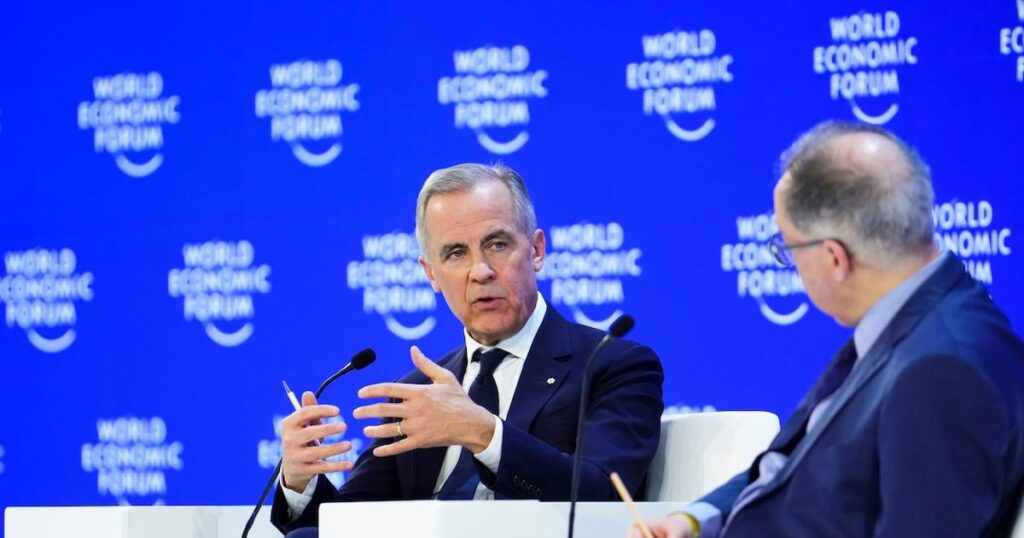
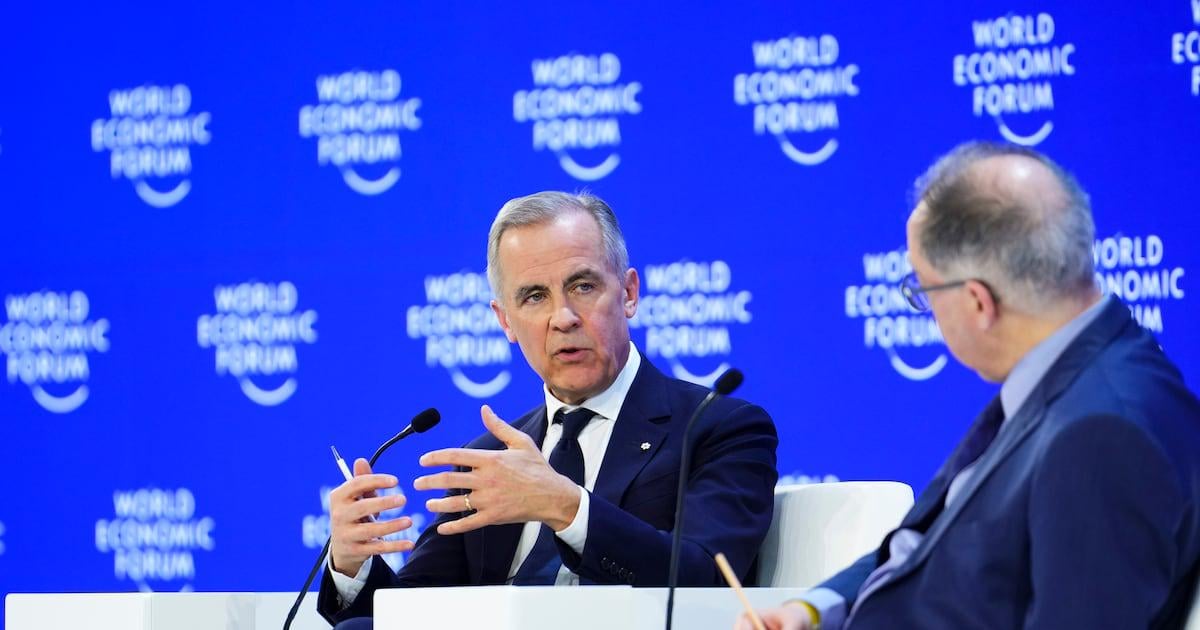
On the world stage at the World Economic Forum in Davos, Carney demonstrated that what his opposition views as a liability is, in fact, a rare and vital asset. He proved that in an era of global rupture, the man who truly understands the machinery of the world is the only one who can fix it.
Positive-Aspect-3566 on
A statement of intent is not a contract. The USCMA review is the real test of his perspective.
MercyPlainAndTall on
Time will tell.
Until we drastically alter our major trading partnerships, increase our industrial capacity and manufacturing industries, and invest heavily into homegrown tech, we are still far from freeing ourselves from the U.S. Goes without saying major changes to our military need to go along with that.
Not a defeatist or a naysayer, and I loved the speech, but now it needs to translate into action.
Routine-Opinion1471 on
You misspelled “protection”
ifuaguyugetsauced on
Talk is cheap. Let’s see the deals that will be made
shriand on
I fail to understand why everyone’s so winded up about DT’s statements. It hardly reflects a real change in US foreign policy. He’s already announced a *deal* for Greenland. I’m sure it’s the same as the old deal, but with his autograph. The yoyo tariffs are a nuisance, I agree. But that’s hardly a reason for strategic realignment. Only more balanced trade agreements.
Charlie9261 on
Part of the speech listed things they’ve already done.
I don’t think any Canadian premier has ever gone this far to criticise America or the West. It was quite courageous of Carney to have given that speech. After all,
– Canada is much, much more dependent on American patronage than Europe, Japan, South Korea or even Taiwan. 75% of their exports go to the United States. Their economy would genuinely collapse if Trump were to retaliate to this act of defiance with everything he has.
– Carney is also perhaps the first Western leader to publicly admit that the US-led “rules-based world order” was a beautiful lie, that the rules were always applied selectively and defied by the great powers whenever convenient, and that everyone else knew this but played along with the facade because they were benefiting from the order while poorer countries suffered.
AnomalyNexus on
I had dismissed a closer EU/Can tie but idk, the last week suddenly makes that a whole lot more plausible
Use-Quirky on
Has anyone seen love actually?
perestroika12 on
Realistically Canada can hedge but they can’t divorce. The US is almost 8x their size in population and 10-14x larger economically. There are tons of Canadians in the US. They all come here for jobs, buy houses etc. mutual tax agreements will need to stay in place.
SriMulyaniMegawati on
In 1925, 35% of Canada’s exports went to the US, and 35% went to the British Empire. This was a period when Canada was largely a commodities exporter.
What makes Canada different now than 100 years ago is that Canada has a manufacturing sector that is integrated with the US. This integration with the US started in the 1950s and was the main reason why Canada and the US have a Free Trade Agreement.
The easy stuff to find alternative markets is natural resources. Canada could shift from 75% to 50% of her exports going to the US relatively easily. It’s going from 50% to 35% that is going to be really difficult because it involves exports that are part of an integrated supply chain.
I think that is hte ultimate aim would be to reduce the US share of Canadian exports to about 35-40%.

13 Comments
On the world stage at the World Economic Forum in Davos, Carney demonstrated that what his opposition views as a liability is, in fact, a rare and vital asset. He proved that in an era of global rupture, the man who truly understands the machinery of the world is the only one who can fix it.
A statement of intent is not a contract. The USCMA review is the real test of his perspective.
Time will tell.
Until we drastically alter our major trading partnerships, increase our industrial capacity and manufacturing industries, and invest heavily into homegrown tech, we are still far from freeing ourselves from the U.S. Goes without saying major changes to our military need to go along with that.
Not a defeatist or a naysayer, and I loved the speech, but now it needs to translate into action.
You misspelled “protection”
Talk is cheap. Let’s see the deals that will be made
I fail to understand why everyone’s so winded up about DT’s statements. It hardly reflects a real change in US foreign policy. He’s already announced a *deal* for Greenland. I’m sure it’s the same as the old deal, but with his autograph. The yoyo tariffs are a nuisance, I agree. But that’s hardly a reason for strategic realignment. Only more balanced trade agreements.
Part of the speech listed things they’ve already done.
https://globalnews.ca/news/11620877/carney-davos-wef-speech-transcript/
I don’t think any Canadian premier has ever gone this far to criticise America or the West. It was quite courageous of Carney to have given that speech. After all,
– Canada is much, much more dependent on American patronage than Europe, Japan, South Korea or even Taiwan. 75% of their exports go to the United States. Their economy would genuinely collapse if Trump were to retaliate to this act of defiance with everything he has.
– Carney is also perhaps the first Western leader to publicly admit that the US-led “rules-based world order” was a beautiful lie, that the rules were always applied selectively and defied by the great powers whenever convenient, and that everyone else knew this but played along with the facade because they were benefiting from the order while poorer countries suffered.
I had dismissed a closer EU/Can tie but idk, the last week suddenly makes that a whole lot more plausible
Has anyone seen love actually?
Realistically Canada can hedge but they can’t divorce. The US is almost 8x their size in population and 10-14x larger economically. There are tons of Canadians in the US. They all come here for jobs, buy houses etc. mutual tax agreements will need to stay in place.
In 1925, 35% of Canada’s exports went to the US, and 35% went to the British Empire. This was a period when Canada was largely a commodities exporter.
What makes Canada different now than 100 years ago is that Canada has a manufacturing sector that is integrated with the US. This integration with the US started in the 1950s and was the main reason why Canada and the US have a Free Trade Agreement.
The easy stuff to find alternative markets is natural resources. Canada could shift from 75% to 50% of her exports going to the US relatively easily. It’s going from 50% to 35% that is going to be really difficult because it involves exports that are part of an integrated supply chain.
I think that is hte ultimate aim would be to reduce the US share of Canadian exports to about 35-40%.
Actions speak louder than words.