
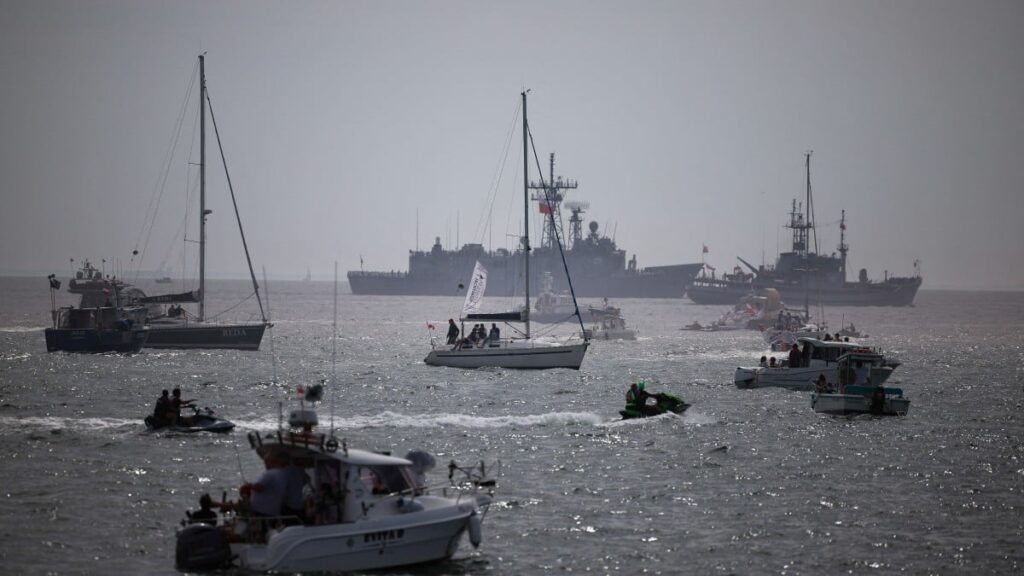
People watch from boats as Polish Navy vessels Multi-task rescue-salvage ship ORP Piast and Guided-missile frigate ORP General Tadeusz Kosciuszko participate in a naval parade on Armed Forces Day, commemorating Poland’s victory over the Soviet Red Army in 1920, in Gdansk Bay, Poland, August 15, 2025. Reuters file
Poland has upgraded its navy, the biggest of its kind since the Cold War, building advanced capabilities that were long overdue amid Russia’s continued military activity in the Baltic Sea.
The country is building three frigates at Gdynia on Poland’s northern Baltic coast. It will also purchase three Swedish submarines in November this year. From launching new minesweepers to constructing a rescue ship, Poland is making sure its navy does not lag.
These acquisitions aim to remedy decades of naval under-investment. The current fleet is ageing significantly, consisting of a single Soviet-era submarine transferred in 1986 and two US frigates dating back to the 1970s.
Paweł Bejda, Poland’s deputy defence minister, said, “The Russian threat is spreading and we cannot ignore now their hybrid warfare, as seen for example with the rupturing of cables. Poland needs to be a very active participant in ensuring security in the Baltic Sea.”
‘Zero to hero’
As Moscow continues to threaten European security, the Polish navy has upgraded itself from “zero to hero”, said Jan Grabowski, a board member of PGZ, which owns the Gdynia yard.
The warships are being built under a budget of €3.5 billion, with a partnership with PGZ and British defence manufacturer Babcock.
In 2025, Poland became NATO’s top spender by GDP percentage (4.7 per cent), investing tens of billions to overhaul its military. These funds have primarily fueled a massive procurement of American and South Korean equipment for its land and air branches.
The cable incidents triggered the need to protect critical infrastructure, as a result of which, Poland and Sweden staged their first joint military exercise in September last year.
The construction of three frigates in Gdynia marks a dramatic turnaround for a shipyard once on the brink of collapse. After the cancellation of a previous frigate program due to budget cuts, the yard was left to spend 17 years on a single patrol vessel, the Ślązak. These new ships, slated for service between 2029 and 2031, represent a long-awaited revival for Polish naval manufacturing.
How is Russia threatening security?
Growing concerns over NATO’s Baltic Sea vulnerabilities have been fueled by Russia’s recent hybrid warfare tactics. While Moscow maintains its Baltic fleet in the Kaliningrad exclave, regional neighbours have accused it of orchestrating sabotage against undersea power and data infrastructure. These provocations are further compounded by frequent drone incursions into NATO airspace.
Additionally, allies are increasingly targeting Russia’s “shadow fleet”, a network of oil and cargo vessels used to bypass Western sanctions. Enforcement is tightening; Swedish authorities boarded a sanctioned vessel in December, while Baltic nations recorded six suspicious cable-related incidents in just a six-day window earlier this month.
End of Article