
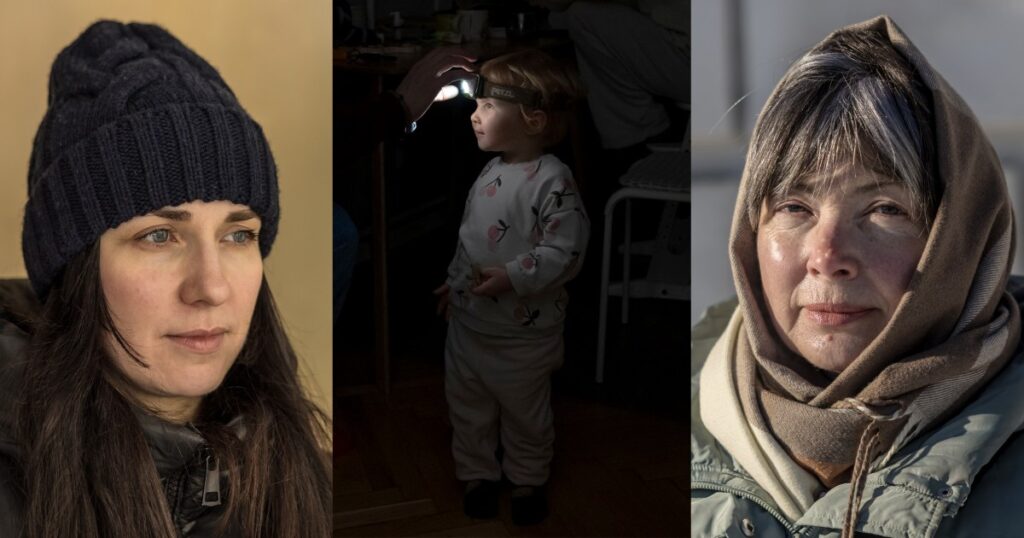
Information technology manager Maryna, who didn’t want to share her last name because her husband is serving in the army, told NBC News she and her 4-year-old son, Martin, used to hide from Russian strikes inside their hallway. Now “it would be too cold to sleep there,” Maryna said, forcing her to prioritize comfort over safety.
There has been no heating in her apartment since the Jan. 9 attack, Maryna said, so she and Martin wear thermal underwear and cozy up under blankets to feel some degree of comfort inside, where the temperature has been hovering around 40 degrees. She said Martin, born three months before the full-scale invasion in 2022, is used to this wartime reality and “doesn’t know any other way.”
Translator Kateryna Matiukhina, who lives in the western city of Lviv with her 7-year-old daughter, Ivanna, has been in Kyiv for the last month visiting her husband, Heorhii, for winter holidays.
Since the blackouts started in the capital, they have gone for up to 31 hours at a time without power, Matiukhina, 39, said. “Planning has to be next level,” she added, when the power sporadically comes back on at night. She can only dream of washing her hair, Matiukhina said, because doing basic chores and cooking for her daughter take priority.
 Kateryna Matiukhina with her husband, Heorhii, and their 7-year-old daughter, Ivanna.Courtesy of Kateryna Matiukhina
They try to maintain a sense of normalcy for the sake of Ivanna, she said, trying to “keep it fun” for her with flashlights, twinkle lights and candlelit dinners. “We don’t want to overwhelm her,” she added.
Kyiv residents told NBC News it’s the coldest winter they have experienced at least since the war started, with such low temperatures unusual for Kyiv even in January. Despite the blistering cold, some said they still try to take in wintry sights and enjoy the snow, even taking their children sledding. Social media videos verified by NBC News show Kyiv residents dancing and cooking outside with neighbors in freezing temperatures.
Some suspect the bitter cold is precisely why the Kremlin decided to launch such a massive attack on energy infrastructure now.
“The Russians intended to strike when it’s cold. We understand that. It’s not an accident,” said Kyiv resident Liubov Oliinyk, 62. “They did it in the most painful way.”
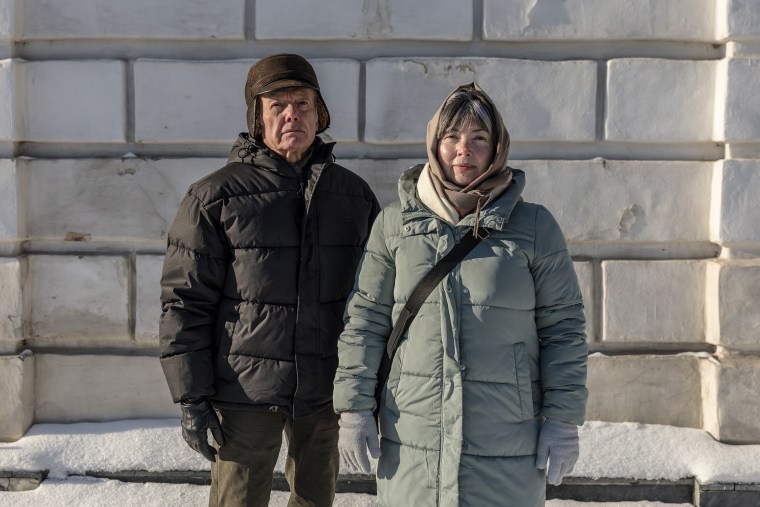 Liubov Oliinyk, 62, and her father, Leonid Zhurakovskyi, 89, in Kyiv on Sunday.Oksana Parafeniuk for NBC News
The outages have been especially hard on Oliinyk’s 89-year-old father, Leonid, who lives alone, also in Kyiv. He can’t turn on the TV or read a book in the darkness, she said, and it’s hard for him to navigate his home without light due to visual impairment. “He keeps on remembering the Second World War when he was a boy,” Oliinyk added. “He says, ‘When the Germans came, we had no heat, no water, sporadic electricity during the whole war, and we carried on.’ So he is an optimist this way.”
Volker Türk, the United Nations high commissioner for human rights, this week accused Russia of targeting energy infrastructure despite extensive and well-documented public information regarding the severe impact on civilians. He said in a speech in Geneva that “it is appalling to see civilians suffering in this way,” warning that targeting civilians “is a clear breach of the rules of warfare.” Russia denies intentionally targeting civilians, despite strikes reducing entire Ukrainian towns to ruins and the documented killing of civilians across the war.
Ukraine has meanwhile continued strikes in Russia’s border regions, as officials hope to bring some pain to Putin on his own territory. Authorities in the Belgorod border region have blamed Kyiv for attacks that authorities said left 600,000 people without electricity, heat or water around the same time as the Russian strikes on Jan. 9. The region’s governor, Vyacheslav Gladkov, said Sunday that work to restore electricity has been nearly completed, while the crisis in Ukraine continues to worsen.
Zelenskyy has called the Russian attacks that have led to the energy crisis in Ukraine a “discreditation of the diplomatic process.” Zelenskyy met with President Donald Trump at the World Economic Forum in Davos on Thursday and later announced Ukrainian and Russian teams will hold their first trilateral meeting with U.S. officials in the coming days. But despite a flurry of diplomatic activity to end the war, there is still no peace deal in sight.
For some people freezing in Kyiv, the diplomatic wrangling seems like a distant reality.
Maryna, the IT manager, said she had little faith in negotiations reaching peace on conditions that would not amount to Ukraine’s surrender.
“I think their goal is to destroy us, so peace negotiations won’t lead us anywhere,” she said. But the freezing temperatures will eventually thaw, she said, adding: “We can’t make concessions because we are cold.”