
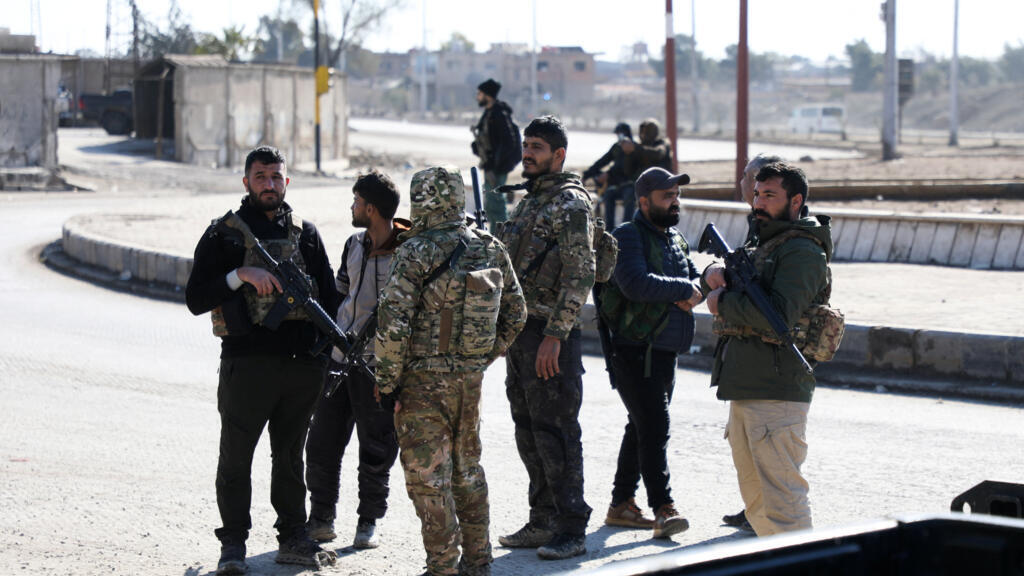
As Syria’s Kurds come under increased pressure from the central government in Damascus, they have seen their alliance with the US crumble.
Backed by the US, the Kurds have long spearheaded efforts by the West to fight against the Islamic State (IS) group.
The Kurdish-led armed group, the Syrian Democratic Forces (SDF), in 2012-2013 established its governance over swathes of territory in the north and northeast of the country that became known as the Autonomous Administration of North and East Syria, or Rojava (meaning “west” in Kurdish).
But since the fall of dictator Bashar al-Assad, Syria’s new leadership has formed its own alliance with Washington and pushed the Kurds to give up their aspirations of autonomy.
Violent clashes with government forces in January saw the Kurds driven out from the city of Aleppo. They later evacuated Raqqa and Deir Ezzor.
The SDF, which previously controlled around 30 percent of Syria’s territory, has been pushed back to strongholds along the Turkish border in al-Hasakah, Qamishli and Kobane and handed over governance of prisons holding thousands of IS group members.
“The original purpose of the SDF as the primary anti-ISIS force on the ground has largely expired, as Damascus is now both willing and positioned to take over security responsibilities, including control of ISIS detention facilities and camps,” US ambassador to Syria Tom Barrack wrote on X, using an alternative acronym for the IS group.
Read moreSyria, Kurdish-led SDF agree to ceasefire as US says IS group fight largely over
Syrian President Ahmed al-Sharaa has now given the Kurds until January 24 to propose a plan for the peaceful integration of Rojava into the Syrian state.
Are the Kurds’ gains in autonomy and sovereignty over the last few years now disintegrating?
Adel Bakawan, director of the European Institute for Studies on the Middle East and North Africa (EISMENA) and author of “La Décomposition du Moyen-Orient. Trois ruptures qui ont fait basculer l’Histoire” (“The Decomposition of the Middle East: Three Breakdowns that Changed History”) explains.
FRANCE 24: Why have Syria’s Kurds been cornered so successfully by Sharaa?
During the Syrian civil war from 2011-2014, around 105 different groups were fighting, sometimes against each other.
This is when Daesh [also known as the Islamic State group] emerged from a split with al Qaeda. The United States and Europe chose to train and support the Kurds so that they could lead the fight against Daesh.
In doing so, the SDF advanced as far as Raqqa and Deir Ezzor – zones controlled by Arab tribes.
When Sharaa took power on December 8, 2024, it was thanks to his network in the Gulf: Saudi Arabia, Qatar and Turkey.
When he visited Riyadh, [Saudi leader] Mohammed bin Salman convinced [US President] Donald Trump to normalise relations with Syria, lifting sanctions and integrating it into the international coalition against Daesh.
The SDF no longer held the card of fighting against Daesh, and when the new Syrian state was integrated into the international coalition, the Kurds also had to hand over control of prisons holding thousands of Daesh leaders and militants.
Read moreUS begins transfer of up to 7,000 IS group detainees from Syria to Iraq
Next, the Americans asked the Arab tribes that were integrated in the Kurd’s autonomous administration in north-east Syria to cut their ties with the SDF and to join Sharaa’s new army. The Kurds could not wage war against their former allies and the Syrian army, so the cities they were holding fell very quickly.
Finally, the Kurds lost control of the oil and gas fields that had financed their economy, and dams that were very important for geostrategy and geopolitics.
What room for manoeuvre do the Kurds have now?
They don’t have much leverage, except through Iraqi Kurdistan, with whom they have had disagreements throughout the 13 years of Rojava’s governance.
Read moreKurds march in Iraqi Kurdistan against Syrian government takeover of minority
Thanks to strong international lobbying, Donald Trump picked up the telephone to tell Sharaa not to enter Rojava, the historic Kurdish territory.
Kurdish fighters have now left Aleppo and Raqqa. Clashes there did not spark a war – although the Kurds do still have a very powerful army. It’s a trained and armed ideological organisation, which will not surrender. And that is a means of exerting pressure.
What does the future hold for Rojava? Is it the end of the Kurds’ dream of their own state?
We are entering into a grey area. It was predictable that the US would drop the Kurds, and we foresaw that. The Kurds in Rojava have also been abandoned by Israel – even though Israel has helped the Druze.
Read moreDeadly clashes in Damascus plunge Syria’s Druze minority into uncertainty
Israel will not intervene to defend the Kurds against the Syrian army now that Israel and Syria are normalising their relations.
It’s an existential question. In 2017, as they were coming out of a war with Daesh, the Iraqi Kurds played a major role in toppling the caliphate in Mosul and organised a referendum on independence for Iraqi Kurdistan.
Iraq’s Kurds voted 93 percent in favour, but the international community was fiercely opposed, and all the territories were recovered.
In 2019, when the Syrian Kurds were at the height of their powers in Afrin, a very strategic location for them, the Americans gave the green light for pro-Turkish militia organisations to occupy the city. It was a tragic blow for the Kurds.
Is it the end of the dream of independence? There are 50-60 million Kurds, making them the largest people in the Middle East without their own state. How can you stabilise and secure the Middle East when you have 60 million people that have been betrayed and abandoned?
If the international community wants to secure and stabilise the region there must be a Palestinian state and a Kurdish state.
And as the dream of independence has become fragile in Rojava, it has become much more plausible in Iraqi Kurdistan.
What impact will this have on Turkey and its peace process with the Kurdistan Workers’ Party (PKK)?
[PKK leader] Abdullah Ocalan sent a letter to the group from prison asking it to disband, put down its weapons and stop demanding Kurdish independence, federalism, autonomy and even decentralisation.
Its goal is now to fight for a democratic society in Turkey.
The Turks believe this applies to not only the PKK in Turkey but also its branches in Iraq, Syria and Iran – but Abdullah Ocalan has not clearly stated a position on this.
Read morePKK fighters destroy weapons at key ceremony in Iraqi Kurdistan
Turkey has strongly encouraged and supported Sharaa’s offensive into territory controlled by the Kurds, while asking that he integrates the Kurds into the new Syria.
But for Turkey to implement its grand strategy across the Middle East, it needs to foster a relationship of “eternal brotherhood” with the Kurds.
Turkey, 20 years ago, did all it could to undermine the regional government in Kurdistan. Today its greatest ally in the region is the Kurdistan regional government in Iraq.
The West has for years relied on the Kurds to fight Daesh. Can the Syrian army really take over this fight?
Sharaa has renounced his former radical beliefs. He is pragmatic and knows how the international arena works. A Qatari communication firm has been helping him with everything from the choice of his suits to trimming his beard.
What interests me is his militant base that must now wage war against Daesh, the Kurds, the Alawites and the Druze.
Sharaa abandoned al Qaeda for Daesh and created its Syrian branch with authorisation from the caliph Abu Bakr al-Baghdadi. And his militant base has absolutely not changed.
When I analyse videos, accounts and speeches on the ground I don’t really see a big difference between the Daesh of 2014 and 2019. Their entire lives are shaped by radical ideology.
For example, they still associate the Kurds with pigs and heretics who must be killed. It’s exactly the same ideology as before.
Read moreFears mount for Syria’s minorities as video emerges showing rebel fighters executing suspects
Personally, I think that the international community will regret transferring the fight against Daesh from the SDF to Hayat Tahrir al-Sham [HTS, the Islamist rebel group directed by Sharaa during the war]. How can he control his militant base?
Beyond this, the new Syrian army, which has been entrusted with the fight against Daesh, is not homogenous.
There were around 500 armed groups fighting against Bashar al-Assad. Their loyalty ranges from the Syrian state, to Turkey, to Saudi Arabia. So, it’s a very, very risky gamble.
This article was adapted from the original in French by Joanna York.