
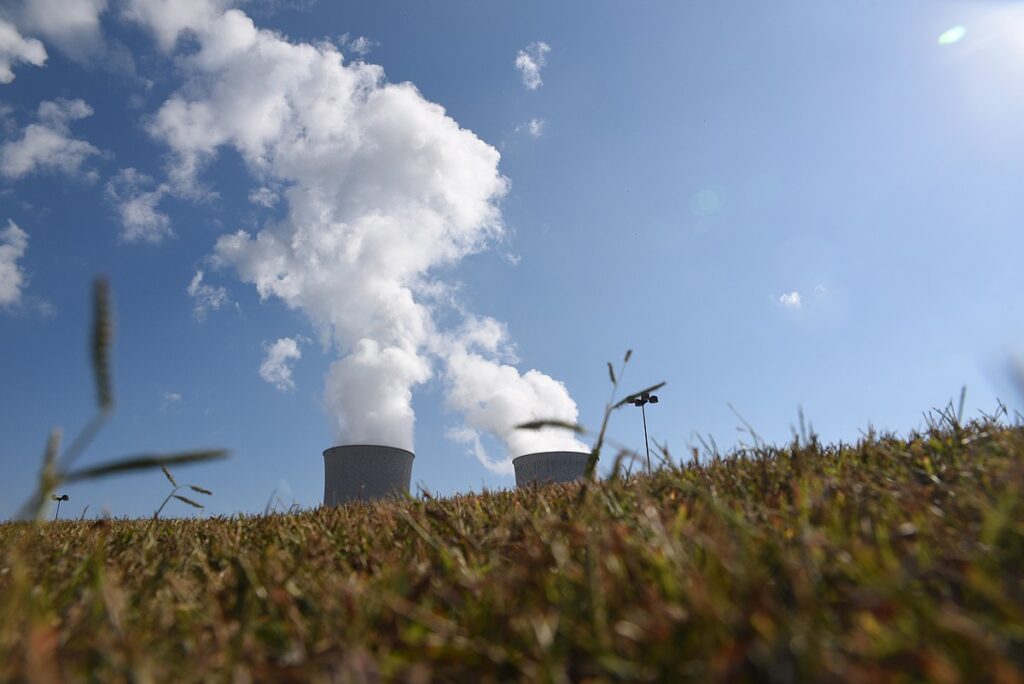
The U.S. agency in charge of nuclear weapons achieved a record production of tritium, a radioactive gas that increases the explosive power of nuclear warheads, after the Tennessee Valley Authority got approval to boost production at one of its civilian nuclear plants.
The Watts Bar plant between Chattanooga and Knoxville is the only nuclear plant in the nation licensed to produce tritium for the U.S. government, which reimburses TVA for the service.
TVA is federally owned but operates more like a private company from sales of wholesale electricity. Its lithium production is a rare mixing of civilian nuclear power and U.S. military nuclear weapons activities that has drawn criticism from antinuclear activists.
TVA inserts rods of lithium into the two Watts Bar reactors during their normal operations. The lithium converts into tritium in a nuclear reaction when it is bombarded with neutrons.
(READ MORE: TVA transformed 20 years ago. These graphs show what’s happened since)
TVA removes the rods during refueling outages and ships them to the Savannah River Site outside Aiken, South Carolina, where workers with the National Nuclear Security Administration extract the gas.
The National Nuclear Security Administration completed 13 tritium extractions in nine months, according to a press release Friday. The previous record was eight extractions in 12 months, set in 2023.
“This accomplishment significantly strengthens our national security and reinforces the strategic readiness of our deterrent mission,” Brandon Williams, administrator of the agency, said in the release.
The semiautonomous agency is under the U.S. Department of Energy. It oversees nuclear weapons, nuclear nonproliferation across the globe and fuel for the U.S. Navy’s on-board nuclear reactors.
The Y-12 Nuclear Security Complex in Oak Ridge, Tennessee, where the nation’s stockpile of bomb-grade uranium is processed and stored, is one of the agency’s main production sites.
HIGHER OUTPUT
The U.S. Nuclear Regulatory Commission, which regulates civilian nuclear power plants, approved an increase in tritium production at Watts Bar in April 2024. The agency amended TVA’s operating license to allow up to 2,496 lithium rods per refueling cycle, up from 1,792 rods.
Tritium is a radioactive isotope of hydrogen gas. It causes a fusion reaction in the core of a thermonuclear weapon that expands its explosion. The U.S. stopped producing tritium in 1988 but quickly began planning how to restart production.
The U.S. government selected TVA in 1998 as the preferred nuclear operator to produce tritium in its reactors. The first batch of lithium rods were inserted into a reactor core at Watts Bar in 2003 and removed 18 months later in 2005.
Workers at the Savannah River Site process the tritium gas into “boost gas” and load it into stainless steel reservoirs, which they send to the Department of Defense for installation into nuclear weapons.
Tritium has a half-life of 12.3 years and must be continually replenished in existing nuclear weapons to maintain the U.S. stockpile, according to the National Nuclear Security Administration.
Congress created the agency in 2000, though its legacy goes back to the Atomic Energy Act of 1946.
TVA has been involved in weapons production for most of its history as the supplier of electricity to Oak Ridge, the first production site for the Manhattan Project in the 1940s.
Congress created TVA in 1933 to provide electricity to the rural Tennessee Valley during the Great Depression. The agency’s mission soon expanded to provide electricity for weapons, munitions and military craft production during World War II.
— Compiled by Daniel Dassow