
The aircraft cabin environment sensor market is projected to be valued at USD 861 million in 2026. Industry revenue is expected to rise to approximately USD 1,279 million by 2036, expanding at a compound annual growth rate (CAGR) of about 4.6% during the 2026-2036 period. Market valuation is supported by growing integration of temperature, humidity, air quality, pressure, and smoke detection sensors within commercial and business aircraft cabins to improve passenger comfort, safety, and regulatory compliance.
Key Takeaways from Aircraft Cabin Environment Sensor Market
- Aircraft Cabin Environment Sensor Market Value (2026): USD 861 million
- Aircraft Cabin Environment Sensor Market Forecast Value (2036): USD 1,279 million
- Aircraft Cabin Environment Sensor Market Forecast CAGR 2026 to 2036: 4.6%
- Leading Aircraft Class in Aircraft Cabin Environment Sensor Market: Narrow-body Aircraft (43%)
- Key Players in Aircraft Cabin Environment Sensor Market: Honeywell International Inc., Collins Aerospace, Thales Group, TE Connectivity Ltd., Amphenol Advanced Sensors, Sensirion AG, Parker Meggitt, L3Harris Technologies Inc., ITT Aerospace Controls, Korry Electronics Co.
- Key Growth Regions in Aircraft Cabin Environment Sensor Market: Asia Pacific, Europe, North America, Latin America, Middle East & Africa.
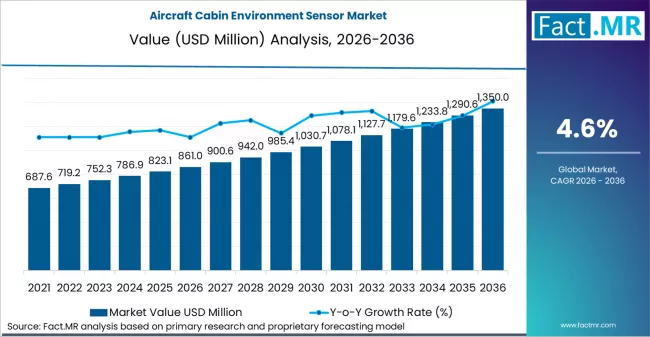
Growth momentum is closely linked to steady expansion of the global aircraft fleet, rising air passenger traffic, and increasing focus on cabin health monitoring following heightened awareness of in-flight air quality. Aircraft manufacturers and airlines are placing greater emphasis on real-time cabin environment monitoring to support predictive maintenance and enhance passenger experience across long-haul and high-density routes. Adoption is particularly strong in new-generation aircraft programs and retrofit installations.
Technological development centers on miniaturized, multi-parameter sensors with higher accuracy and lower power consumption. Manufacturers are investing in digital integration, enabling sensors to interface with aircraft health monitoring systems. Expanding deployment across commercial aviation, business jets, and regional aircraft, especially in Asia Pacific and North America, is expected to support sustained market growth through 2036.
Aircraft Cabin Environment Sensor Market
Metric
Value
Category
Category
Segments
Segmental Analysis
By Parameter Sensed, Which Segment Registers the Highest Share in the Aircraft Cabin Environment Sensor Market?
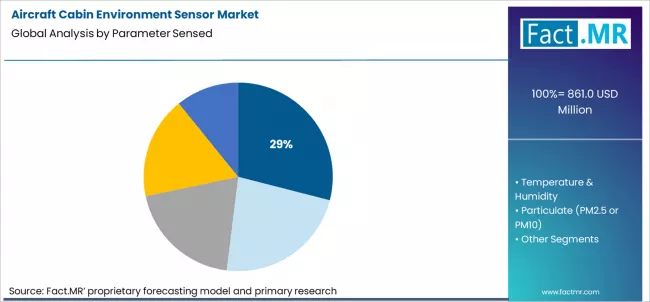
By Parameter Sensed, CO₂ / air quality (VOC) sensors represent the largest segment in the aircraft cabin environment sensor market, accounting for an estimated 29% share. This dominance is driven by increasing emphasis on in-cabin air quality monitoring, passenger comfort, and regulatory attention toward ventilation efficiency and contaminant detection.
- Aircraft manufacturers and airlines increasingly prioritize CO₂ and VOC sensors to support real-time cabin air monitoring and optimize environmental control systems.
- Rising focus on passenger health, particularly on long-haul and high-density routes, is expected to sustain strong demand for air quality sensors across both new aircraft deliveries and retrofit programs.
By Aircraft Class, Which Segment Holds the Dominant Share in the Aircraft Cabin Environment Sensor Market?
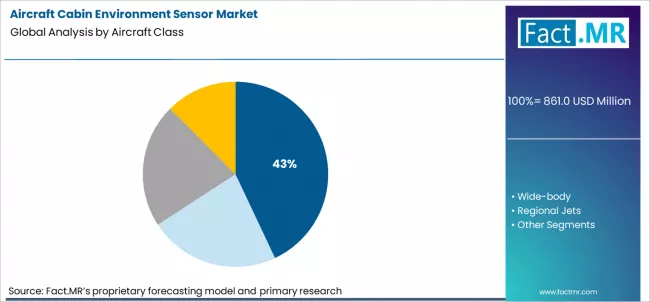
In terms of aircraft class, narrow-body aircraft hold the dominant share, accounting for 43% of global demand in 2026. High global fleet volumes, frequent flight cycles, and strong delivery pipelines for single-aisle aircraft drive extensive sensor installation requirements.
- Narrow-body aircraft generate higher cumulative sensor demand due to shorter replacement cycles and large-scale deployment across domestic and regional routes.
- Continued expansion of low-cost carriers and single-aisle fleet modernization programs is expected to reinforce narrow-body aircraft as the primary revenue-generating segment.
By Installation Type, Which Segment Accounts for the Largest Share in the Aircraft Cabin Environment Sensor Market?
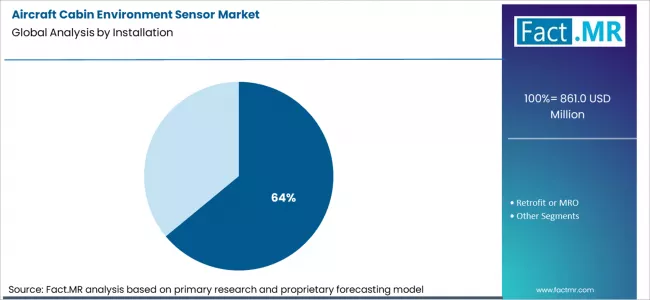
By installation type, line-fit (OEM) installations represent the leading segment, capturing around 64% share. Strong aircraft production backlogs and integration of cabin environment sensors during manufacturing support higher OEM-level adoption.
- Airframe manufacturers increasingly integrate multi-parameter sensors at the production stage to meet certification, safety, and passenger comfort requirements.
- Although retrofit and MRO activity continues to grow, line-fit installations remain the dominant channel due to consistent new aircraft deliveries and standardized sensor architectures.
Market Dynamics
How Is Aircraft Fleet Modernization Driving the Aircraft Cabin Environment Sensor Market?
A primary driver shaping the aircraft cabin environment sensor market is ongoing modernization of global commercial aircraft fleets, with strong emphasis on passenger comfort, safety, and regulatory compliance. Airlines and airframe manufacturers are increasingly integrating advanced temperature, humidity, air quality, and particulate sensors to improve cabin environmental control and support real-time monitoring. Rising passenger traffic, longer flight durations, and heightened awareness of in-cabin air quality continue to accelerate sensor adoption across narrow-body and wide-body aircraft programs. Sensor data also supports predictive maintenance strategies, helping operators reduce downtime and improve operational efficiency.
Do Certification and Cost Constraints Limit Market Expansion?
A key restraint affecting the aircraft cabin environment sensor market is the stringent certification requirements and high qualification costs associated with aerospace-grade components. Sensors must meet rigorous reliability, accuracy, and safety standards, increasing development timelines and production expenses. Budget pressures among airlines, particularly during retrofit decisions, can slow adoption of advanced sensor upgrades. Additionally, integration complexity with existing environmental control systems and avionics architectures may delay deployment, especially in older aircraft fleets, moderating near-term market expansion despite long-term growth potential.
Analysis of the Aircraft Cabin Environment Sensor Market by Key Country
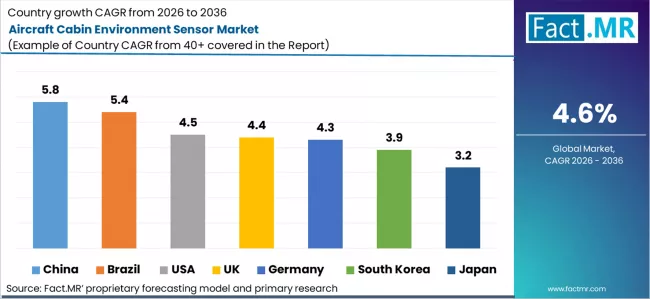
Country
CAGR (2026 to 2036)
Why Is China a High-Growth Market for Aircraft Cabin Environment Sensors?
China is expected to record a CAGR of 5.8%, the fastest among key markets, driven by rapid expansion of commercial aviation and aircraft deliveries.
- Large narrow-body aircraft order backlogs generate strong OEM sensor demand.
- Rising focus on passenger comfort and cabin health accelerates technology adoption.
How Is Brazil Supporting Growth in the Aircraft Cabin Environment Sensor Market?
Brazil is expected to grow at a CAGR of 5.4%, driven by expanding regional aviation and narrow-body aircraft usage.
- Growth of domestic and regional carrier’s increases demand for cabin monitoring systems.
- Rising MRO activity supports sensor replacement and upgrade opportunities.
What Opportunities Can Aircraft Cabin Environment Sensor Manufacturers Expect in the U.S.?
Revenue from aircraft cabin environment sensor sales in the U.S. is projected to grow at a CAGR of 4.5% through 2036, supported by steady commercial fleet replacement, strong retrofit activity, and emphasis on cabin safety and passenger comfort.
- High adoption of advanced cabin monitoring systems across narrow-body and wide-body fleets supports consistent OEM and retrofit demand.
- Focus on predictive maintenance and compliance with aviation safety standards continues to drive sensor integration.
What Is Driving Market Expansion in the U.K.?
The U.K. aircraft cabin environment sensor market is projected to grow at a CAGR of 4.4%, supported by fleet upgrades and active MRO operations.
- Demand is reinforced by strong presence of aerospace suppliers and integrators.
- Retrofit programs across commercial and business aviation fleets support steady growth.
What Opportunities Exist for Sensor Manufacturers in Germany?
Germany is projected to witness growth at a CAGR of 4.3% through 2036, supported by its role as a major aviation manufacturing and maintenance hub.
- High concentration of MRO facilities drives retrofit and upgrade demand.
- Engineering focus on system reliability and certification supports adoption of advanced sensor technologies.
How Is South Korea Creating Opportunities in the Aircraft Cabin Environment Sensor Market?
The South Korean market is projected to grow at a CAGR of 3.9% through 2036, driven by expansion of domestic airlines and regional aviation services.
- Increasing narrow-body aircraft utilization supports sensor demand.
- Investments in aviation infrastructure and fleet modernization strengthen long-term adoption.
What Is Driving Growth in the Japanese Aircraft Cabin Environment Sensor Market?
Revenue from aircraft cabin environment sensors in Japan is expected to expand at a CAGR of 3.2%, reflecting stable fleet size and gradual technology upgrades.
- Demand is supported by high safety standards and preference for precision monitoring systems.
- Retrofit programs across aging aircraft fleets sustain moderate but reliable market growth.
What Shapes Competitive Intensity in the Aircraft Cabin Environment Sensor Market?
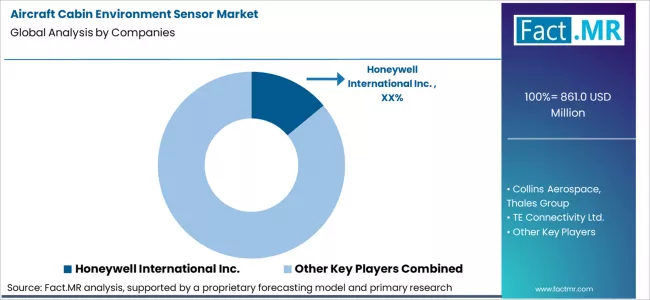
The competitive landscape of the aircraft cabin environment sensor market is defined by the integration of aerospace-grade sensing technology, system reliability, and certification expertise. Leading suppliers compete on sensor accuracy, durability, and compliance with stringent aviation safety standards, alongside the ability to integrate seamlessly with aircraft environmental control and health-monitoring systems. Major aerospace component manufacturers leverage long-standing relationships with airframe OEMs, in-house engineering capabilities, and certified production processes to secure positions on new aircraft platforms. Ongoing investment in miniaturization, multi-parameter sensing, and digital connectivity continues to strengthen competitive positioning.
Market participants further differentiate through lifecycle support services, including calibration, retrofit compatibility, and long-term spares availability. Close collaboration with airlines and MRO providers allows suppliers to tailor sensor solutions for specific fleet requirements and operational environments. As retrofit activity increases, companies offering flexible installation options and faster certification pathways gain advantage. The ability to balance high-reliability performance with cost-effective scalability across narrow-body and wide-body fleets remains a key factor shaping long-term competitiveness.
Key Players in Aircraft Cabin Environment Sensor Market
- Honeywell International Inc.
- Collins Aerospace, Thales Group
- TE Connectivity Ltd.
- Amphenol Advanced Sensors
- Sensirion AG, Parker Meggitt
- L3Harris Technologies Inc.
- ITT Aerospace Controls
- Korry Electronics Co.
Scope of Repot
Items
Values
Methyl Dihydrojasmonate Market by Segments
-
By Parameter Sensed :
- CO₂ / Air Quality (VOC)
- Temperature & Humidity
- Particulate (PM2.5/PM10)
- Pressure / Differential
- Bio/Pathogen & Other
-
By Aircraft Class :
- Narrow-body
- Wide-body
- Regional Jets
- Business Aviation
-
By Installation :
- Line-Fit (OEM)
- Retrofit/MRO
-
By End User :
- Airframe OEMs
- Airlines & Operators
- MROs & Integrators
-
Region :
- North America
- Europe
- Germany
- Italy
- UK
- France
- Spain
- Netherlands
- Switzerland
- Rest of Europe
- Asia Pacific
- Japan
- Australia
- South Korea
- China
- India
- Rest of Asia Pacific
- Latin America
- Brazil
- Argentina
- Rest of Latin America
- Middle East and Africa
- United Arab Emirates
- South Africa
- Rest of Middle East and Africa
- North America
Bibliography
- International Civil Aviation Organization. (2023). Environmental control systems and cabin air quality standards in commercial aircraft. ICAO.
- Federal Aviation Administration. (2022). Aircraft environmental control systems: Certification requirements and safety guidance. FAA.
- European Union Aviation Safety Agency. (2023). Cabin air quality, environmental monitoring, and sensor integration in transport category aircraft. EASA.
- Journal of Aerospace Engineering Editorial Board. (2024). Advances in aircraft cabin environmental sensing technologies and health monitoring systems. Journal of Aerospace Engineering, 37(2), 04024018.
- Sensors Editorial Board. (2023). Multi-parameter sensing and air quality monitoring technologies for aerospace applications. Sensors, 23(18), 7856.