
On January 13, 2026, the U.S. Department of the Treasury’s Office of Foreign Assets Control (OFAC) designated the Egyptian and Jordanian branches of the Muslim Brotherhood, for their material support to Hamas, as Specially Designated Global Terrorists (SDGT).
In a concurrent action, the Department of State designated the Lebanese Muslim Brotherhood, also known as al-Jamaa al-Islamiyah, as both a Foreign Terrorist Organization pursuant to section 219 of the Immigration and Nationality Act, and a Specially Designated Global Terrorist pursuant to E.O. 13224. Moreover, the Department of State also designated the Secretary General of the Lebanese Muslim Brotherhood, Muhammad Fawzi Taqqosh, as a Specially Designated Global Terrorist.
As indicated in the US DOT’s press release: “Although the Muslim Brotherhood, to which Hamas has pledged allegiance, claims to have renounced violence, the Muslim Brotherhood branches designated today continue to promote, incite, and glorify terrorism that directly threatens the interests of the United States and its allies.”
Interestingly, the measures taken by Washington against the Muslim Brotherhood do not include the Movement’s two main state-sponsors Qatar and Turkey, which are also the two major Hamas supporters.
Historically, Qatar has offered refuge to Muslim Brotherhood members, providing the Islamist movement with financial and media support as a tool of its foreign policy.
As illustrated in a report presented to the British Parliament in 2020 by Steven Merely, an intelligence analyst and editor of the Global Muslim Brotherhood Daily Watch, Qatar has been helping the Muslim Brotherhood to further increase its influence in Europe, hindering the integration of Muslim minorities, fostering hatred, and contributing to the incubation of home-grown terrorism.
In addition, since 2007, Qatar has pumped over $1.8 billion into Gaza, and in 2021, Doha pledged $360 million in annual support to the Strip, as reported by the Foundation for Defense of Democracies. Funds that helped subsidize Hamas’s force buildup ahead of the October 7 massacre, as recently concluded by a Shin Bet investigation and highlighted by FDD researcher Natalie Ecanow: “The Shin Bet identified “the flow of money from Qatar to Gaza and its delivery to Hamas’s military wing” as one key reason why Hamas was able to build up its offensive power. In its rebuttal, Doha insisted that “no aid has ever been delivered to Hamas’s political or military wing.”
By supporting Hamas, Qatar has sought to consolidate its influence in the Arab-Islamic world, where the Palestinian terror group is widely portrayed as a “resistance movement.” This support has contributed to Hamas’s political and media legitimacy, including through the television network Al Jazeera.
Then we get to Turkey; under Erdogan’s leadership, Ankara has repeatedly cast itself as a sponsor of the Muslim Brotherhood on several fronts. It has provided a safe haven to Hamas leaders such as Zaher Jabarin, who manages Hamas’s finances from Turkey. Erdogan also provided shelter to Egyptian Muslim Brotherhood leaders who fled the country after Morsy’s ousting in 2013. Moreover, it must be recalled that Turkey’s ruling Justice and Development Party (AKP) has extensive, well-documented ideological and political ties to the Muslim Brotherhood.
Therefore, why isn’t the Trump administration targeting the two main sponsors of the Muslim Brotherhood: Qatar and Turkey? What’s the point in limiting the sanctions to the branches active in Lebanon, Jordan and Egypt, also considering that in the latter two states, the Muslim Brotherhood is already outlawed?
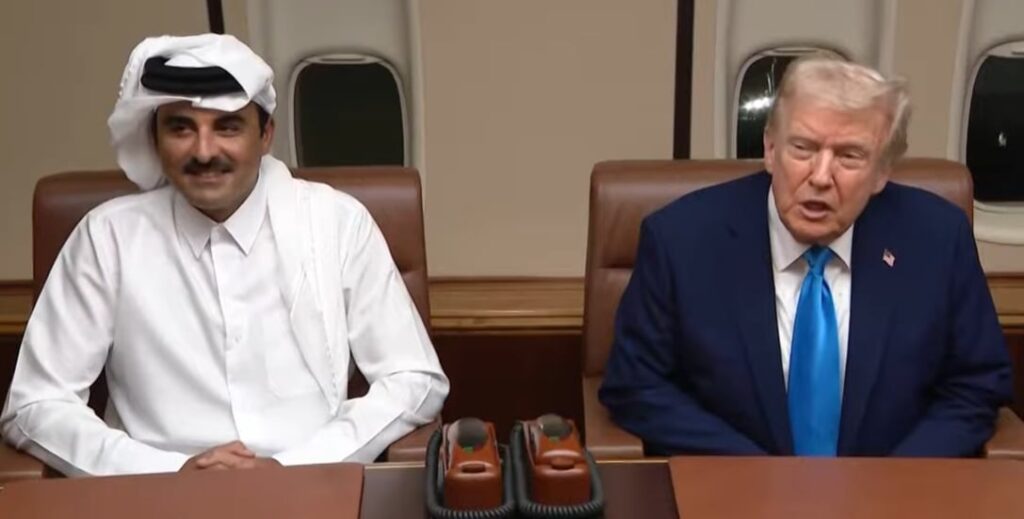
The question is clearly provocative as it is well known that Trump has forged a strong alliance with Qatar; he was furious with Netanyahu for the September 2025 (failed) raid against Hamas leaders in Doha and obliged the Israeli Prime Minister to apologize by conference call to Sheikh Tamim bin Hamad al-Thani.
Trump also invited Turkey and Qatar to be part of the key Gaza committee (or Board of Peace) set to oversee the Strip’s postwar management, regardless of the fact that Israel had been very clear on their exclusion. Israel was simply kept in the dark about this decision.
The overall picture regarding Trump’s alleged offensive against the Muslim Brotherhood is puzzling, as the White House is simply sanctioning some branches of the Movement while simultaneously accrediting and politically empowering the two main Middle Eastern countries that support the Muslim Brotherhood and Hamas; all this, to the detriment of Israel’s security.
Giovanni Giacalone is a senior analyst in Islamist extremism and terrorism at the Italian Team for Security, Terroristic Issues and Managing Emergencies-Catholic University of Milan, at the Europe desk for the UK-based think tank Islamic Theology of Counter-Terrorism, and a researcher for Centro Studi Machiavelli. Since 2021 he is the coordinator for the “Latin America group” at the International Institute for the Study of Security-ITSS. In 2023 Giacalone published the book “The Tablighi Jamaat in Europe”.