
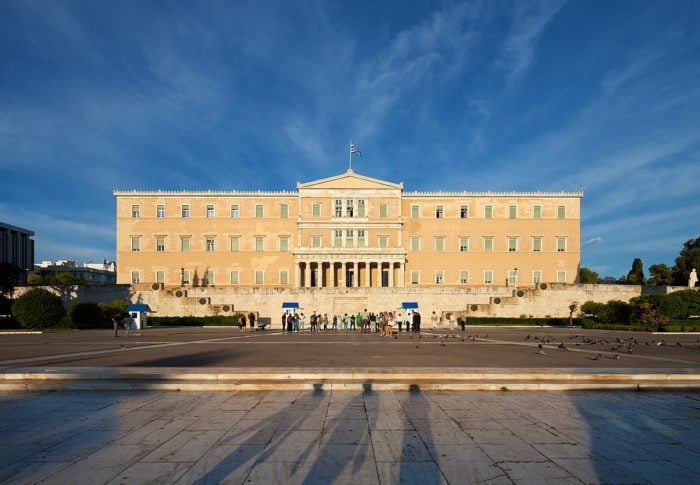
 A special ballot plan for Greek expatriates to vote for three MPs of their choice has been drafted. Photo of the Greek Parliament in Athens. Credit: Tomas Wolf / Wikimedia Commons CC BY-SA 3.0 DE
Greek expatriates can now elect three members of the Greek Parliament with their own ballot in a new electoral district designed especially for expatriates.
Following the success of the postal voting model in the European Parliament election in June 2024, the Greek government has decided to expand the model to the national election. The Ministry of the Interior is working on an extensive plan of changes regarding the participation of Greeks living and working abroad in the parliamentary election. The main goal is to substantially facilitate the exercise of the right to vote to Greek expatriates.
The government estimates that the current system, despite improvements of recent years, continues to push a significant portion of expatriates away from the ballot box, mainly as a result of practical matters, and is therefore promoting a series of changes. A comprehensive reform of the expatriate vote facilitation will be submitted to Parliament within the first half of 2026. The central axis of the new framework will be the establishment of postal voting exclusively for Greeks living abroad.
An exclusive ballot for Greek expatriates
The most significant change is that Greeks living abroad will no longer vote using the Greek State ballot, as has been the case until now, but will instead cast their vote using a dedicated expatriate ballot. This ballot will include candidates from across the world, allowing voters not only to select a political party but also, by marking a cross, to choose their preferred Member of Parliament.
The “Greeks abroad ballot” will be universal. In practical terms, this means that a Greek citizen residing in the United States, for example, will be able to vote for a candidate based in Australia, Europe, or any other part of the world, thereby directly sending their chosen representative to the Hellenic Parliament.
At present, representation of Greeks living abroad does exist; however, it is achieved indirectly through State ballots that simply require the inclusion of a Greek expatriate candidate. In this system, the political party—not the expatriate voter—selects the Member of Parliament.
Under the new regulation, this dynamic changes fundamentally. Greeks living abroad will be free to choose whichever candidate they prefer, as provided by the new framework. The objective is to mobilize Hellenism abroad and to strengthen the ties between the Greek diaspora and the homeland, since expatriate voters will be able to send their chosen representative directly to the Greek Parliament—reinforcing participation, representation, and democratic engagement.
The State ballot
The government plans to elect three representatives for Greeks living abroad by using seats that already exist in Parliament, known as State MPs. This way, the total number of MPs stays at 300, and no new electoral district is created. Creating a new district would change how Greece’s population is represented and would violate the Constitution.
For this plan to apply in the very next national election, at least 200 MPs must vote in favor of it. If that number is not reached, the changes will still happen, but they will take effect in the election after that. Regardless of whether the amendment secures the 200 necessary votes, an additional political obstacle may still emerge.
Under the new system, Greeks living abroad will no longer be represented indirectly by party-appointed State MPs. Instead, they will directly choose their own representatives. The government believes that opposition parties—especially PASOK and SYRIZA, which have many supporters among Greeks abroad—would have a hard time explaining a “no” vote, because it could be seen as refusing political representation to expatriate Greeks.
The biggest objections are expected from smaller parties. For large parties like New Democracy, losing one State MP would make little difference. But for smaller parties, losing just one seat could mean losing their only presence in Parliament.
So while every party would technically lose the same number of seats, the political impact would not be the same. The changes would affect smaller parties much more than larger ones, shifting the balance in Parliament in a way that goes beyond simple math.