
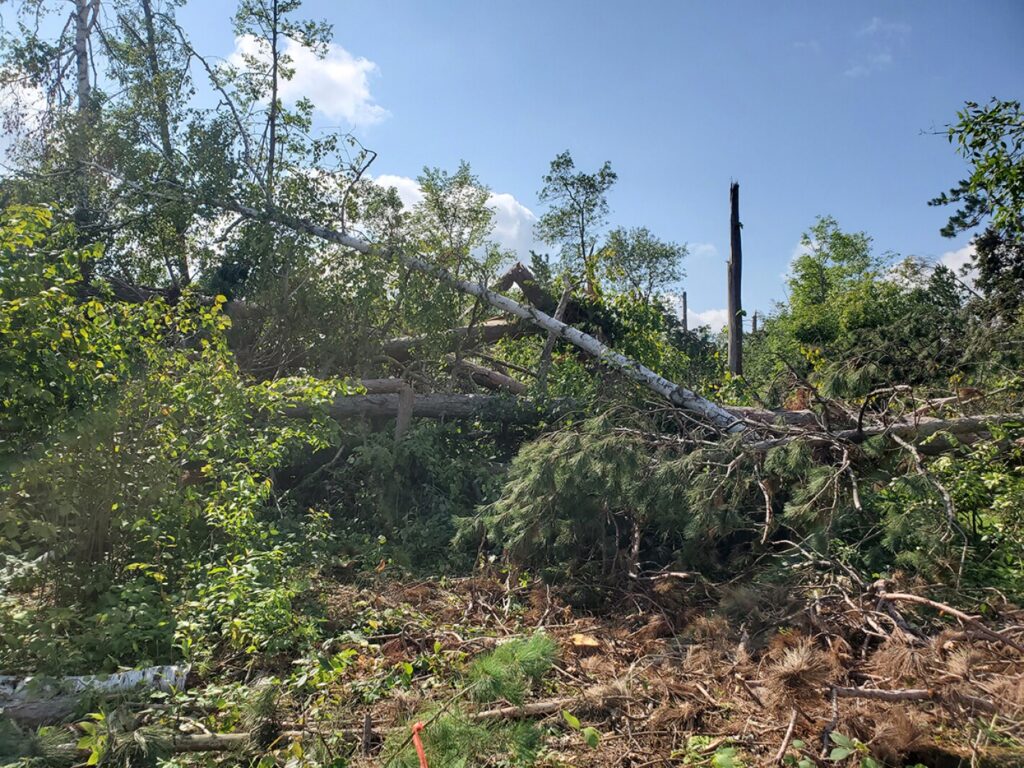
The Minnesota Department of Natural Resources recently released its annual forest health report from 2025. The report highlights impacts to forestland over the past year, which came in the form of insects, wildfires and extreme weather.
One of the extreme weather events was a derecho that damaged 11,600 acres of forest in and around Bemidji.
The Upper Midwest is prime real estate for derechos, according to Pete Boulay, climatologist with the DNR Ecological and Water Resources Climatology Office.
“Derecho is the Spanish word for ‘straight,’ and the term was first used in 1888 after a July 31, 1877, derecho in Iowa,” he told the Grand Forks Herald. “Derechos happen on a time scale where it would be difficult to determine some kind of trend. There’s also been a change in definition in recent years, and that makes statistics a little trickier. But we’ve always had them as part of our climate.”
Boulay said derechos are expansive weather patterns, and their impact can be tremendous.
Of the derecho that damaged forestland near Bemidji, “extremely intense thunderstorms” started Friday night and early Saturday, June 20-21, leading to “an extraordinary regional severe weather outbreak” that caused “catastrophic damage near Bemidji from the strongest measured winds in Minnesota since 2012,” according to information from the DNR.
Boulay further explained about derechos:
Derechos can occur in most states east of the Rocky Mountains, he said, except for maybe Florida and Maine. The epicenter of this extreme weather pattern is Branson, Missouri.
“If you live in Branson, you’ll likely experience a derecho,” Boulay said.
They occur in the summer, typically in the months of May, June and July. Grand Forks is on the border of the region’s typical derechos, but that doesn’t mean they can’t impact the area. The derecho that impacted the Bemidji and surrounding area started with an F5 category tornado that killed three people in Enderlin, North Dakota.
As damaging as that derecho was, there have been larger storms. One was a storm that struck during the daylight hours on Sunday, July 4, 1999, and stretched across northern Minnesota. The blowdown impacted nearly 500,000 acres of Superior National Forest, with 80 to 100 mph winds leaving the treescape “almost completely flattened,” according to the
. Recreationists in the Boundary Waters that day found themselves in peril, some of them reported injured.
The 1999 derecho has become “part of Minnesota weather lore,” according to NWS.
Boulay said as nice as it is talking about summer weather patterns in winter – it helps take the chill off, he said – derechos are nothing to take lightly.
When they occur, they can impact a large area and not only its forests, but also its people. But like winter’s sub-zero temperatures, derechos are another weather pattern Minnesotans and North Dakotans have to deal with.
“They are something we’ve always had,” he said. “I suspect Lewis and Clark saw evidence of derechos during their time in the area.”

Andrew Weeks is an award-winning journalist who has reported for newspapers and magazines. Prior to joining the Grand Forks Herald as its outdoors editor, Weeks was editor for several years of Prairie Business, a publication of the Grand Forks Herald and Forum Communications Co. Before that role, he was outdoors editor for a daily newspaper in Idaho.