
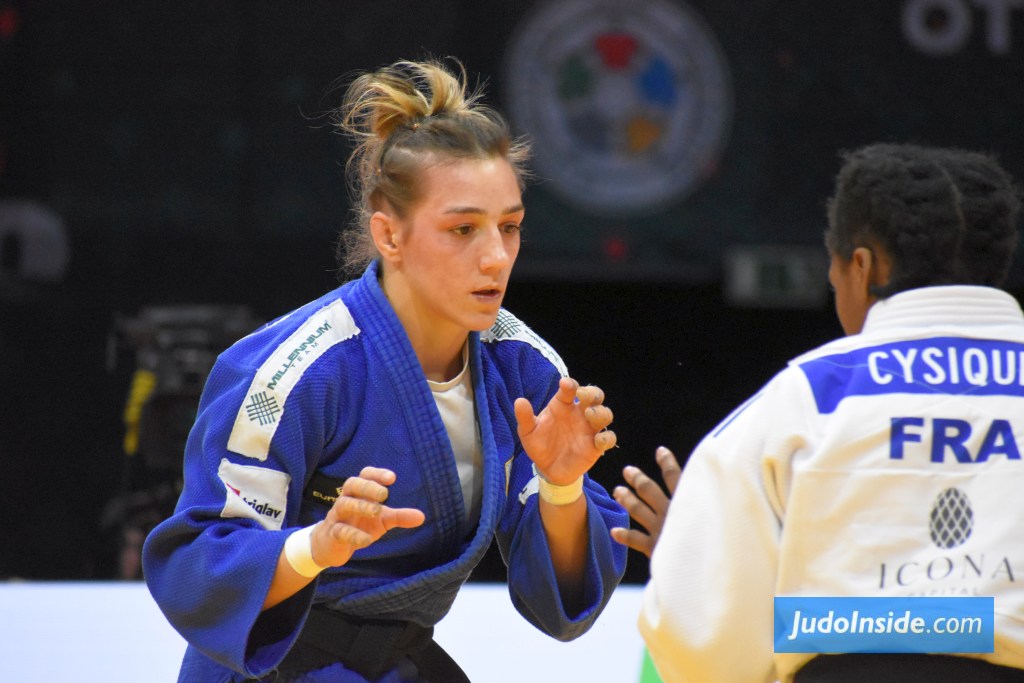
Marica Perišić already carries the experience of a veteran and the hunger of an athlete still shaping her best years. Known universally by her nickname Mara, the judoka from Novi Sad has become one of the most recognisable figures in Serbian women’s judo, balancing early success, Olympic pressure and steady evolution at senior level.
Turning 25 on Sunday, she was born into judo. Her mother Radmila was herself a member of the Serbian national team, a Balkan champion, European team bronze medallist in 2006 and fifth at the 2008 European Championships. Growing up with that example made the decision almost inevitable. At the age of nine, Marica stepped onto the tatami in Temerin, choosing judo not out of obligation, but inspiration.
Her competitive instincts appeared early. In 2015, she claimed bronze at the European Cup in Belgrade at U52kg. Two years later, she tested herself at a higher level, finishing fifth at the European Open in Belgrade at U57kg. These early outings revealed an athlete willing to learn through exposure rather than protection.
Junior success followed. In 2020, Perišić captured the Junior European title in Poreč, a milestone that confirmed her status among Europe’s best young judoka. She added a bronze medal at the European U23 Championships soon after, and in 2022 she went one step further by winning the European U23 title in Sarajevo, completing a full age group progression.
Her transition to senior elite level was marked by immediate impact. In 2021, she stepped onto the Grand Slam podium twice, claiming bronze medals in Kazan and Tashkent. These results placed her firmly among the international contenders and signalled that she belonged in the toughest draws.
The year 2023 proved decisive. Perišić produced one of the most memorable performances of her career at the European Championships in Montpellier, where she fought her way to the final and secured silver. It remains her most cherished moment, not only for the medal, but for the belief it reinforced. That same year, she triumphed at the Grand Slam in Tbilisi and won gold at the Grand Prix in Zagreb, asserting herself as a consistent winner rather than a surprise finalist.
Success continued into the following seasons. In 2024, she added gold at the Grand Prix in Linz and later finished seventh at the Olympic Games, her second Olympic appearance, a result that reflected both progress and the unforgiving nature of the biggest stage. In 2025, she returned to the podium with bronze medals at the Grand Slams in Baku and Tbilisi, while once again standing on the top step at the Grand Prix in Zagreb.
Behind these results lies a strong support structure. Perišić represents Red Star Belgrade and is coached by Vladimir Jovičić. In daily training, she works closely with sparring partner Vukašin Gačić, building the physical and tactical sharpness required at world level. Away from the tatami, she studied at the Faculty of Sport and Physical Education at the University of Novi Sad and works in the field of sport and science, reflecting her interest in understanding performance beyond competition.
Family remains central to her life. Alongside her mother Radmila, her siblings Jovica, Marko, Stevan and Ivana are a constant presence, as is her boyfriend Miljan Radulj. When asked about influence, Perišić consistently points to her family first. Her ambition is framed simply. To make herself proud of what she does.
Like many Serbian athletes, she draws inspiration from Novak Djokovic, admiring not only his records but his resilience and longevity at the highest level.
Her career has been shaped by demanding rivalries. Against Türkiye’s Hasret Bozkurt, she holds a strong record, winning six of eight meetings. France’s Sarah-Léonie Cysique has edged their encounters, winning five of eight. Georgia’s Eteri Liparteliani has proven a particularly difficult opponent, winning seven of their eight contests. Slovenia’s Kaja Kajzer and Kosovo’s Nora Gjakova have also tested Perišić repeatedly, reflecting the depth and brutality of her weight category.
At 25, Marica Perišić stands at an important crossroads. Junior titles are behind her, Olympic experience already gained, and senior gold now part of her reality. With ambition grounded in family, education and daily work, she represents a generation of Serbian judoka who compete not for shortcuts, but for substance. For fans of the sport, her story remains easy to follow and worth watching.