
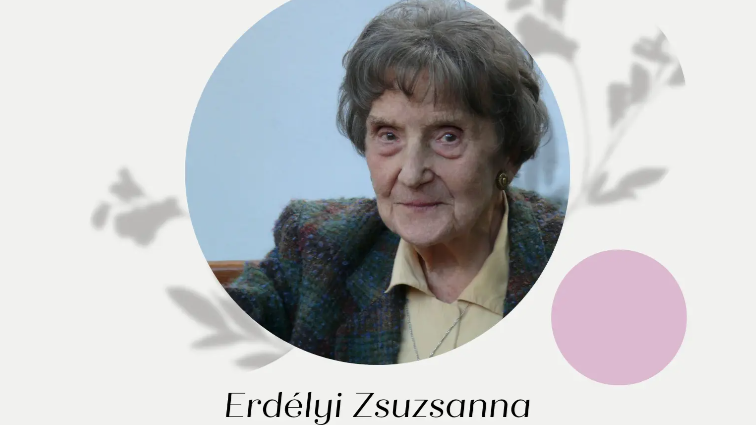
The following is an adapted version of an article written by Emese Hulej, originally published in Hungarian in Magyar Krónika.
The 20th century in women’s reading. Artists, scientists, legendary educators, lifesavers, and society’s favourites. A woman of many talents who accidentally joined an ethnographic collection group and became an epoch-making scholar by compiling archaic folk prayers. Dr Zsuzsanna Erdélyi was born 105 years ago.
‘That was my life!’ — Surprisingly, this is what the internationally renowned ethnologist, who had received numerous awards and honours, said about her diplomatic work decades later. After the war, she was appointed to the Ministry of Foreign Affairs as the first female diplomat. As a ministerial clerk, she effectively utilized her excellent organizational skills and demonstrated a genuine passion for her work.
The girl with roots in Transylvania and Upper Hungary spoke several languages and graduated from university with a degree in Italian. She was even once asked to interpret for Mátyás Rákosi, who turned out to know Italian, so he only asked Zsuzsanna for help with complex sentences.
The young interpreter did not come from the movement, but from a rather conservative family. She grew up with her siblings near Komárom, her father was a library director and winegrower, and the family home was set for meals four times a day. In the morning and evening, with a white tablecloth, and during the day with a colourful table runner. Stargazing, conversation, chamber music—such were her early childhood years.
Zsuzsanna Erdélyi’s diplomatic career was cut short by the communist takeover. The pain of her dismissal was eased by the fact that she met her husband, Elemér Dobozy, a promising young cardiologist, shortly afterwards. They were married in 1948—with only one guest!—and lived happily together until his death.
‘Zsuzsanna Erdélyi’s diplomatic career was cut short by the communist takeover’
In 1953 she was expecting her third child when she was able to climb aboard ‘Noah’s Ark’—this was the name given to the ethnographic collection group organized by László Lajtha, a composer who had also been unjustly persecuted. Lajtha was removed from his position at the National Conservatory, but they wanted to give him something, so they formed a small group consisting of Cistercian nuns, English ladies, and intellectuals like Zsuzsanna—there was even a Countess Teleki among them. Lajtha met Zsuzsanna Erdélyi when her family moved to Pest and her father, Pál Erdélyi, sold a crate of embroidered items from Kalotaszeg to the Museum of Ethnography, where Lajtha worked as a young museologist.
In 1953, they began regular seven- to eight-day collecting trips. Lajtha, Erdélyi, and former Cistercian nun Margit Tóth travelled across the country, bumping along on trains, walking, and carrying only a tape recorder and a few personal belongings. They often ate lunch by the roadside—bread, salami, and cheese—refusing food offered by their informants, who had only meagre supplies. Priests usually helped, telling the elderly that a professor was coming with colleagues and asking them to sing the beautiful religious songs they knew.
During these visits, gypsies, funeral leaders, and lead singers performed in festive attire while Lajtha, Erdélyi, and Tóth recorded, wrote down, and transcribed everything they heard. Once back home, they organized and processed the material. Zsuzsanna Erdélyi left her children at home with a heavy heart, often only beginning her work after they had been put to bed.
The news of the 1956 Revolution reached them while they were on a collecting trip. She did not know what had happened to her children and husband, and she was so worried that she could not sleep for four days. Finally, she was hospitalized due to nervous exhaustion, and it was only days later that she was able to calm down when she found her family safe and sound.
Their family life was a refuge, offering security and joy. Although her husband was transferred from the clinic to the SZTK (workers’ unions) surgery in Csepel, they lived a rich life despite their many hardships. There was a lot of work, a lot of laughter, and a lot of music. Her family had a summer house in Balatonszemes, where they spent most of their summers, and where she spent a lot of time even in the last period of her life, going swimming as long as she could.
‘She searched, researched, and reached the oldest layers of our culture, whose memories had been passed down through generations’
After Lajtha’s death, one day on the vineyard hill in Nagyberény, 98-year-old Aunt Rozi sang Friday prayers for her. It was a moving experience, a real journey through time. With her Latin education, she felt that she was not looking into the past, but into the well of the distant past. She searched, researched, and reached the oldest layers of our culture, whose memories had been passed down through generations in words, melodies, and spirituality. She rescued our archaic folk prayers from oblivion and became the defining figure, analyst, and systematizer of the genre.
Her collection entitled Hegyet hágék, lőtőt lépék (Climbing Mountains, Descending Slopes) reached a lay audience, but professional recognition was more difficult to come by. A deeply devout Catholic woman, who was taken in by the ÁVO (State Security Authority) several times in the 1950s because, as a diplomat, she was in their crosshairs. She encountered both good and bad communists in her professional life. From her point of view, she counted the ethnographer Gyula Ortutay among the former, who took her into the Hungarian Academy of Sciences’ Institute of Ethnography and helped her career. Another ally was the then-Cardinal János Lékai, with whom she founded a museum of folk religious artefacts in Esztergom.
Zsuzsanna Erdélyi, who extended her research to Central Europe and the entire continent, only received recognition well into her fifties. She received the Europe Prize, the Kossuth Prize, and became an Artist of the Nation.
10 January marked the 105th anniversary of her birth.
Read more about famous Hungarian women:
Click here to read the original article.