
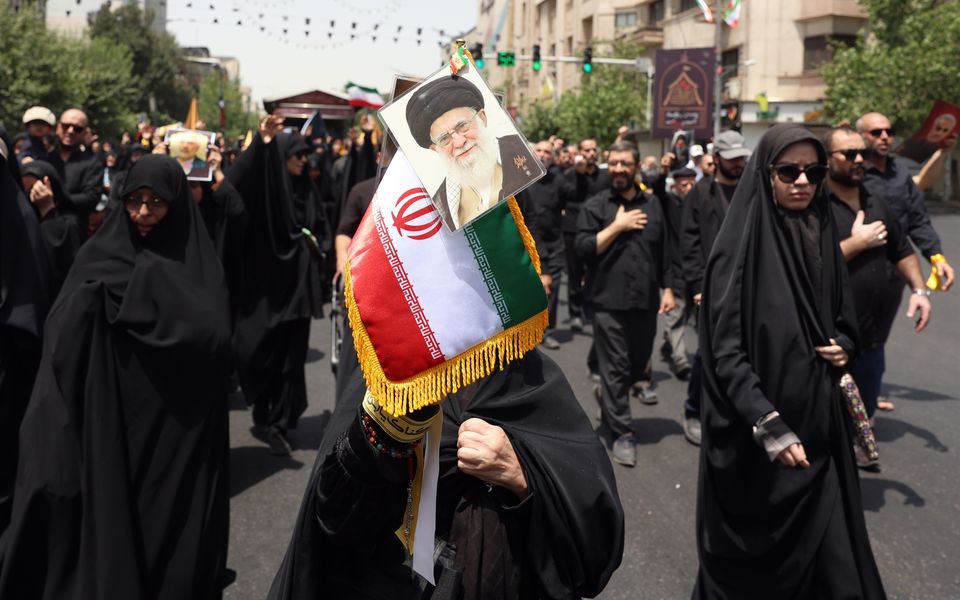
An Iranian woman holds a picture of Iranian supreme leader Ayatollah Ali Khamenei and an Iranian flag during a rally to show their support for Khamenei during the ‘Tasha Day’ in Tehran, Iran, on 5 July 2025. [ABEDIN TAHERKENAREH/EPA]
What the West sees as Iran’s strategic relief, Ankara and Doha fear as strategic loss. Not because they trust Tehran, but because their leverage rests on the regime’s survival. Iran does not need affection; it needs endurance, a familiar enemy that organizes attention in Washington, Brussels, and with NATO. Take it away, and the danger fades. So does the excuse.
For Ankara, Iran is a long, porous neighbour; collapse is not theoretical when you share a frontier. Regime failure is not “transition” but fragmentation, refugee pressure, and the nightmare Ankara rarely states openly: a Kurdish arc of momentum. A weakened Iranian state would turn its Kurdish periphery into a corridor for militants and political aspiration that does not stop at the border, intensifying Turkey’s already contested campaigns at home, in Syria, and in Iraq.
As long as Iran remains the region’s headline antagonist – nuclear risk, missiles, proxies – Turkey is indulged. Allies complain, then compartmentalize. Ankara can buy Russian systems, bully neighbors, weaponize migration, and test alliance discipline while remaining “too important” to confront. Remove the Iranian emergency, and that indulgence collapses. Turkey’s file stops being postponed; questions once softened by necessity harden into demands over cross-border operations, democratic regression, and alliance discipline.
This is where bases turn into leverage. Incirlik air base embodies Ankara’s ability to hold allied operational access hostage. After the 2016 coup attempt, US air operations were halted and Washington adjusted in real time. Since then, contingency planning has lingered – around Souda Bay in Crete and, quietly, Israel’s Ovda air base. Ankara understands the equation: As long as Iran remains the urgent problem, Western capitals absorb Turkish friction for proximity. Downgrade Iran, and alternatives in Greece, Cyprus, and Israel cease to be theoretical. Turkey’s leverage depreciates fast.
Iran is profitable for Turkey when it is pressured but not broken. Isolation expands Ankara’s intermediary role, generating trade channels, energy routes, finacial workarounds, and diplomatic premium. The Halkbank sanctions case was not an anomaly but a template: Turkish statecraft thrives in gray zones created by confrontation that never quite ruptures.
That logic extends directly to energy. Turkey’s gas relationship with Iran is contractual, with supply agreements expiring in mid-2026 and diversification still routed through Iranian infrastructure. A sanctioned but functioning Iranian state serves Turkey’s supply security and bargaining position. Collapse disrupts flows; rehabilitation creates competition. Ankara’s optimal outcome is stability without resolution.
Qatar reaches the same conclusion through different means. Wealthy, connected, and militarily small, it survives by engineering protection and relevance. Iran provides both: a persistent threat that justifies the American umbrella, and a neighbor whose channels translate into diplomatic capital – the US military presence at Al Udeid air base extended for another decade – is the anchor of this logic. It is an insurance policy, paid for in hosting costs and political complexity, redeemed in existential crises.
That insurance has been tested. During the 2017-2021 blockade, Iran and Turkey helped reroute supplies and air traffic, and Doha’s alignment held. Iran has since shown a willingness to strike US assets in the Gulf, while Qatar has repeatedly worked – often at Washington’s request – to secure de-escalation and ceasefires. Even when Qatari territory is exposed, the response is to preserve the channel. That channel is what Qatar sells.
Turkey and Qatar converge on one objective: indispensability. Ankara leverages access to Tehran; Doha converts it into mediation and delay. Amid Iran’s unrest, both push the same line – warn against collapse, sell stability, buy time.
Remove Iran, and the spotlight shifts across NATO and Europe: Turkey’s force against Kurdish actors, pressure in the Aegean and Eastern Mediterranean, and its posture in the Turkish-occupied north of Cyprus. For Greece, for Israel, and for NATO planners alike, this reassessment is already underway. Israeli security reviews have warned that under certain scenarios the Turkish threat may rival, even exceed, Iran’s – an assessment increasingly echoed across the alliance.
That is the reckoning Ankara and Doha are working to delay. Iran is protected not by conviction, but by utility. When the emergency ends, so does the cover.
Shay Gal is a strategic analyst on international security and geopolitical strategy, advising governments and institutions on crisis management and regional power dynamics.