
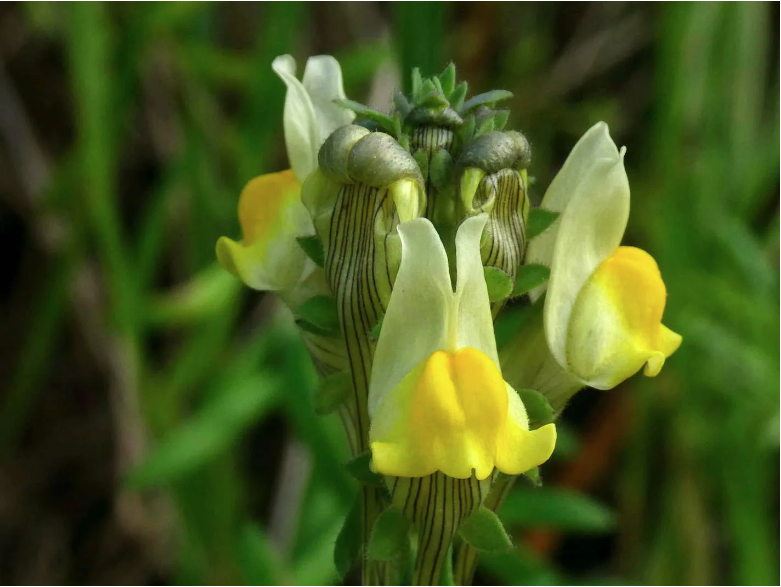
Named Linaria almadensis, the plant was first collected in 1843, but only now, as part of a taxonomic review, has it been recognised and described in Botany Letters, explained the Faculty of Science and Technology of the University of Coimbra (FCTUC) in a statement sent to the Lusa news agency.
The specimen used as a reference for the description of this new species is kept in the UC Herbarium, the largest botanical collection in the country.
“The material was collected at the foot of Cristo-Rei and in front of the Jerónimos Monastery, occurring exclusively on sandy cliffs and terraces, near limestone rocks,” explained the researcher from the Centre for Functional Ecology (CFE) at FCTUC.
According to João Farminhão, this species differs from others “with which it had previously been confused” by its leaves and the colouring of its corolla, “with yellowish-white upper petals, an orange-yellow palate and a spur often tinged with violet”.
The specialist from the Terra Associated Laboratory also warned that “the species has been classified as Critically Endangered, which is the most serious level of threat of extinction”.
“Only a few dozen individuals are known to exist, and their habitat is in urgent need of conservation measures,” he explained.
For FCTUC, the discovery demonstrates the level of ignorance about Portuguese biodiversity, even in relatively well-known groups such as vascular plants, and even in places so close to centres of knowledge, such as the river cliffs of Almada.
“Its identification coincides with the discovery of a new area of plant endemism, which helps experts understand the formation of new species on the western coast of the Iberian Peninsula, in close dependence on geology and geomorphology,” added the higher education institution.
João Farminhão also highlighted the urgent need to control the spread of invasive species, pointing out that “Linaria almadensis joins the approximately 90 species of plants that, worldwide, only exist in mainland Portugal, whose conservation depends on everyone.”