
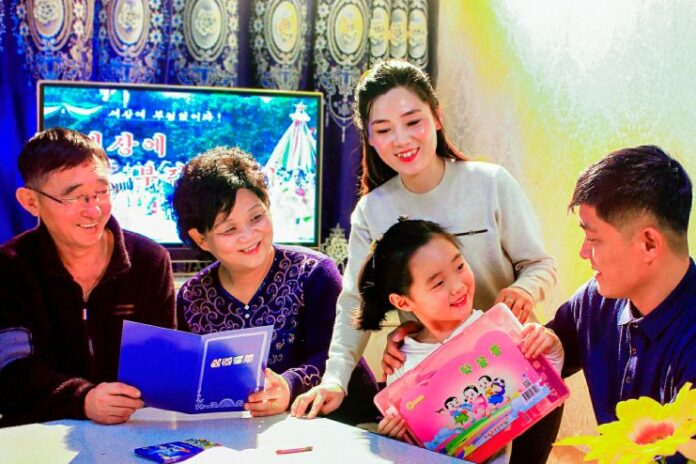
 “North Korean leader Kim Jong Un sent heartfelt gifts to children at revolutionary academies, elementary schools, nursery schools, childcare centers, and to nursery school children, preschool school students, and students at day care centers and kindergartens across the country on the occasion of the Kwangmyong Festival,” Rodong Sinmun reported on on Feb. 17, 2024. The gifts included “sunflower” school supplies and foodstuffs, the newspaper said. (Rodong Sinmun-News1)
North Korean authorities said the ruling party would take direct responsibility for distributing dairy products to promote children’s growth and improve their nutrition, but even in the capital, Pyongyang, dairy product supplies are irregular.
“The government pledged to distribute dairy products, saying the nation would take responsibility for and take care of the growth of young children ‘with the love of a great mother,’ but a January 8 inspection of dairy product supplies to local daycares and kindergartens in several Pyongyang districts like Sunan district showed that suspensions of supplies and passing on of costs to parents were chronic,” a Daily NK source in Pyongyang said recently.
According to the source, the latest inspection was launched without prior notice per the party’s order to “flawlessly implement the distribution of dairy products everywhere so that children—the future of the fatherland—grow well.”
The inspection aimed to determine whether the distribution of dairy products to daycares and kindergartens brought substantive changes to children’s growth, development, and nutrition, and whether distribution was being carried out effectively. Contrary to authorities’ hopes, the results were terrible.
In central districts of Pyongyang, distribution was passable, even if not 100%, with little to worry about, but in the outlying districts of the capital, like Sunan, distribution was below 30%.
Supply shortages, transport costs, and poor quality
Officials at daycares and kindergartens in outlying districts explained that this was because they sometimes receive no dairy products due to supply shortages. At other times, they cannot accept them because they have no vehicles to transport them, even when there are supplies.
The officials also complained that the dairy products have no added sugar, smell terrible, and taste thin because too much water has been added, so children tend to avoid them.
“The kids refuse to drink them, and we can’t force them to,” they said. “They don’t provide nutrition—in fact, the dairy products provide little help to their growth or development.”
Another problem discovered during the inspection was that daycares and kindergartens must borrow cars to transport dairy products, but the costs—including gas—are passed on to parents. In fact, parents have to pay regardless of whether they receive proper provisions of dairy products or not.
Not only that, in some districts like Sunan, daycares and kindergartens were caught collecting 1 million North Korean won (roughly $137) from parents to buy snacks for their children in marketplaces last month, but did not provide the snacks—they only pretended to do so.
“No punishments or measures were known to have followed the latest inspection,” the source said. “The authorities inspected dairy product provisions not only in Pyongyang but nationwide, but in other provinces like South Pyongan province, it goes without saying that provisions were completely cut off, so the government was greatly disappointed overall.”