
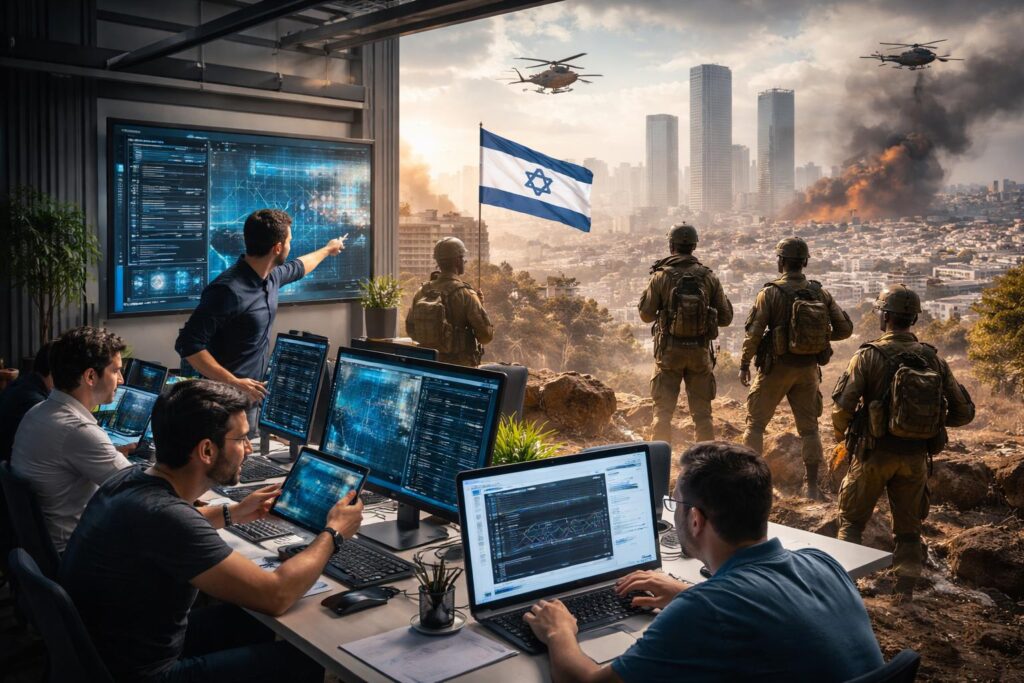
Yesterday, I found myself in one of those moments that feel quintessentially Israeli.
I’m currently attending CyberTech Global 2026 in Tel Aviv, a cyber conference buzzing with energy, ideas, and reinforcing Startup Nation’s strength amid global powerhouses. Founders and investors leaned into conversations about AI, acquisitions, and the promise of the next breakthrough.
I was sitting in a talk with executives from NVIDIA, Wiz, and Check Point discussing the power of AI in cybersecurity as my phone buzzed with bittersweet news: Israel’s IDF had retrieved the body of Ran Gvili, the final captive from the October 7 hostage crisis, after 843 days.
Finally: there were no more hostages in Gaza. The last thread of that long and painful chapter had been brought home. Closure had finally come.
I sat there, absorbing both realities, and felt a familiar tension settle in my chest.
Those living in Israel aren’t new to that tension. One part of our country eyes the next generation of disruptive technologies that could transform industries and economies. The other is still learning to carry forward the weight of a national trauma as our society endures the longest hostage ordeal in its history.
My reporting on Startup Nation is well documented. But I’ve also written about the war, perhaps most intimately in The Times of Israel in an article titled “Kfar Aza and Me.” In that piece, I walked the ruins of a kibbutz forever changed by the Hamas attack on October 7, 2023, speaking with locals whose lives were shattered, homes destroyed, and communities emptied.
And yet, back at the Tel Aviv Expo, I recognized another truth. Israeli innovation hasn’t slowed despite the war. In many ways, it’s accelerated. AI startups are scaling. Global companies are acquiring Israeli firms. Investors are still showing up. The headlines keep coming, often to the frustration of those who would prefer Israel be defined only by conflict or controversy.
I’ve written about this too, this time in my own publication, The Spiro Circle. We live amid a phenomenon of Israel continuing to win economically and technologically while being relentlessly criticized politically. “It’s a bad week for Israel haters,” I declared last week, praising news of funding, acquisitions, and tech expansion. But I did so with a tinge of defensiveness because success here always feels like it requires a caveat.
It’s tempting to try to separate Israel’s two realities of war and tech innovation into neat categories. But they overlap in ways that define life in this country. The same spirit that fuels resilient communities also powers our startups. The very challenges that shape our collective psyche, like security concerns, global criticism, and deep historical grief, are part of the backdrop against which we build.
“Resilience” is a word I hear every week when I speak to founders and investors for my reporting and my podcast. And it’s a word that applies to both realities. Today, as day two of the conference begins, former hostage Noa Argamani will share the stage with Ben Gurion University Prof. Daniel Chamovitz to discuss “Restarting Life and Pursuing Purpose”. Other fireside chats touch on cybersecurity news, M&A excitement, and the power of AI.
There is pride in Israel’s innovation economy. There is also profound sadness in the chapters of war that penetrate everyday life here. And as a journalist and a resident watching both worlds unfold firsthand, I find myself living in that tension.
The truth is that dual realities coexist in Israel, which makes it one of the most extraordinary places on Earth.
James Spiro, formerly of CTech, now runs The Spiro Circle, an independent publication and podcast that explores ideas at the intersection of culture, technology, and meaning. You can subscribe here.
https://jamesspiro.substack.com/