
In Central and Eastern Europe, hesitation is a luxury history does not tolerate. Power shifts quickly, alliances realign abruptly, and relevance is never guaranteed. Yet Romania continues to behave as if time itself were an ally. While the region moves, Bucharest pauses. While neighbors decide, Romania delays. While others assume political risk, Romania seeks procedural comfort.
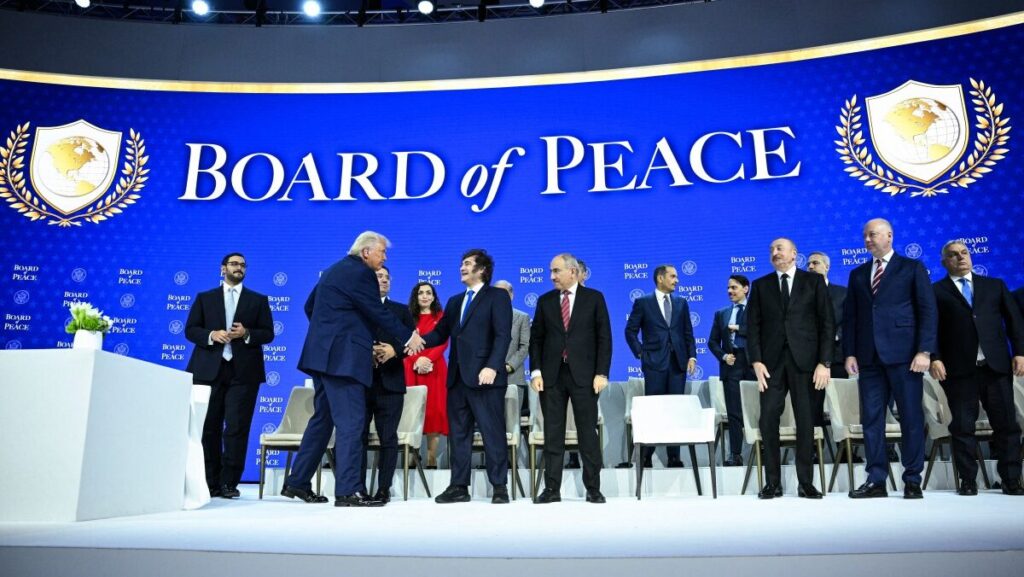
The emerging Board of Peace initiative of U.S. President Donald Trump has become a new test of strategic clarity in the region. Hungary and Bulgaria joined without hesitation—not because they were instructed to, but because they understood a basic geopolitical truth: relevance is built through positioning, not permission.
Romania, by contrast, chose suspension. No clear support. No clear rejection. No independent line. Only silence rebranded as “deeper analysis.” This is not diplomacy. It is political paralysis.
That silence was reinforced symbolically by the absence of Nicușor Dan from the World Economic Forum in Davos—a forum where precisely such strategic alignments, geopolitical initiatives, and regional directions are debated and shaped. The decision not to participate did not signal neutrality. It signaled calculated avoidance: a deliberate refusal to assume any clear public position—not only on the Board of Peace initiative and Romania’s strategic direction but on a wider set of critical issues with direct consequences for Romania, the European Union, and the entire region. It was not caution. It was abdication. Avoidance has become policy. Ambiguity has become method.
From sovereign voice to administrative alignment
That logic of avoidance was also visible in the Romanian president’s statement during the informal meeting of the European Council in Brussels, where Nicușor Dan said,
I believe that before we go there as well, as it has been said in Romanian public discourse, we must first have certain strategies prepared, so that such visits can be constructive.”
At first glance, the statement appears prudent. In reality, it exposes the core problem: the absence of any existing strategy. A state that speaks about ‘preparing strategies’ in moments of geopolitical decision is a state that admits it does not already have one. Coherence is not improvised. Doctrine is not assembled ad hoc. Strategic vision is not built reactively.
This is not caution. It is structural unpreparedness.
When leadership speaks about future strategies instead of acting on existing doctrine, it reveals that Romania does not operate with a coherent geopolitical framework. It navigates events rather than shaping them. It reacts to agendas, rather than setting them. It manages situations, rather than pursuing interests.
In this sense, Romania’s problem is not indecision—it is strategic emptiness.
A state that cannot articulate its own interests ceases to be an actor and becomes an extension. Romania’s foreign policy increasingly resembles bureaucratic alignment rather than strategic thinking. Decisions are no longer framed through national interest but through conformity. Positions are not built—they are simply adopted. Direction is not generated internally—it is imported.
Hungary and Bulgaria calculated their interests and acted. Romania outsourced its judgment. This is not an isolated episode. It is a pattern.
Romania aligned with the EU on the Mercosur agreement, despite the direct risks for Romanian agriculture and domestic producers. Romania continues to channel political and financial support to Ukraine, while at home its own citizens face austerity policies, budget cuts, and growing fiscal pressure imposed by the government.
Weightlessness as a political condition
An accurate diagnosis of Romania’s geopolitical condition comes from within its own political class. Kelemen Hunor, president of the RMDSZ, the main political party representing the Hungarian ethnic minority in Romania, described the situation with rare clarity:
From a political point of view, Romania today is weightless: it has assumed positions on almost nothing, it does not even set its own direction, it aligns itself with the positions of others and drifts on an open and stormy sea. Romania would need local and regional allies. At present, among its neighbors, Romania maintains no strong relationship based on trust with anyone.
Romania is not marginal because it is hostile. It is marginal because it is passive. Not independent. Not strategic. Not anchored. Just simply aligned.
In a region increasingly shaped by strategic blocs, assertive diplomacy, and regional coordination, Romania has chosen the most fragile posture possible: obedient neutrality.
By failing to assume a clear position on key issues, a deeper transformation is confirmed: Romania no longer behaves as a sovereign strategic actor but as a compliant institutional satellite. It does not initiate. It does not convene. It does not shape agendas. It adapts to them.
In international politics, loyalty does not produce relevance. Strategy does.
States that do not define their own interests inevitably serve the interests of others. Romania once aspired to regional leadership. Today, it risks becoming a regional appendix.
Bucharest still confuses obedience with security and alignment with stability. But history teaches a harsher lesson: states without strategic autonomy are not protected—they are bypassed. Silence is not neutrality. Hesitation is not prudence. Alignment is not sovereignty.
And in geopolitics, those who only follow are never invited to design the future. They are only asked to implement it.