
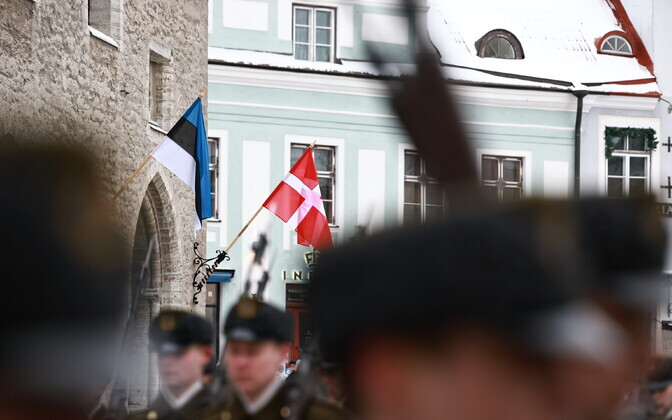
If you’ve visited Tallinn, you’ve probably spotted the red and white Danish flag around the Old Town. With the visit of Denmark’s king and queen, ERR News explains the legend that has bound the countries together for over 800 years.
According to legend, the Danish flag – the Dannebrog – fell from heaven in present-day Estonia during the Battle of Lindanis between the Danes and Estonians in 1219.
In the early 13th century, the Danish king Valdemar Sejr (Valdemar the Victorious) led his army on a crusade in territory that is present-day Estonia. During a battle on June 15, 1219, the Danes were on the defensive when suddenly a red banner with a white cross fell from the sky.
As a result, the Danish army’s luck changed, they won the battle, and Denmark got its flag.
The legend was first mentioned by historians in the early 16th century. Since 1913, the flag — and the legend of its origin — is celebrated annually on June 15 in Denmark, which is named Valdemar’s Day after the late king.
 The Dannebrog falling from the sky during the Battle of Lindanis, June 15, 1219, painted by Christian August Lorentzen in 1809, on display at Estonia’s KUMU in 2019. Source: Siim Lõvi / ERR
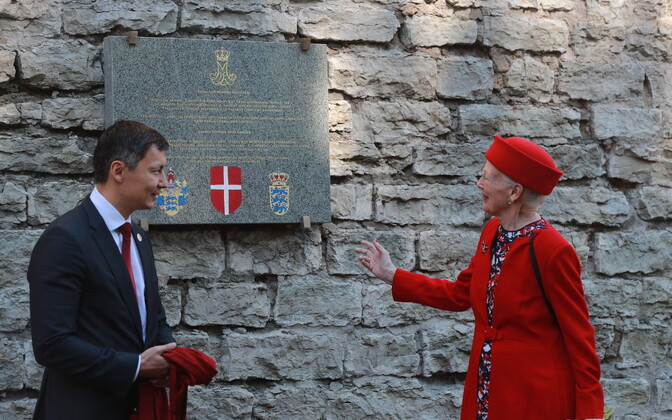
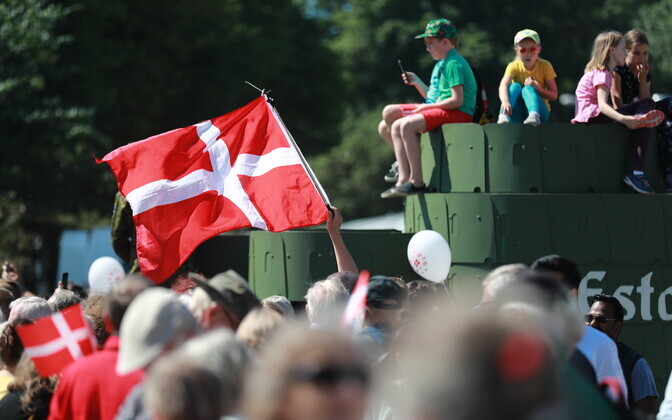 Queen Margrethe II of Denmark visited Tallinn’s Freedom Square together with President Kersti Kaljulaid on Saturday. June 15, 2019. Source: Ken Mürk/ERR
Although King Valdemar’s crusade did take place, the story of the falling flag obviously has no basis in reality, writes the official tourism website denmark.dk, adding that this does not make it any less powerful for Danes.
“What matters is that it’s a good story. The mythological and religious elements only make it better. So does its old age,” Torben Kjersgaard Nielsen, historian at Aalborg University in Denmark and author of a book on the Danish flag, told the website.
The Danish flag is now considered the oldest consistently used national flag in the world.
Tallinn = Danish town
The name of Estonia’s capital also references the historical connection to Denmark.
The first reliable data about Tallinn dates back to the Livonian Chronicle of Henry. The chronicle describes the Danish fleet led by King Valdemar II landing near Lindanise castle in June 1219.
The Danish landing was part of the German-Scandinavian colonization of Livonia and Estonia, during which the German crusaders invaded Latvian and Southern and Central Estonian territories, as well as Saaremaa, and the King of Denmark invaded Northern Estonia.
After the Danes won the battle against the Estonians and their flag, they began building a stronghold. Today, the place is known as Tallinn — from the words “Taani linn” or “Danish town.”
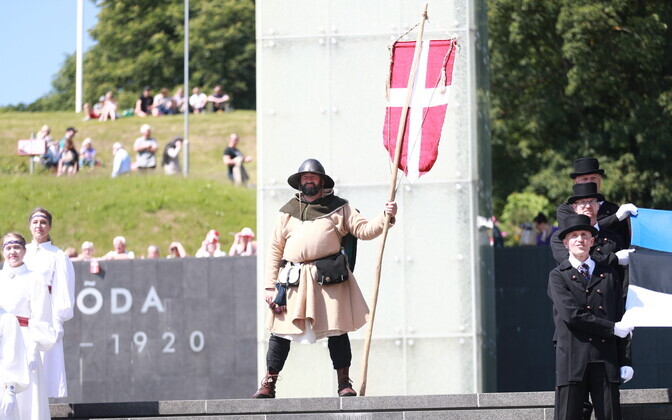 The lesser coat of arms of Tallinn is the red and white Danish flag. Source: Ken Mürk/ERR
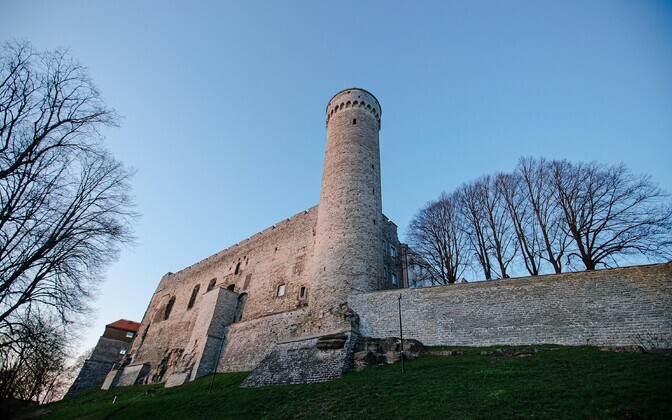 Toompea Source: Ken Mürk/ERR
The Danes established a stone castle on Toompea, and the Head Bishop of Lund Andreas Sunesen became the first regent of Denmark in Tallinn. Today, the Danish Embassy overlooks Toompea Castle from across Hivre Park.
Tallinn obtained its city rights based on the city rights of Lübeck with the signature of King Eric IV of Denmark (Ploughpenny), who confirmed on May 15, 1248, that the citizens of Tallinn now held “the same rights as the citizens of Lübeck.”
In the middle of the 14th century, forced by difficulties in internal policy and lack of money, the king of Denmark decided to sell his Northern Estonian lands, together with Tallinn, to the German Order. After years of preparation, the deal was finalised in 1346.
Today, you can still find the Danish flag around Tallinn, especially in the Danish King’s Garden, which, according to legend, is the spot where the flag descended from the sky in 1219.
However, Visit Estonia says: “It was the Danish reign that lasted for over a century in Tallinn and Northern Estonia that gave the name to the garden.”
Additionally, the lesser coat of arms of Tallinn, which is also the coat of arms of Harju County, dates back to the Danish rule and depicts the Dannebrog cross.
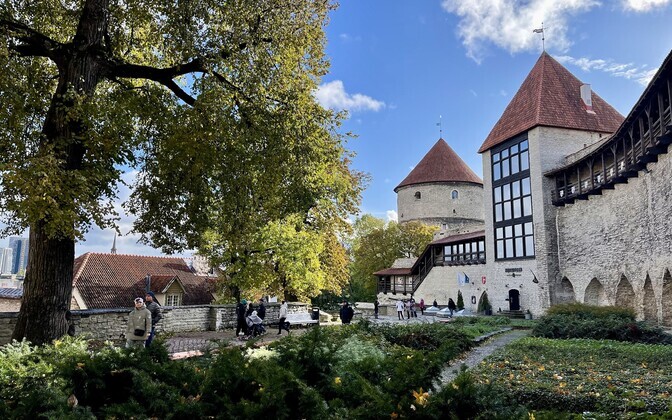 The Danish King’s Garden in Tallinn. Source: Helen Wright/ERR
Contemporary diplomatic relations
Danish volunteers fought for Estonia’s freedom in the War of Independence. On April 3, 1919, 184 men arrived in Estonia, forming the infantry regiment of the Danish-Baltic Auxiliary Corps. Danish doctors and nurses also worked at the Valga field hospital.
Denmark recognized the independence of Estonia on February 5, 1921.
The country never recognized the Soviet Union’s occupation of Estonia and the Kingdom of Denmark was the second country, after Iceland, to restore diplomatic relations with the Republic of Estonia in August 1991.
The countries are both NATO and EU members and work closely together in the Nordic-Baltic 8 format, among others.
“Today, Estonians and Danes live in harmony — two Baltic Sea countries of a similar size that share history and values,” the Estonian Ministry for Foreign Affairs says. “It is important to look to the future when it comes to the cooperation of our countries.”
—
Follow ERR News on Facebook and Twitter and never miss an update!