
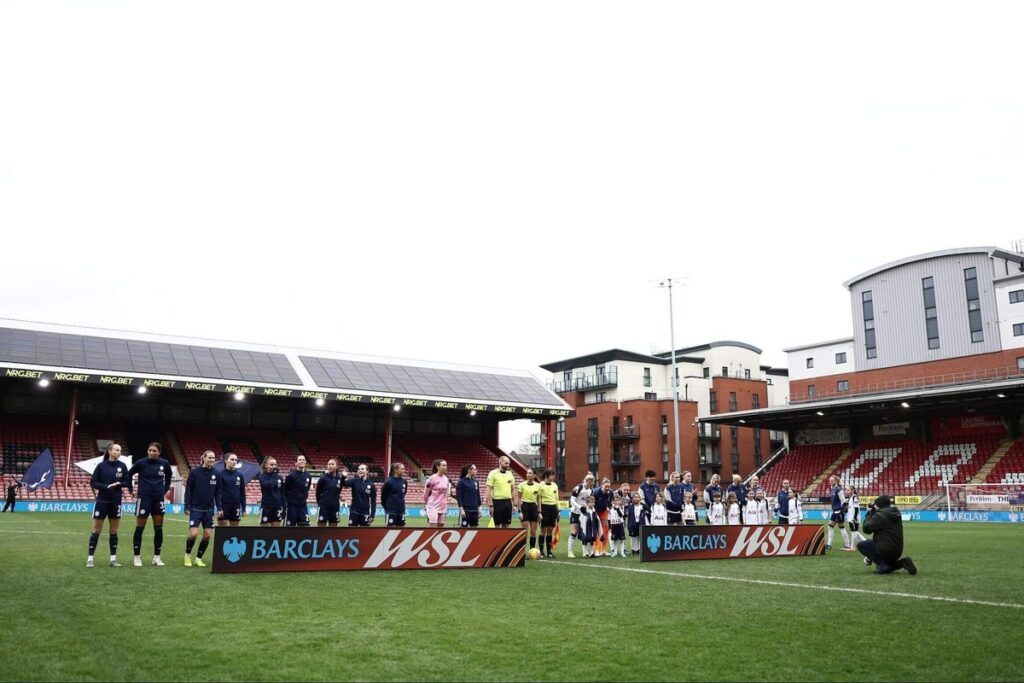
Women’s Super League Football Limited (WSLF), the entity which oversees the top two divisions of women’s football in England, has announced an £8.2million operating loss on the back of £17.4m revenues in its inaugural year.
The loss reflects WSLF’s position as, in effect, a start-up company, whereby costs exceeded income in the first season of English women’s football being overseen by a standalone entity. The operating loss was, per the accounts, “in line with the business plan”, and does not include the impact of the WSL’s new and improved broadcast rights deal with Sky Sports and the BBC, which commenced at the start of the ongoing 2025-26 season.
WSLF was set up in 2024 to provide the women’s game with its own dedicated governance structure, alongside the aim of driving commercial income and maximising growth. Prior to 2024-25, the WSL and WSL2 were operated as a cost centre within the Football Association.
These results — which are distinct from those of the individual women’s teams — allow greater visibility of the finances behind women’s leagues in England, even if some headline findings are arguably already out of date.
The broadcast rights revenue in 2024-25 of £8.7m comprised the largest element of WSLF’s turnover, but it is already known that the figure will increase by around 50 per cent to £13m this season. Sponsorship and licensing income totalled £8.5m but, again, will bear little resemblance to 2025-26 numbers: WSL title sponsor Barclays last year agreed to a renewed and uplifted deal which will provide £15m a season to WSLF coffers.
Revenue figures unsurprisingly pale in comparison to men’s football in England, but the difference in make-up of income is notable. Where just six per cent of distributions to men’s Premier League teams are driven by the league’s central commercial revenues, sponsorship and licensing comprised 49 per cent of WSL income last season. It is a trend reflected at club level: recent figures released by consultancy firm Deloitte showed that, in 2024-25, commercial revenues made up 72 per cent of income among the highest-earning women’s teams.
Over half (£9.4m) of that revenue was distributed to WSL and WSL2 member clubs, and the costs of operating a newly formed business drove an operating loss which looks hefty compared to income but is part of a longer-term strategy.
Indeed, figures released for the current season are projected to be rather more encouraging. WSLF is expected to be profitable this season, on the back of those improved broadcast and sponsorship deals.
Speaking at a media briefing and referring to figures which will be released next year for the 2025-26 season, WSL’s CEO Nikki Doucet said: “We will have tripled revenue in the first two years of the business (via) the new Barclays deal, the new media rights deals and then all the other new commercial partners that have come on board.”
Those results are a year away from publication but last season’s loss was driven in part by the WSL choosing to maintain previous distribution levels for its member clubs.
“It was really important that we didn’t reduce distributions of support for WSL2 clubs,” said Doucet. “That was one of the commitments we made to the clubs.”

Nikki Doucet (L) says the WSL will have “tripled revenue in the first two years of the business” (Molly Darlington – The FA via Getty Images)
Reducing those distributions would have allowed for a lower first-year loss, perhaps no loss at all, but was deemed unhelpful in the primary aim of growing the women’s game. In another departure from the men’s form, WSL2 teams were given the same amount of money as WSL clubs, a decision the women’s league believes should help ensure growth across a broader slate of clubs.
Losses need to be funded and WSLF’s first-year deficit was primarily backed by an interest-free loan provided by the Premier League. The funding agreement, signed following the incorporation of WSLF, allows the league to draw on up to £20m. Repayments will not start until the beginning of the 2030-31 WSL season, unless an unspecified level of revenue is achieved by WSLF before then.
Notably, WSLF did not draw upon the full £20m immediately, even as it was offered free of interest. That is an encouraging sign, implying a desire to quickly move the business into a position of sustainability.
Last season just £6.1m, less than a third of the total available, was borrowed, with Doucet highlighting the need for the WSL to grow of its own accord rather than relying on external funding. “The business has to drive enough revenues to support fixed costs going forward,” she said. “Over time, any revenue above (the fixed cost level) will fall 100 per cent to the clubs. We’re in a start-up phase.”
Like any new business, funding is required to get things going, especially when, as Doucet herself noted, WSLF “inherited a business that distributed more money than it made”. Between August 1 and December 19 2025, a further £4.4m was drawn down from the Premier League loan, leaving £9.5m in borrowing capacity should it be needed.
Despite not utilising all of the funding currently available, further borrowing hasn’t been ruled out if it is viewed as in line with WSLF’s long-term aims. A report in the Guardian in October claimed the women’s league had commissioned third parties to explore ways of raising money, and Doucet has not dismissed the potential for future external lending.
She said: “We’re still being really thoughtful on what is required to grow, and the impact of the changes. As in any responsible business, you’re constantly reviewing the strategic growth opportunities and how that is funded, whether that’s through the operating business or do you need external capital. And where would that come from? What’s the best cost of capital?”
This first set of accounts points to the clear aims atop the WSL’s priority list, with the underlying goal of growing women’s football in England at pace. “Driving visibility” is detailed as a primary goal in WSLF’s strategic report, with references made to the decision to broadcast 70 games in the 2024-25 season on YouTube, as well as the WSL topping one million followers across various social media platforms.
Making a loss might draw eyes but in truth that was inevitable from the moment the new entity chose not to reduce its club distributions in year one. A profit in year two, as projected by WSL itself, would be noteworthy, and if nothing else would improve the league’s ability to help its member clubs should they run into problems.
In the past two seasons both Reading FC Women and Blackburn Rovers WFC have withdrawn from competing in the top two tiers, each of them citing financial difficulties.
The new governance structure of women’s football has its eyes on growth but also on ensuring clubs no longer fall victim to money troubles. Per Doucet: “It’s really important at this stage of growth, with the financial fragility in other parts of the pyramid, that we’re supported as best we can be.”
(Additional reporting: Women’s sport writer Charlotte Harpur)