
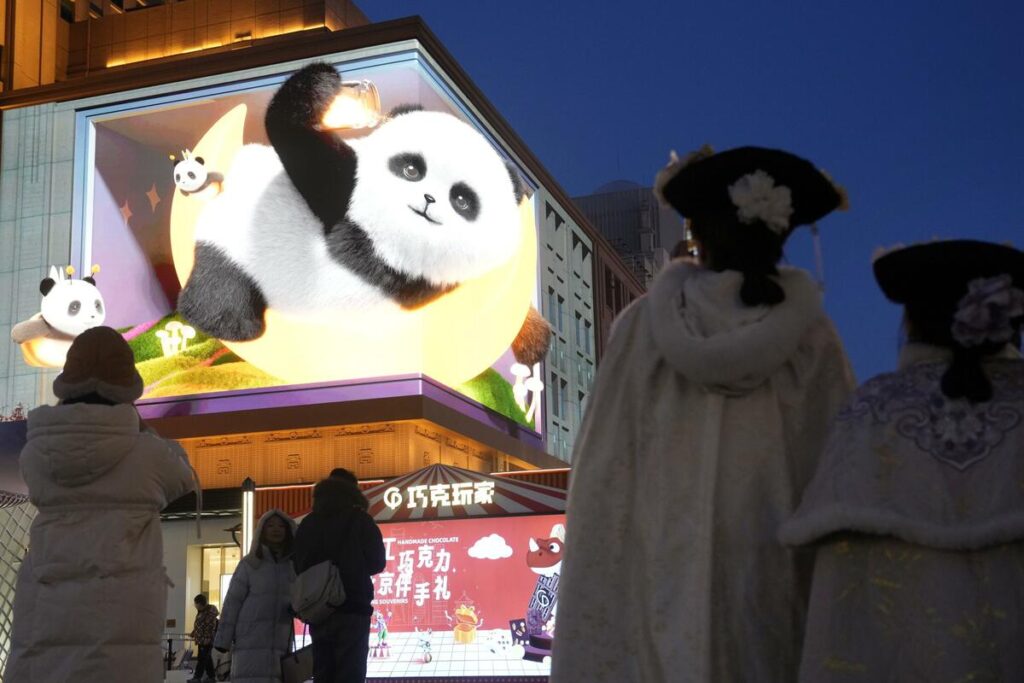
BEIJING – Japan on Tuesday faced its first period without any giant pandas in over half a century with the departure of the last two from a Tokyo zoo, as China continues to use panda loans as a diplomatic tool in its relations with other countries.
Around 40 giant pandas are currently in about a dozen countries under lease agreements with China, according to Chinese media, as Beijing has increasingly offered the animals during high-level meetings to advanced bilateral ties.
Those countries include Australia, Germany, Russia, South Korea and the United States, as well as members of China’s signature Belt and Road infrastructure initiative — Indonesia and Qatar.
Amid a deterioration in Sino-Japanese ties following Prime Minister Sanae Takaichi’s remarks in parliament in November suggesting Japan could act in the event of an attack on Taiwan, a self-ruled democratic island claimed by China, Beijing has suggested it will not make a fresh panda loan to the neighboring country.
Chinese Foreign Ministry spokesman Guo Jiakun said at a press conference on Tuesday, “As always, we welcome members of the Japanese public to visit China to see giant pandas.”
In December, the Global Times, a tabloid affiliated with the ruling Communist Party, carried a commentary by a government-affiliated think tank researcher blaming “right-wing forces in Japan represented by Takaichi” for ruining the atmosphere for bilateral cooperation in giant panda conservation.
Even before the establishment of the Communist-led People’s Republic of China in 1949, the Nationalist government led by Chiang Kai-shek offered a pair of pandas to the United States in 1941 as an expression of gratitude for American support in China’s war of resistance against Japan.
The Communist Party continued the practice, gifting pandas to its allies the Soviet Union and North Korea. Beijing later sent the animals to the United States and Japan to commemorate U.S. President Richard Nixon’s landmark trip to China and the normalization of Sino-Japanese diplomatic ties, both of which occurred in 1972.
As international trade of giant pandas for commercial purposes was banned in 1984, with the animals classified under the Convention on International Trade in Endangered Species of Wild Fauna and Flora, commonly known as the “Washington Convention,” China began leasing them as part of conservation research projects.
The annual rental fee for a pair of giant pandas is estimated at $1 million, which is spent for the protection of the species. According to the official Xinhua News Agency, the giant panda population in China has grown to around 2,700, including those kept in zoos.
Following Chinese President Xi Jinping’s first trip to the United States in six years in 2023, four giant pandas were leased to the country in the following year.
As Xi met with French President Emmanuel Macron in Beijing in December, China agreed to send a new pair of pandas to the European country in 2027, with the loan period lasting 10 years.
Earlier this month, China and South Korea also held working-level discussions on a fresh lease of giant pandas, following an agreement between Xi and South Korean President Lee Jae Myung to launch the dialogue.
Last week, the China Wildlife Conservation Association signed an agreement with a German zoo on giant panda conservation cooperation, under which two animals from China will stay at a Munich zoo under a 10-year program, according to Xinhua.
A source familiar with China-Japan relations said giant panda leases are “associated with leaders’ exchanges” and the zero panda moment in Japan “cannot be helped,” given the deterioration of bilateral ties. “We have to regard the current situation as a new normal,” he said.