
BYLINE: Lea E. Radick
Recent research showed that a novel, on-chip sensor can quickly measure ultrafast electromagnetic bursts. This breakthrough makes beam diagnostics simpler and more precise, setting the stage for next-generation accelerator technology.
The BeamNetUS initiative reached a major milestone in accelerator science with the successful testing of a new detector at the Argonne Wakefield Accelerator (AWA). Located at the U.S. Department of Energy’s (DOE) Argonne National Laboratory, the AWA is a leading electron accelerator research facility dedicated to advancing science and technologies for future particle colliders. It is one of 12 beam test facilities participating in the BeamNetUS initiative — a new program that provides prospective users with access to state-of-the-art accelerator beam test facilities at six DOE national labs, including Argonne.
This achievement, led by Ingrid Wilke, professor of physics at Rensselaer Polytechnic Institute, represents a significant advancement in the tools and techniques used to measure and analyze the properties of electron beams with extremely high precision and speed. Electron-beam diagnostics are essential for understanding how these beams behave in particle accelerators and for improving their performance in scientific experiments.
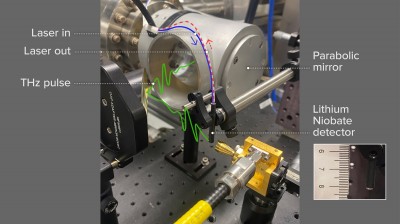
In the pilot-phase experiment, researchers worked with Argonne staff to test a novel, electro-optic sensor. Developed in collaboration with industry partner Partow Technologies LLC, the sensor uses thin-film lithium niobate, a special material that converts electric fields of electron beams into changes in light, boosting measurement sensitivity. As such, the sensor was able to detect very fast bursts of terahertz (THz) radiation created when high-energy electron beams hit a metal foil. THz radiation is a special type of light that falls between microwaves and infrared light on the electromagnetic spectrum, making it useful for many applications.
“Argonne’s commitment to fostering innovation and collaboration is evident in its active role in the BeamNetUS initiative.” — Philippe Piot, director of the Argonne Accelerator Institute
The sensor is small and combines many parts onto one chip, making it easier to use and allowing scientists to measure particle beams with femtosecond-level precision — down to 1 quadrillionth of a second. In other words, 1 millionth of 1 billionth of a second.
Such accuracy allows scientists to study particle beams in much greater detail than before, helping them to better understand and fine-tune how accelerators work. These improvements make accelerators more efficient and effective for research, accelerating the development of next-generation technologies.
“This is an important milestone for our research,” Wilke said.
Accelerators are essential tools for advancing science and technology, enabling discoveries in fields ranging from particle physics to materials science and medical imaging.
For example, precise beam diagnostics are critical for developing advanced radiation therapies, such as proton therapy. This type of therapy requires highly controlled particle beams to target cancer cells while minimizing damage to surrounding tissue.
The on-chip, electro-optic detector could enhance the capabilities of accelerator-driven facilities such as the Advanced Photon Source (APS), Argonne’s world-leading X-ray light source, by reducing interference from unwanted electrical signals, or “noise,” which can disrupt measurements. The APS is a DOE Office of Science user facility at Argonne that uses controlled beams to produce X-rays for studying materials in detail.
The new sensor technology’s resistance to electrical noise also make it ideal for use in industrial settings, where reliable diagnostics are essential for quality control and process optimization.
Further development of the novel sensor technology, including designing sensors with wider detection ranges, is being funded by the DOE-sponsored Small Business Innovation Research program.
An ideal testing ground for next-gen technologies
The successful demonstration also highlights the distinctive strengths and versatility of the AWA facility, which supports broad, collaborator-driven research and development.
The facility supports research to improve particle accelerators and develop new technologies, such as smaller and more powerful lasers. It also plays a vital role in advancing the technologies needed for Argonne’s light source, the APS.
Key strengths of the AWA include the ability to create powerful bursts of electrons and control them with incredible precision in both space and time, allowing scientists to guide and shape the electron beams exactly as needed for experiments. These capabilities are essential for testing new ways to accelerate particles faster and studying how beams behave.
The AWA’s ability to synchronize laser pulses was beneficial to this particular experiment. Researchers used a small laser that produces very short bursts of invisible light to test the sensor.
When connected with the novel, on-chip, electro-optic detector using flexible optical fibers, scientists could direct the light exactly where it was needed, allowing them to synchronize the laser with the electron beam and measure rapid changes in the beam with extreme precision.
Another unique AWA tool used in this experiment was the electronic delay line, which helps scientists fine-tune the timing of signals, making experiments more accurate. The facility can create different types of particle beams to match the needs of various experiments.
“Argonne is one of the first national laboratories to deliver beyond our expectations for this initiative,” said John Power, group leader for the AWA and an accelerator physicist.
“The experiment shows our facility’s ability to quickly reconfigure hardware and perform precise beam measurements. It also strengthens our commitment to attracting new collaborators and securing essential funding for future projects,” Power added.
Fostering collaboration and expanding access
Funded by the DOE Office of Science High Energy Physics program, BeamNetUS connects a broad community of academic, government and industry researchers with accelerator beam test facilities at six DOE national laboratories. All of these labs have facilities with charged particle beams and infrastructure for accelerator R&D. The mission of the initiative is to advance accelerator research by improving awareness of and access to these unique facilities.
In addition to the AWA, two additional accelerator facilities at Argonne have been added to the BeamNetUS portfolio starting in fiscal year 2026: the Injector Test Stand and the Linac Extension Area, both housed at Argonne’s APS.
In its first year, the program awarded eight researchers, including Wilke, and continues to foster innovative collaborations — including those with graduate students.
More than 10 graduate students currently conduct research at the AWA, reflecting Argonne’s role in training future accelerator scientists and engineers.
By nurturing these new partnerships, Argonne is expanding access to its advanced research infrastructure, opening opportunities previously limited to internal users or close collaborators.
“Argonne’s commitment to fostering innovation and collaboration is evident in its active role in the BeamNetUS initiative,” said Philippe Piot, director of the Argonne Accelerator Institute and deputy group leader for the AWA.
Piot was also recently named co-chair of the BeamNetUS initiative along with Emma Snively, department head for accelerator research and technology within the Technology Innovation directorate at SLAC National Accelerator and the operations manager for the Next Linear Collider Test Accelerator test facility at SLAC.
“By opening its advanced accelerator facilities to a wider range of users, Argonne ensures that groundbreaking research continues to drive progress in accelerator science and engineering,” he added.
About the Advanced Photon Source
The U. S. Department of Energy Office of Science’s Advanced Photon Source (APS) at Argonne National Laboratory is one of the world’s most productive X-ray light source facilities. The APS provides high-brightness X-ray beams to a diverse community of researchers in materials science, chemistry, condensed matter physics, the life and environmental sciences, and applied research. These X-rays are ideally suited for explorations of materials and biological structures; elemental distribution; chemical, magnetic, electronic states; and a wide range of technologically important engineering systems from batteries to fuel injector sprays, all of which are the foundations of our nation’s economic, technological, and physical well-being. Each year, more than 5,000 researchers use the APS to produce over 2,000 publications detailing impactful discoveries, and solve more vital biological protein structures than users of any other X-ray light source research facility. APS scientists and engineers innovate technology that is at the heart of advancing accelerator and light-source operations. This includes the insertion devices that produce extreme-brightness X-rays prized by researchers, lenses that focus the X-rays down to a few nanometers, instrumentation that maximizes the way the X-rays interact with samples being studied, and software that gathers and manages the massive quantity of data resulting from discovery research at the APS.
This research used resources of the Advanced Photon Source, a U.S. DOE Office of Science User Facility operated for the DOE Office of Science by Argonne National Laboratory under Contract No. DE-AC02-06CH11357.
Argonne National Laboratory seeks solutions to pressing national problems in science and technology by conducting leading-edge basic and applied research in virtually every scientific discipline. Argonne is managed by UChicago Argonne, LLC for the U.S. Department of Energy’s Office of Science.
The U.S. Department of Energy’s Office of Science is the single largest supporter of basic research in the physical sciences in the United States and is working to address some of the most pressing challenges of our time. For more information, visit https://energy.gov/science.